
Can Texas Police Stop Every Car To Check For Licenses, Insurance, Or DWI?
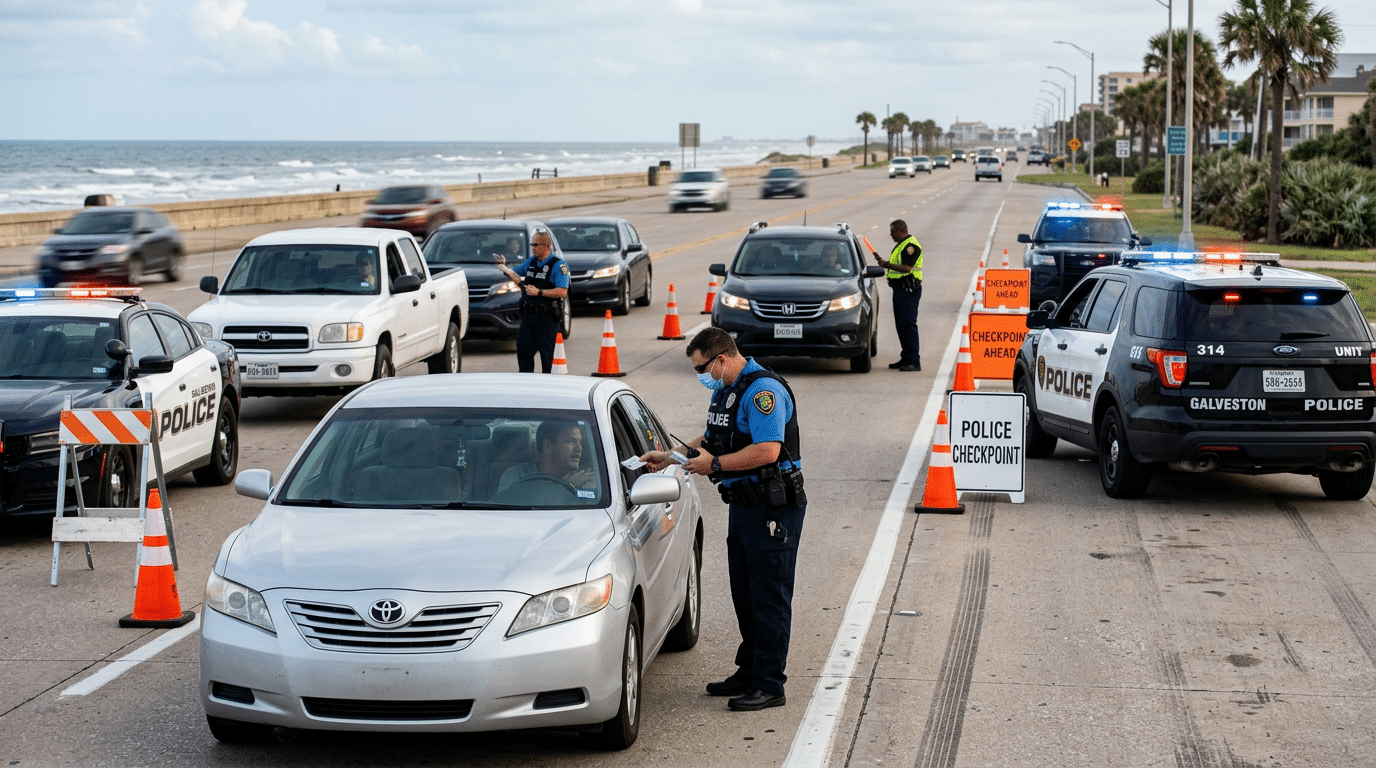
Many drivers have seen news about DUI checkpoints in other states and wonder if Texas police can stop every car to check for licenses, insurance, or signs of intoxication. This question comes up often during holidays and busy weekends in Galveston County, when police increase traffic enforcement. In short, Texas law usually does not allow DWI checkpoints as used in other states. Still, police can investigate impaired driving and enforce traffic laws. Knowing the difference can help you protect your rights if you are stopped in Texas.
Why Traffic Stops Are Protected By The Fourth Amendment
The Fourth Amendment protects people from unreasonable searches and seizures. When police pull you over and turn on their emergency lights, you are not free to leave, so the law considers this a seizure.
In Texas, police usually need reasonable suspicion that a crime or traffic violation has happened before they can stop a car. Reasonable suspicion is less strict than probable cause, but it must be based on clear facts, not just a guess.
This rule is important because it stops the government from pulling over drivers without a good reason. Courts have said that drivers still have constitutional rights on the road, even if those rights are a bit different from what you have at home.
Are DWI Checkpoints Legal In Texas?
Unlike some states, Texas does not generally conduct DWI checkpoints. The primary reason is a landmark decision by the Texas Court of Criminal Appeals in Holt v. State, 887 S.W.2d 16 (Tex. Crim. App. 1994).
In that case, the court determined that Texas had not established sufficient legislative guidelines authorizing sobriety checkpoints. Because there was no statutory framework regulating how such checkpoints would operate, the checkpoint in question violated constitutional protections.
Because of this, Texas police usually do not use roadside sobriety checkpoints like those in California, Florida, or New York. Many Texas drivers are surprised to find out that something legal in another state may not be allowed here. This does not mean police have stopped looking for impaired drivers. Instead, they use other ways to find suspected drunk drivers while following the law.
How Texas Police Investigate DWI Without Checkpoints
Instead of stopping every car at a checkpoint, Texas police usually watch for signs that give them reasonable suspicion to pull someone over. An officer can stop a car if they see things like speeding, drifting between lanes, running a stop sign, driving without headlights, making unsafe turns, or other traffic violations. Sometimes, unusual driving is enough reason to check if a driver is impaired.
Once a lawful stop occurs, officers may look for additional signs of After a legal stop, officers may look for more signs of intoxication. These can include slurred speech, red eyes, the smell of alcohol, open containers, admitting to drinking, or trouble answering questions. With probable cause, law enforcement may request field sobriety tests or continue a DWI investigation. The important distinction is that the stop itself generally must be supported by reasonable suspicion rather than simply stopping every vehicle that happens to pass through an area.
Can Police Stop Every Car To Check Drivers’ Licenses?
Many people think police can set up a checkpoint and stop every car just to check for valid licenses. Under Texas law, this is usually not allowed. The same constitutional issues that affect DWI checkpoints also apply to license checkpoints. Texas courts usually require a legal reason before police can stop a car.
Law enforcement officers certainly have the authority to request a driver’s license during a lawful traffic stop. Texas Transportation Code Section 521.025 requires a driver to display a valid driver’s license upon demand of a peace officer. However, the officer must generally have a lawful reason to make the stop in the first place.
The distinction may seem small, but it is significant. Texas law allows officers to verify licenses during valid traffic stops. It generally does not permit officers to stop every passing vehicle solely to determine whether drivers possess valid licenses.
Can Police Stop Every Car To Check Insurance?
Texas law requires drivers to maintain financial responsibility, commonly referred to as automobile liability insurance. Texas Transportation Code Section 601.051 requires motorists to establish financial responsibility for vehicles operated on public roadways.
Just as with driver’s licenses, police may request proof of insurance during a lawful traffic stop. Drivers who cannot provide proof of financial responsibility may face citations and other consequences.
However, the existence of insurance requirements does not automatically permit officers to stop every vehicle solely to determine whether insurance exists. Constitutional protections still apply.
Today, many law enforcement agencies use technology to assist in identifying potential insurance violations. License plate databases and electronic verification systems often provide information without requiring blanket checkpoints that stop every passing vehicle.
What About Seatbelt Enforcement Campaigns?
Texas law requires drivers and passengers to wear seatbelts under Texas Transportation Code Section 545.413. Failure to wear a seatbelt can result in a traffic citation.
During high-visibility enforcement periods, law enforcement agencies may increase patrol activity and focus on seatbelt violations. However, this differs from stopping every vehicle at a checkpoint.
An officer who observes a seatbelt violation may have legal grounds to conduct a traffic stop. The officer’s observation creates the individualized suspicion necessary to justify the stop. This approach differs substantially from a checkpoint where every vehicle is stopped regardless of whether any violation is observed.
What Happens During A Lawful Traffic Stop?
If police lawfully stop your vehicle, you should remain calm and cooperative. Texas drivers are generally required to provide identification and certain vehicle-related documents when requested during a lawful stop. These documents often include a driver’s license and proof of insurance. The officer may ask questions regarding your travel plans, destination, or activities. While drivers should remain respectful, individuals also retain important constitutional rights during police encounters.
The length of the stop must generally be related to the purpose of the stop. Courts have held that officers cannot unnecessarily prolong a traffic stop without developing additional reasonable suspicion of criminal activity. This issue frequently arises in DWI investigations and drug investigations where officers attempt to expand the scope of an otherwise routine traffic stop.
Understanding Texas DWI Laws
Texas Penal Code Section 49.04 makes it unlawful to operate a motor vehicle in a public place while intoxicated. Under Texas law, intoxication may be established by showing that a person lacks the normal use of mental or physical faculties because of alcohol, drugs, controlled substances, or a combination of substances. Intoxication may also be established by proving a blood alcohol concentration of 0.08 or higher.
Because DWI investigations often begin with ordinary traffic stops, the legality of the initial stop can become a critical issue in a criminal defense case. If an officer lacked reasonable suspicion to initiate the stop, important evidence obtained afterward may become subject to challenge. This is one reason why we carefully examine every aspect of a DWI arrest, including the officer’s stated basis for initiating contact with the driver.
No Refusal Weekends Do Not Create Checkpoints
Many people hear the term “No Refusal Weekend” and mistakenly believe it refers to a checkpoint operation. In reality, no-refusal initiatives generally involve obtaining search warrants for blood samples when drivers refuse breath testing. These programs do not authorize officers to stop vehicles without legal justification.
Officers must still establish reasonable suspicion for the stop and probable cause for the arrest. Constitutional protections remain in place even during periods of heightened DWI enforcement.
Understanding this distinction helps prevent confusion about what police can and cannot do under Texas law.
Challenging An Illegal Traffic Stop
When we defend clients accused of DWI or other offenses, one of the first issues we examine is whether the initial stop was lawful. If police lacked reasonable suspicion or otherwise violated constitutional protections, evidence obtained after the stop may be challenged through a motion to suppress. Depending on the circumstances, a successful challenge can significantly weaken the prosecution’s case.
Every case is different. The legality of a stop often depends on police reports, dash camera footage, body camera recordings, witness testimony, and other evidence. Small details can make a substantial difference when determining whether an officer acted lawfully.
Because constitutional issues frequently arise in DWI cases, early investigation is often critical to identifying potential defenses.
Why Understanding Your Rights Matters
Many drivers mistakenly believe they must comply with any police directive regardless of whether the stop was lawful. Others assume that police can stop vehicles whenever they choose. Neither assumption accurately reflects Texas law.
Constitutional protections continue to apply on Texas roadways. While law enforcement officers possess significant authority to enforce traffic laws and investigate criminal activity, that authority is not unlimited.
Understanding when police can stop a vehicle, what documents must be provided, and how DWI investigations typically occur can help drivers make informed decisions during police encounters. When criminal charges result from a traffic stop, understanding these legal principles may also play an important role in building a defense.
Frequently Asked Questions About Texas Traffic Stops And DWI Checkpoints
Are DWI Checkpoints Legal In Texas?
Generally, no. Texas does not currently operate the type of sobriety checkpoints commonly seen in many other states. The Texas Court of Criminal Appeals ruled that such checkpoints lacked proper legislative authorization, making them unconstitutional under Texas law as currently structured.
Can Police Stop Every Vehicle To Check Drivers’ Licenses?
Generally, no. Texas law typically requires reasonable suspicion or another lawful basis before stopping a vehicle. Officers may check licenses during a lawful stop, but they generally cannot stop every passing vehicle solely to determine whether drivers possess valid licenses.
Can Police Stop Every Vehicle To Check Insurance?
No. While Texas requires drivers to maintain financial responsibility under state law, police generally must have a lawful reason to stop a vehicle before demanding proof of insurance.
What Should I Do If I Am Pulled Over?
Remain calm, keep your hands visible, and comply with lawful requests for identification and vehicle documentation. Avoid sudden movements and remain respectful throughout the encounter.
Can Police Ask Me If I Have Been Drinking?
Yes. Officers frequently ask questions regarding alcohol consumption during traffic stops. How you respond may become evidence in a criminal investigation.
Can An Officer Stop Me For Weaving Within My Lane?
Possibly. Courts evaluate the totality of the circumstances. Depending on the facts, weaving, erratic driving, or other unusual conduct may create reasonable suspicion supporting a traffic stop.
What Is Reasonable Suspicion?
Reasonable suspicion is a legal standard requiring specific and articulable facts suggesting criminal activity or a traffic violation may have occurred. It is more than a hunch but less than probable cause.
Can An Illegal Traffic Stop Result In Dismissal Of Charges?
Potentially. If a court determines that a stop violated constitutional protections, evidence obtained as a result of that stop may be suppressed. In some cases, suppression of critical evidence can significantly affect the prosecution’s ability to proceed.
Call Our DWI Defense Lawyer In Galveston For A Free Consultation
At Mark Diaz & Associates, we carefully examine every traffic stop, arrest report, body camera recording, dash camera video, and piece of evidence to determine whether law enforcement complied with constitutional requirements. We fight aggressively to protect our clients’ rights and pursue every available defense.
When you hire me, you work directly with me. My clients have my personal cell phone number because questions, emergencies, and concerns don’t always happen during business hours. You won’t be handed off to a junior associate or lost in a system where your case is one of dozens on a crowded docket. From arrest through resolution, I remain personally involved and accessible.
If you were arrested for DWI or another criminal offense following a traffic stop in Galveston, Houston, or the surrounding areas, contact our Galveston DWI attorneys at Mark Diaz & Associates by calling 409-515-6170 to for your free consultation.
