
Refusing A Breath Test In Galveston: Does It Help Or Hurt Your Defense?
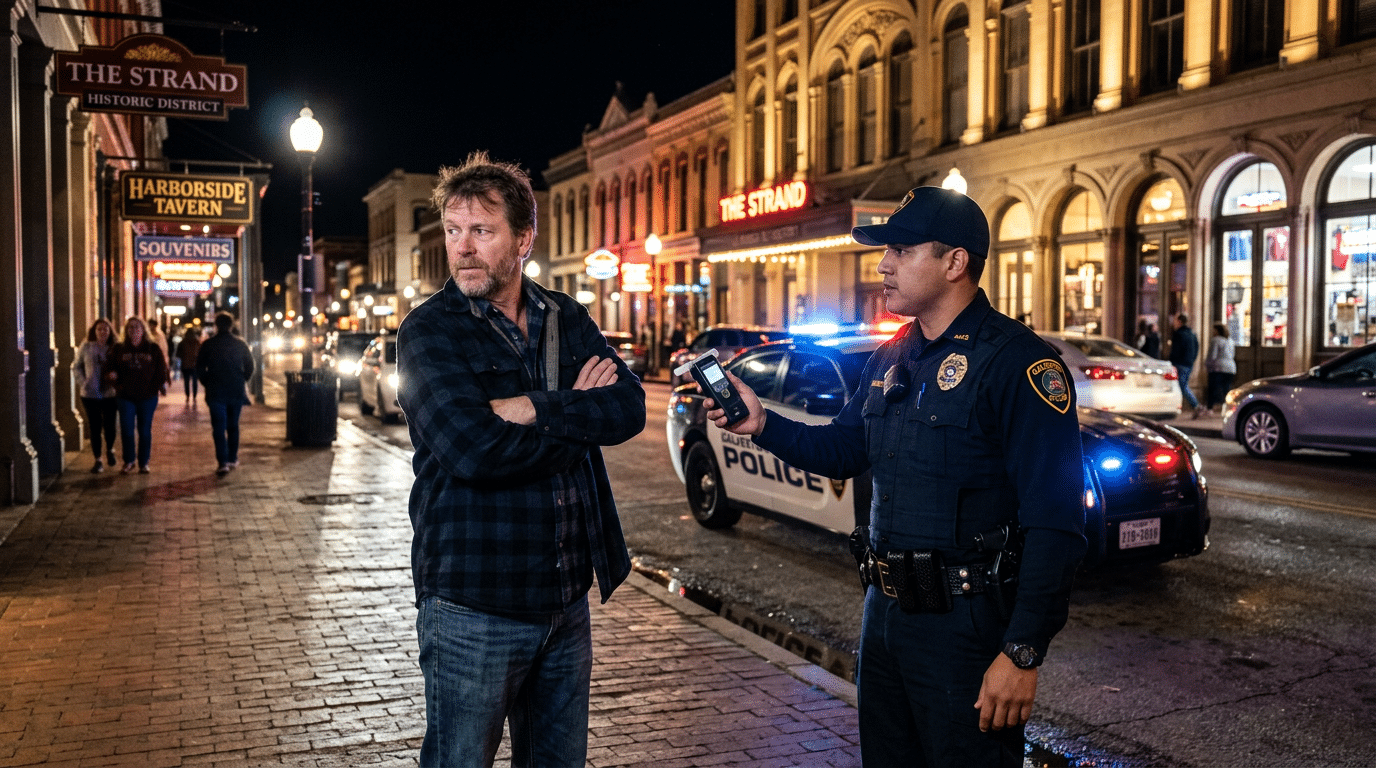
If a police officer in Galveston County suspects you of DWI, they may ask for a breath sample after arresting you. Many drivers think they have to choose between giving the State evidence or refusing and making things worse. Refusing a breath test can keep the prosecution from getting an immediate breath-alcohol result, but it will not stop an arrest, guarantee a dismissal, or prevent officers from seeking a blood sample. Refusing may also lead to a separate license suspension and can be used as evidence in court. Whether refusal helps or hurts depends on the details of the stop, the evidence, the officer’s actions, and the defense strategy after the arrest.
What Does Texas Law Consider Driving While Intoxicated?
Texas Penal Code § 49.04 provides that a person commits DWI by operating a motor vehicle in a public place while intoxicated. Under Texas Penal Code § 49.01, a person is considered intoxicated when the person does not have the normal use of mental or physical faculties because of alcohol, a controlled substance, a drug, a dangerous drug, a combination of substances, or another substance. A person is also legally intoxicated when the person has an alcohol concentration of 0.08 or more.
These two definitions matter in a breath-test refusal case. The State does not need a breath-alcohol result to prosecute someone for DWI. Prosecutors may attempt to prove intoxication through driving behavior, field sobriety exercises, body-camera recordings, statements, appearance, balance, speech, odor of alcohol, and other observations.
A refusal may deprive prosecutors of one category of scientific evidence, but it does not remove the remaining evidence. We therefore examine the entire encounter rather than assuming that the absence of a breath result makes the case weak.
How Texas Implied-Consent Law Works
Texas Transportation Code § 724.011 establishes the state’s implied-consent rule. A person arrested for an offense involving the operation of a motor vehicle or watercraft while intoxicated is considered to have consented to the taking of one or more breath or blood specimens, subject to the requirements and limitations of Chapter 724.
Implied consent does not mean an officer can always make someone take a breath test. It means that refusing a properly requested test can lead to administrative penalties that affect your driver’s license.
After a DWI arrest, the officer may request a breath or blood specimen under Texas Transportation Code § 724.012. Before requesting the specimen, the officer must provide the statutory warnings required by Texas Transportation Code § 724.015. Those warnings explain that refusing the specimen may result in a driver’s license suspension, that providing a specimen over the legal limit may also result in suspension, and that the refusal may be used against the accused in court.
Does Refusing A Breath Test Prevent A DWI Arrest?
Refusing a breath test will not stop an officer from arresting you. Usually, the officer has already decided to arrest before asking for a breath or blood sample. This request usually comes after the officer believes they have enough reason based on the stop, questions, observations, and field sobriety tests.
A driver may therefore be arrested even when no chemical test is completed. The officer’s report may state that the driver had red or glassy eyes, smelled of alcohol, spoke unusually, drove poorly, or performed poorly during roadside testing. Video may either support or contradict those statements.
We carefully compare the officer’s written report with dashboard and body camera videos. Sometimes, the report uses serious language, but the video shows the person speaking clearly, walking normally, following instructions, and responding well. These differences can be important when questioning the officer’s conclusions.
Can Refusal Help The Defense?
Refusing a breath test may help in some ways because prosecutors will not have a breath-alcohol number to show the jury. Without this result, the State cannot argue that you were at or above 0.08 based on breath evidence. Instead, they must rely more on the officer’s observations and other indirect evidence.
This can make a difference if your driving was not bad, your speech was clear, the video does not show clear signs of impairment, and the field sobriety tests are questionable. A jury may be less likely to convict if there is no reliable chemical test and the other evidence could be seen in different ways.
However, refusal is not automatically favorable. Prosecutors frequently argue that the accused refused because the accused knew the test would show intoxication. Texas Transportation Code § 724.061 generally allows evidence of a person’s refusal to submit to a requested specimen to be introduced at trial.
The defense must be prepared to offer a different explanation. A person may refuse because of fear, confusion, distrust of the machine, medical concerns, communication problems, uncertainty about legal rights, or an inability to understand the warnings. The circumstances of the request matter greatly.
How Prosecutors Use A Refusal At Trial
A prosecutor may describe a refusal as evidence of consciousness of guilt. The argument is usually that a sober person would have agreed to testing, while an intoxicated person had a reason to avoid producing the result.
That argument is not always correct. People do not always make calm or informed choices when they are at a police station or being processed after an arrest. They might be scared, tired, confused, upset, or unsure if the test is accurate. Some have also heard different advice about whether to give a sample.
We can challenge the prosecution’s view by showing what really happened before and during the refusal. The officer might have rushed the warning, used confusing words, interrupted questions, ignored a language barrier, or treated an unclear answer as a definite refusal. Video and audio recordings are often key to deciding if the State’s version is accurate.
Refusal Can Lead To A Separate License Suspension
The criminal DWI case and the administrative driver’s license case are separate proceedings. A person may face a license suspension for refusing a specimen even if the criminal charge is later dismissed or reduced.
Under Texas Transportation Code § 724.035, a refusal generally carries an 180-day license suspension for a person without a qualifying alcohol-related or drug-related enforcement contact during the preceding ten years. The suspension may increase to two years when the person’s record contains one or more qualifying contacts within that period.
The administrative process is commonly known as an Administrative License Revocation proceeding. The deadlines for challenging the suspension are short. A hearing must generally be requested within 15 days after the person receives notice of suspension. Missing that deadline can allow the suspension to take effect without an administrative hearing.
The hearing gives us an opportunity to challenge whether reasonable suspicion or probable cause existed, whether the person was properly arrested, whether the officer requested a specimen, and whether the person actually refused. It may also allow us to question the officer under oath before the criminal case reaches trial.
When Texas Law Requires A Specimen
Texas Transportation Code § 724.012 identifies circumstances in which an officer must require the taking of a specimen after certain intoxication-related arrests. These situations can include cases involving serious bodily injury, death, a child passenger, certain prior convictions, and other conditions stated in the statute.
Even when a statute directs an officer to obtain a specimen, constitutional search-and-seizure protections still matter. Depending on the facts, law enforcement may need a valid warrant or a recognized exception to the warrant requirement. The existence of a statutory provision does not end the constitutional analysis.
We review whether a warrant was obtained, whether probable cause supported it, whether the affidavit contained material errors or omissions, and whether the search stayed within the warrant’s lawful scope.
The Difference Between Roadside Breath Testing And Evidentiary Testing
Drivers may encounter more than one type of breath-testing device. A portable breath test may be offered on the roadside during the investigation. A separate evidentiary breath instrument may be used after arrest.
The roadside device is generally used as an investigative tool. The post-arrest instrument is intended to produce a formal alcohol-concentration result for use in the criminal case. The legal consequences and evidentiary issues are not identical.
The prosecution must establish that the evidentiary breath test was administered according to applicable rules and by a qualified operator. The machine’s maintenance, calibration, observation period, testing procedure, and surrounding conditions may all be reviewed.
A breath-test result is not beyond challenge simply because a machine produced a number. Mouth alcohol, medical conditions, improper observation, maintenance problems, radio-frequency interference, operator error, and other issues may affect the reliability or interpretation of the result.
Field Sobriety Exercises May Become More Important After Refusal
When there is no breath or blood result, prosecutors often rely heavily on standardized field sobriety exercises. These may include the horizontal gaze nystagmus test, the walk-and-turn exercise, and the one-leg-stand exercise.
These exercises are not pass-or-fail tests in the ordinary sense. Officers look for specific clues that they associate with possible impairment. The reliability of the officer’s opinion depends on whether the exercises were appropriate, properly explained, correctly demonstrated, and administered under suitable conditions.
Uneven pavement, poor lighting, traffic, wind, footwear, age, weight, injuries, balance disorders, anxiety, and other factors may affect performance. Galveston weather, roadside surfaces, and coastal wind may also influence what appears on video.
We compare the officer’s claimed clues with the recording and the National Highway Traffic Safety Administration procedures used to train officers. An incorrectly administered exercise may carry far less weight than the report suggests.
Refusing A Breath Test Can Help In One Area And Hurt In Another
There is no universal answer to whether refusal helps or hurts a DWI defense. It may deny the prosecution a breath-alcohol number, which can be valuable when the remaining evidence of intoxication is weak. At the same time, refusal can lead to a longer administrative suspension than a first-time failed test and gives prosecutors another fact to argue before a jury.
A blood warrant may also result in chemical evidence despite the refusal. In some cases, the delay between driving and the blood draw creates important questions about alcohol concentration at the time of operation. In others, the blood result may become the State’s strongest evidence.
By the time we become involved, the refusal has already occurred. Our task is not to second-guess a frightened decision made during an arrest. Our task is to determine how the refusal affects the evidence, challenge unlawful procedures, protect the driver’s license where possible, and build the strongest defense supported by the facts.
Galveston DWI Defense After A Breath-Test Refusal
A breath-test refusal can affect your driver’s license and your criminal case almost immediately. The State may attempt to use the refusal as evidence, pursue an administrative suspension, obtain a blood warrant, and build its case around field sobriety exercises and police observations. We do not assume that a refusal makes the case unwinnable or that the lack of a breath number guarantees a favorable result. We examine every stage of the investigation and determine where the State’s evidence can be challenged.
Mark Diaz & Associates represents people accused of DWI in Galveston and throughout the entire city of Houston, Texas. We review the legality of the traffic stop, the officer’s probable-cause determination, body-camera footage, field sobriety testing, statutory warnings, breath-test paperwork, blood warrants, laboratory records, and administrative license issues.
When you hire me, you work directly with me. My clients have my personal cell phone number because questions, emergencies, and concerns do not always happen during business hours. You will not be handed off to a junior associate or lost in a system where your case is one of dozens on a crowded docket. From arrest through resolution, I remain personally involved and accessible.
Contact our Galveston DWI defense lawyers at Mark Diaz & Associates by calling 409-515-6170 to receive your free consultation. We represent clients in Galveston and throughout Houston, Texas, and we are prepared to protect your rights, your driving privileges, and your future.
