
How Electronic Devices And Cell Phones Become Evidence In Federal Criminal Cases
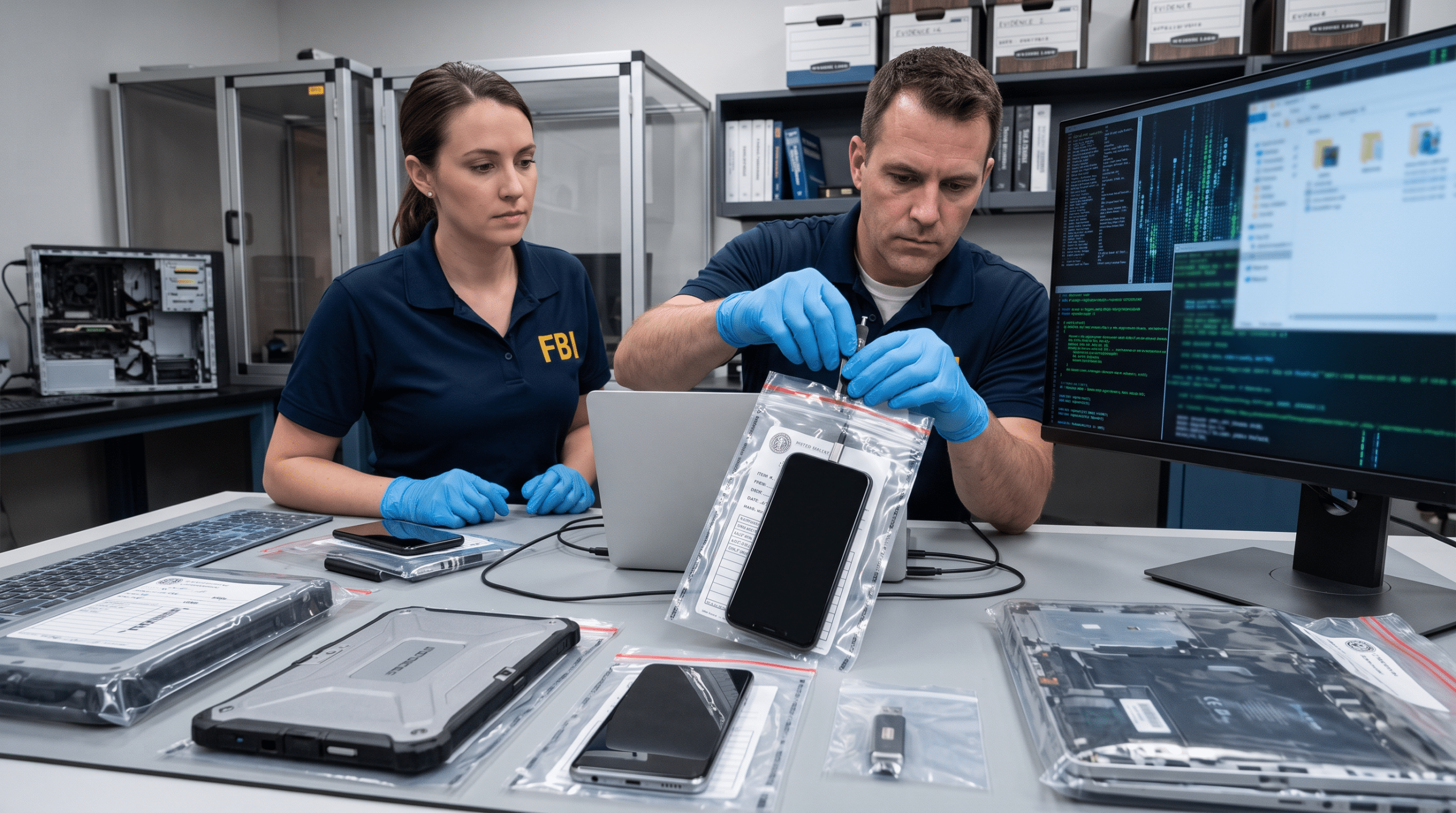
A cell phone may contain more evidence than an entire filing cabinet. Text messages, photographs, location records, internet searches, emails, social media activity, financial transactions, and deleted files can all become part of a federal criminal investigation. Federal agents in Galveston may also examine laptops, tablets, smartwatches, cloud accounts, vehicle systems, and external storage devices. The presence of information on a device, however, does not automatically prove who created it, knew about it, or intended to use it for an unlawful purpose. When we defend a federal case involving digital evidence, we examine both how the government obtained the information and whether prosecutors can reliably connect it to the accused.
Federal Agents Can Seize Devices During An Investigation
Electronic devices often enter a federal case through a search warrant, an arrest, a border search, a consent search, or the execution of a warrant at a home or business. A warrant may authorize agents to seize phones, computers, hard drives, tablets, and other items capable of storing digital information. Federal Rule of Criminal Procedure 41 governs many federal search warrants and permits magistrate judges to authorize searches and seizures when the legal requirements are met.
Agents commonly take possession of a device first and examine its contents later. They may create a forensic copy so investigators can review data without repeatedly altering the original device. A forensic examination may uncover active files, deleted material, account information, application data, device identifiers, photographs, and metadata showing when a file was created or changed.
The government may argue that a device contains evidence of drug distribution, fraud, child exploitation, conspiracy, unlawful firearm activity, money laundering, cybercrime, or other federal offenses. The defense must examine whether the warrant described the devices and categories of data with enough precision. A warrant should not become unlimited permission to search every part of a person’s digital life without a sufficient connection to the suspected crime.
An Arrest Does Not Automatically Permit A Phone Search
Police officers may ordinarily search certain physical items found on an arrested person. Cell phones receive greater constitutional protection because they can hold vast amounts of private information. In Riley v. California, the United States Supreme Court held that officers generally must obtain a warrant before searching the digital contents of a cell phone seized during an arrest. The Court recognized that modern phones contain extensive personal information that differs greatly from the limited contents of a wallet, pocket, or purse.
This rule does not mean that every phone search requires a separate warrant in all circumstances. The government may claim that the owner consented, that an emergency justified immediate access, or that another recognized exception applied. Those claims should be reviewed carefully. Consent must be voluntary, and the scope of consent matters. Permission to make a telephone call or look at one photograph should not automatically become permission to search years of messages, files, and account activity.
We also examine whether agents searched beyond the warrant’s authorized time period, applications, accounts, or categories of evidence. Digital searches can be challenged when investigators exceed the authority granted by a court.
Cloud Accounts And Service Providers May Supply Evidence
Federal investigators do not always need physical possession of a phone to obtain digital evidence. They may serve legal process on email companies, social media platforms, wireless carriers, cloud-storage providers, and other technology companies.
The Stored Communications Act, including 18 U.S.C. § 2703, establishes procedures through which government agencies may require providers to disclose stored communications and customer records. The form of legal process required can depend on the type of information sought. The statute addresses stored content, subscriber information, transactional records, and other provider-held data.
A provider may possess messages, login records, IP addresses, account recovery information, billing records, or records of communications even when those materials are no longer visible on the user’s device. Investigators may also seek delayed-notice orders under 18 U.S.C. § 2705, which can postpone notice to the account holder when statutory requirements are met.
These records can help prosecutors build a timeline or connect an account to a person, location, or device. Yet account ownership does not always prove authorship. Several people may share a device, know a password, use a household internet connection, or access the same account.
Location Information Can Become Important Evidence
Phones and connected devices may generate location information through cell towers, applications, GPS functions, Wi-Fi connections, photographs, and account activity. Federal agents may use this information to place a person near a suspected transaction, meeting, residence, or crime scene.
In Carpenter v. United States, the Supreme Court held that obtaining a substantial amount of historical cell-site location information generally constitutes a Fourth Amendment search. The decision recognized that long-term location records can reveal intimate details about a person’s movements and associations.
Texas law also regulates government access to electronic communications and location information. Texas Code of Criminal Procedure Chapter 18B addresses tracking equipment and access to communications. Article 18B.322 generally requires a warrant to obtain certain location information from an electronic communications service provider.
Location evidence is not always as precise as prosecutors suggest. Cell-site records may identify a broad area rather than an exact location. GPS data can be affected by device settings, account sharing, synchronization, or technical errors. We review what the records actually show instead of accepting the government’s description at face value.
Text Messages And Social Media Posts Must Be Connected To A Person
Screenshots and message records may appear persuasive, but prosecutors still must establish that the evidence is authentic and connected to the defendant. Federal Rule of Evidence 901 requires enough evidence to support a finding that an item is what its proponent claims it to be.
The government may rely on witness testimony, account records, phone numbers, surrounding messages, device ownership, writing patterns, photographs, or other circumstances to establish authorship. In some cases, electronic records can be authenticated through certifications under Federal Rule of Evidence 902. That rule includes procedures for authenticating electronically generated records and data copied from devices or storage media. Hash values may be used to show that a copied file matches the original digital data.
Authentication is only one part of admissibility. A message may still face objections based on hearsay, relevance, unfair prejudice, completeness, or constitutional protections. A screenshot may omit surrounding messages that change its meaning. An account may have been compromised. Another person may have used the device. These issues can become central to the defense.
Deleted Files May Still Be Recovered
Deleting a message, photograph, or document does not always remove it from a device. Some information may remain in unallocated storage, backups, synchronized accounts, application databases, or service-provider records. Forensic software may recover fragments of deleted material or records showing that a file previously existed.
Prosecutors sometimes argue that deletion proves consciousness of guilt. That conclusion may be disputed. Phones automatically delete or overwrite data, applications use temporary storage, and users routinely clear information for innocent reasons. The government must still prove what was deleted, who deleted it, when it happened, and what the act means in context.
A recovered fragment can also be misleading when separated from the complete file or conversation. We examine whether the forensic process preserved the data accurately and whether the government’s interpretation is supported by the surrounding evidence.
Metadata Can Tell A Different Story
Metadata is information about a digital file rather than the visible content itself. It may include creation dates, modification dates, device identifiers, file paths, geographic coordinates, or account information.
Metadata can support or weaken the government’s theory. A photograph may have been downloaded rather than taken by the seized phone. A document may have been created by another user. A file’s timestamps may have changed during transfer, synchronization, or examination. Investigators may present metadata as objective proof, but the meaning of that information depends on how the device and software generated it.
The defense may compare metadata with witness statements, account logs, location records, and other evidence. Contradictions can reveal that a prosecutor’s timeline is incomplete or inaccurate.
Texas Computer And Interception Laws May Also Apply
A federal investigation arising in Galveston or Houston may overlap with Texas criminal laws. Texas Penal Code § 33.02 prohibits knowingly accessing a computer, computer network, or computer system without the owner’s effective consent. The grade of the offense depends on the circumstances, including the value of any benefit obtained or harm caused and the type of system involved.
Texas Penal Code § 16.02 addresses the unlawful interception, use, or disclosure of wire, oral, or electronic communications. Texas Code of Criminal Procedure Chapter 18A provides procedures governing court-authorized interception and permits challenges to communications allegedly intercepted in violation of state or federal law.
State and federal agencies sometimes work together through task forces. Evidence collected during a Texas investigation may be transferred to federal authorities, and conduct initially investigated as a state offense may later support a federal indictment. For that reason, we evaluate every stage of the investigation rather than focusing only on the agency that ultimately filed the charge.
Digital Evidence Can Support A Federal Conspiracy Charge
Federal conspiracy cases often depend heavily on communications between alleged participants. Prosecutors may use messages, calls, contact lists, shared files, payment applications, photographs, and location records to argue that several people agreed to commit a federal crime.
The meaning of a message is rarely established by a few words alone. Slang, jokes, incomplete statements, and ordinary business conversations can be misinterpreted. Merely knowing someone accused of a crime does not establish participation in a conspiracy. A saved contact, group message, or photograph does not necessarily prove an unlawful agreement.
We place communications in context and compare them with the government’s broader claims. The defense may show that the accused lacked knowledge of the alleged criminal purpose, withdrew from the activity, or had an innocent reason for the communication.
The Chain Of Custody And Forensic Process Matter
Digital evidence should be collected, copied, stored, and examined through reliable procedures. The chain of custody documents who possessed the device and what occurred after seizure. Investigators should also preserve the original data and record the tools and methods used during examination.
Questions may arise when a device was unlocked before documentation, when files changed during examination, or when the government cannot explain how a screenshot was created. Although not every gap automatically excludes evidence, weaknesses in preservation and handling may affect reliability and weight.
A defense investigation may include reviewing extraction reports, warrant returns, laboratory notes, forensic images, audit logs, and hash values. These materials can reveal missing information or limits that are not apparent from the government’s selected exhibits.
Fight Your Federal Charges With Mark Diaz & Associates
Electronic evidence can shape nearly every part of a federal criminal case. A text message may be presented as proof of intent, a location record may be used to build a timeline, and a photograph may be offered without the context needed to understand it. We examine how the government obtained the evidence, whether the search complied with constitutional and statutory requirements, and whether prosecutors can prove who created or controlled the data.
Mark Diaz & Associates represents people facing federal investigations and criminal charges in Galveston and throughout the entire city of Houston, Texas. We understand that federal cases can move quickly and may involve several agencies, extensive search warrants, and large amounts of digital evidence. Our goal is to identify weaknesses before the government’s version of events becomes accepted as fact.
When you hire me, you work directly with me. My clients have my personal cell phone number because questions, emergencies, and concerns do not always happen during business hours. You will not be handed off to a junior associate or lost in a system where your case is one of dozens on a crowded docket. From arrest through resolution, I remain personally involved and accessible. Contact our Galveston federal criminal attorney at Mark Diaz & Associates by calling 409-515-6170 to schedule your free consultation.
