
How Long Can Law Enforcement Follow Your Car
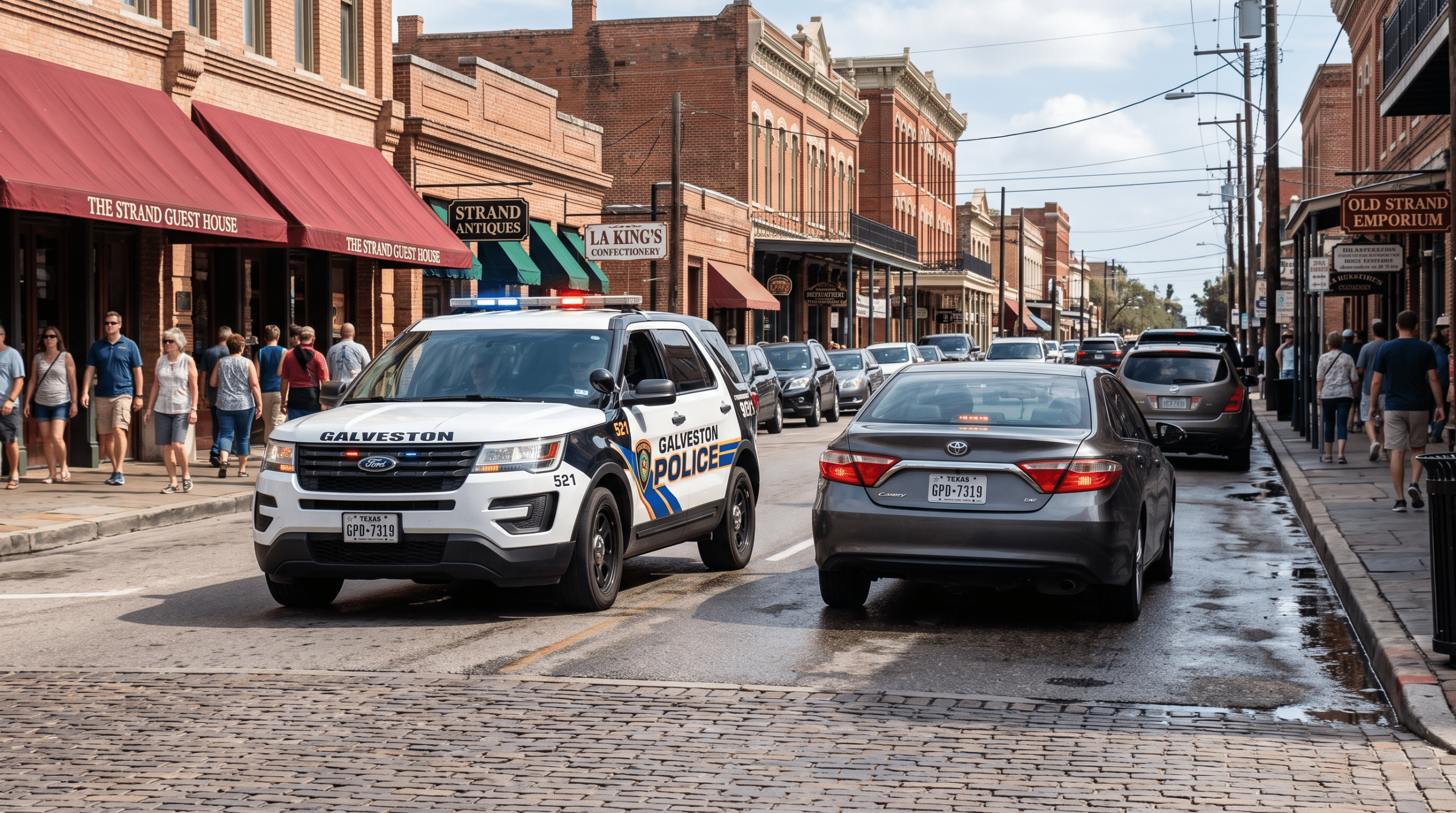
Having a police car follow you for several miles can make anyone uneasy, even if you are driving carefully. You might wonder if the officer is checking your license plate, waiting for you to slip up, or already investigating you for something more serious. In Galveston, we often see criminal and DWI cases that start with an officer following a car before turning on emergency lights and making a stop.
Texas law does not set a specific limit on how long or how far an officer can follow a vehicle on public roads. The key legal issue is when simple observation becomes a detention, and whether the officer had a valid reason for that detention. This difference is especially important if a traffic stop leads to a DWI arrest, drug charge, weapons charge, arrest on a warrant, or another criminal accusation in Galveston.
There Is No Set Time Limit For An Officer To Follow Your Vehicle
Texas law usually allows police officers to drive behind your car and watch how you are driving on public roads. Just because a patrol car is behind you does not mean you have been detained. An officer can follow your vehicle to observe your speed, lane position, use of signals, registration, or other details that might give a legal reason to investigate further.
No Texas law says an officer can only follow you for a certain number of minutes, miles, or intersections. The main constitutional question is whether a reasonable person in your situation would feel they were being restrained by the government, instead of just being watched in public. Article I, Section 9 of the Texas Constitution protects against unreasonable searches and seizures, and the Fourth Amendment gives similar protection under federal law.
This means an officer can follow a driver for a long distance without violating constitutional rights, as long as the driver has not actually been detained. However, once the officer starts a traffic stop, the legal situation changes a lot.
Following Your Car Is Different From Stopping Your Car
When a police officer is just watching your car from behind, it is different from when they turn on their emergency lights and make you pull over. A traffic stop is considered an investigative detention, which means constitutional protections against unreasonable seizures apply.
In Texas, officers must have reasonable suspicion based on clear facts to make a traffic stop without a warrant. This means they need specific reasons to believe a traffic violation or crime has happened, is happening, or will happen soon. Courts look at all the circumstances, not just an officer’s gut feeling. Texas appellate courts have confirmed this rule many times.
This difference is important because an officer can legally watch your driving even if there is not yet a reason to stop you. The officer may keep following to see if more facts come up. If the officer later sees a traffic violation or has reasonable suspicion of a crime, they may then have a legal reason to stop you.
Police May Follow You Looking For A Traffic Violation
A common reason an officer might follow a car is to see if the driver commits a traffic violation. Texas has many rules for how vehicles should be driven, and even small mistakes can be used as a reason for a stop.
For example, Texas Transportation Code § 545.060 addresses driving on roadways divided into marked traffic lanes. Depending on the circumstances, improper lane movement may provide an officer with grounds for a traffic stop. Texas Transportation Code § 545.104 separately addresses the use of turn signals when turning and in other circumstances covered by that statute.
We focus on what the officer actually saw, not just what is written in the police report. Dash-camera video can sometimes prove that a lane violation did not happen, a signal was used correctly, or the driver’s actions were legal. Texas courts have thrown out evidence when the State could not show reasonable suspicion for the stop based on the facts.
An Officer Does Not Have To Stop You Immediately After Becoming Suspicious
Drivers often ask if a stop is invalid just because the officer followed them for several miles before turning on the emergency lights. Usually, the delay by itself does not make the stop illegal. What matters is what the officer knew at the exact moment they decided to stop you.
An officer can watch your driving for a while before deciding if there is reasonable suspicion. For example, in a DWI case, the officer might notice changes in speed, repeated lane changes, braking, or other unusual driving before making a stop. Each observation needs to be looked at in context.
However, an officer cannot just act on a vague feeling. Texas courts require clear and specific facts to support a detention. The Texas Court of Criminal Appeals says reasonable suspicion must be judged by looking at all the circumstances together.
When we look into a case that started with an officer following someone for a long time, we focus on when the officer says reasonable suspicion began and what facts led to that claim.
A Traffic Stop Cannot Be Extended Indefinitely
Once police stop your vehicle, a second issue arises. Even when the initial stop is lawful, law enforcement generally cannot keep a driver detained indefinitely without legal justification.
A traffic stop must remain reasonably related to the legitimate purpose of the detention unless new facts provide legal grounds for additional investigation. During a lawful traffic stop, officers may perform ordinary tasks associated with the traffic matter, including checking information connected with the driver and the vehicle. Texas courts recognize the constitutional limits that apply to investigative traffic detentions.
This can become particularly important in drug investigations. An officer might complete the work connected to the original traffic violation and then attempt to prolong the detention to investigate drugs or wait for additional investigative resources. Whether the continued detention was lawful depends heavily on what the officer knew at that point and whether additional reasonable suspicion had developed.
What If Police Follow You Because They Suspect DWI?
DWI cases often begin before the driver ever sees emergency lights. An officer may testify that the driver was weaving, drifting, driving unusually slowly, accelerating inconsistently, or making some other movement the officer associated with impairment.
We do not assume those observations establish intoxication. There can be innocent explanations for many driving behaviors. Road construction, potholes, weather, unfamiliar roads, surrounding traffic, navigation directions, or avoiding debris can affect how someone drives.
The legal question at the suppression stage is generally whether the facts known to the officer objectively justified the stop, not whether the officer ultimately proved that the driver was intoxicated. Texas courts have described reasonable suspicion as requiring specific, articulable facts and rational inferences viewed under the totality of the circumstances.
That makes the period before the stop highly relevant to a DWI defense. The patrol-car video may show whether the officer’s description of the driving is accurate.
Do Not Try To Lose Or Outrun A Police Officer
If you notice a patrol vehicle behind you, attempting to speed away or deliberately evade the officer can create much larger legal problems. Drive normally, follow traffic laws, and do not make sudden or dangerous movements simply because you believe the officer is watching you.
The situation becomes much more serious once an officer clearly attempts to detain or arrest you. Texas Penal Code § 38.04 makes it an offense to intentionally flee from a person whom you know is a peace officer or federal special investigator who is attempting lawfully to arrest or detain you. The consequences can become significantly more serious when a vehicle is involved.
If emergency lights are activated, the proper response is generally to signal, slow down, and stop in a reasonably safe location rather than trying to determine on the roadway whether the officer has adequate reasonable suspicion. The legality of the detention can be challenged later through the court process.
An Illegal Stop May Affect The Evidence Against You
The legality of the initial stop can affect the entire criminal case. If law enforcement lacked sufficient grounds to detain you, evidence obtained as a result of that detention may become the subject of a motion to suppress.
Texas Code of Criminal Procedure Article 38.23 provides that evidence obtained by an officer or another person in violation of the United States Constitution, the Texas Constitution, or Texas law generally may not be admitted against the accused in a criminal case.
This is why we examine the moments before the emergency lights came on. In a DWI case, the challenged evidence might include observations of intoxication, statements, field sobriety testing, breath results, or blood evidence obtained after the stop. In a drug case, the issue might involve drugs discovered during a subsequent search. A case that initially appears to be about intoxication or possession may ultimately turn on whether police had a lawful reason to stop the vehicle in the first place.
Video Evidence Can Be Critical To Determining What Really Happened
When law enforcement follows a vehicle for an extended period, video can provide an objective record of what occurred. Dash-camera footage may show the driver’s lane position, speed, braking, turn signals, traffic conditions, and the length of time the officer followed before making the stop.
Video may also expose inconsistencies in an officer’s written report. A report may describe repeated weaving while the recording shows only a slight movement within the lane. An officer may claim a driver failed to signal even though the video appears to show the signal operating. Those differences can matter when reasonable suspicion is challenged.
Texas courts give significant attention to video evidence when reviewing suppression issues, and appellate decisions recognize that the actual visual record can be important when determining the historical facts surrounding a stop.
For that reason, we want to identify and preserve relevant video as early as possible.
Talk With A Galveston Criminal Defense Lawyer About An Unlawful Traffic Stop
A police officer following your vehicle does not automatically mean your rights have been violated. The critical questions are what the officer observed, when the detention began, what legal basis existed for the stop, and what happened afterward. If a traffic stop led to a DWI, drug charge, weapons offense, arrest on another allegation, or evidence being seized from your vehicle, we believe the events leading up to that stop deserve careful examination.
At Mark Diaz & Associates, we represent people accused of criminal offenses in Galveston and throughout Houston, Texas. We review dash-camera footage, body-camera recordings, police reports, traffic laws, investigative records, and the circumstances surrounding the stop to determine whether law enforcement acted within constitutional limits. When the facts support it, we can challenge an unlawful detention and seek suppression of evidence obtained as a result.
When you hire me, you work directly with me. My clients have my personal cell phone number because questions, emergencies, and concerns don’t always happen during business hours. You won’t be handed off to a junior associate or lost in a system where your case is one of dozens on a crowded docket. From arrest through resolution, I remain personally involved and accessible.
If you were arrested after police followed and stopped your vehicle, call our Galveston criminal law attorney at Mark Diaz & Associates today by calling 409-515-6170 to schedule your free consultation. We defend clients in Galveston and throughout the entire city of Houston, Texas, and we can review the circumstances of your traffic stop and explain the legal issues that may affect your defense.
