
Can Rising Blood Alcohol Be A Defense To A Texas DWI Charge?
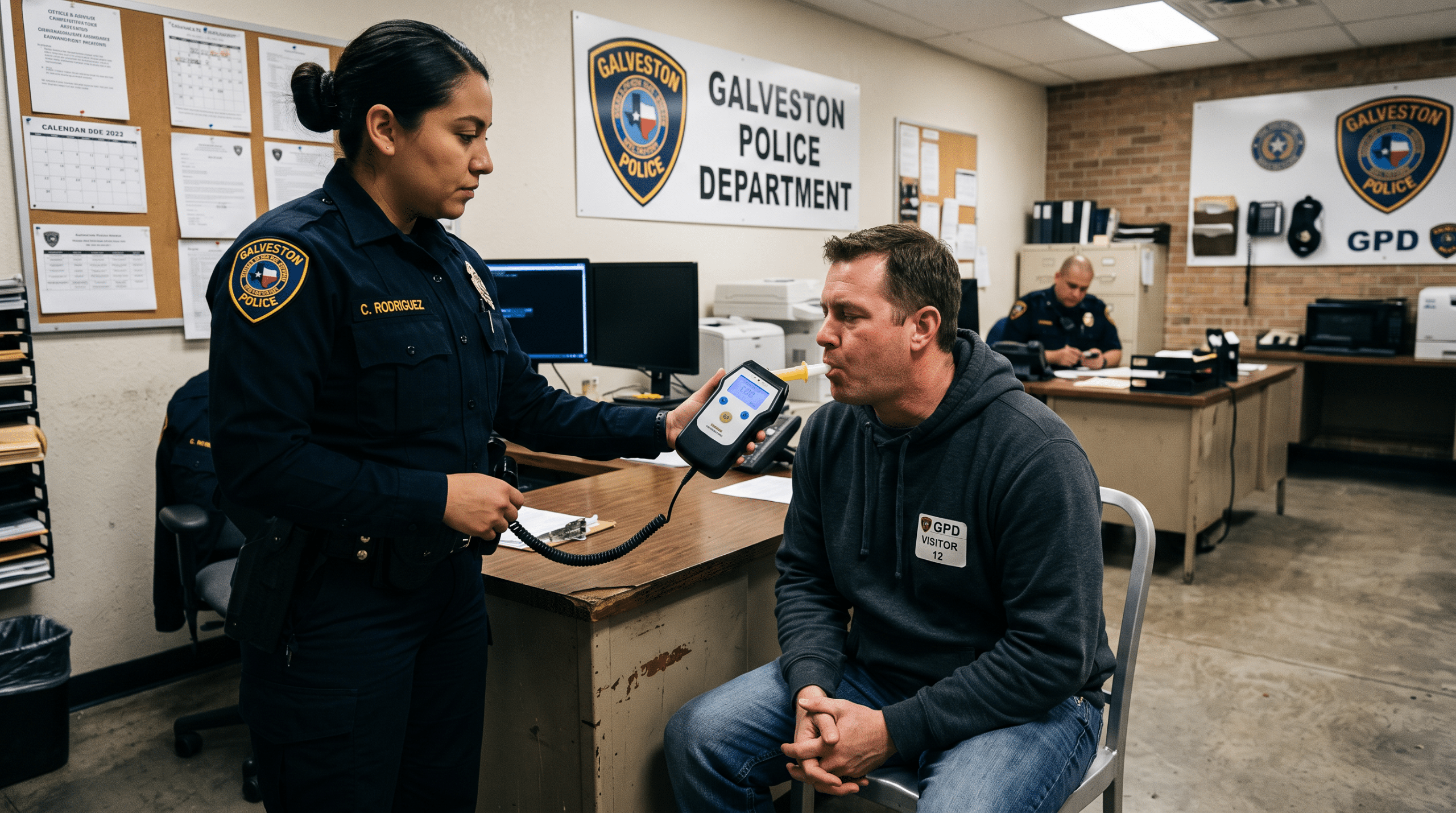
A blood or breath test showing an alcohol concentration above 0.08 does not always reflect your level at the time you were driving. Alcohol takes time to enter the bloodstream, so your blood alcohol concentration can keep rising even after you stop drinking. This timing matters in a Galveston County DWI case, especially if police collect a sample well after the traffic stop. If your alcohol level was still going up, a later test might show a higher number than when you were actually driving. We can use this timing, along with other evidence, to question whether the State can prove you were intoxicated when the law requires.
Texas Law Requires Proof That You Were Intoxicated While Driving
Timing is important because Texas Penal Code § 49.04 does not make it a crime just to have a breath or blood test above 0.08 after driving. The law says a person commits DWI if they are intoxicated while actually driving in a public place. The difference between when you were driving and when you were tested can be a key part of your defense.
Texas Penal Code § 49.01 defines “intoxicated” in two principal ways. A person may be considered intoxicated if the person does not have the normal use of mental or physical faculties because of alcohol, drugs, another substance, or a combination of substances. A person may also be considered intoxicated when the person’s alcohol concentration is 0.08 or more.
The prosecution must prove you were intoxicated while you were driving. A chemical test taken later is evidence, but that number should not be treated as if it shows your level at the exact time you were behind the wheel.
What Does Rising Blood Alcohol Mean?
When someone drinks alcohol, the body does not absorb it all right away. Blood alcohol concentration usually goes up during the absorption phase and then starts to go down as the body processes the alcohol.
This can be a problem if someone drinks right before driving. For example, if a person finishes several drinks, gets in the car soon after, and is stopped not far down the road, police may do roadside tests, make an arrest, and then take time to transport the driver and collect a breath or blood sample. By then, quite a bit of time may have passed.
If the person was still absorbing alcohol during that time, the chemical test might show a higher level than what was present while driving. This is the main idea behind a rising blood alcohol defense.
This defense does not claim that alcohol levels always rise after driving. That is not always true. Each case needs to be looked at closely, considering drinking history, food eaten, timing, testing delays, test results, and other specific evidence.
A .08 Or Higher Test Does Not End The DWI Case
People sometimes see a laboratory report showing 0.08 or higher and assume there is nothing left to defend. Texas DWI law is more complicated than that.
A chemical test is important evidence, but it must be considered in context. The Texas Court of Criminal Appeals has said that a breath test taken after driving can be relevant, even if there is no proof of the exact BAC at the time of driving. Still, the main question is whether the person was intoxicated while driving.
That distinction may become especially important when the result is relatively close to the statutory threshold. A test showing 0.081, 0.085, or another number near 0.08 obtained substantially after the stop can raise a very different evidentiary issue than an extremely high result obtained minutes after driving.
We would not examine the test result in isolation. We would compare it with the arrest timeline, driving behavior, field sobriety video, officer observations, statements about alcohol consumption, body-camera footage, and the precise time the specimen was collected.
Retrograde Extrapolation Can Become An Important Issue
When prosecutors or defense attorneys attempt to estimate a person’s alcohol concentration at an earlier point in time based on a later test, the process is commonly called retrograde extrapolation.
The Texas Court of Criminal Appeals addressed this subject in Mata v. State. The court recognized retrograde extrapolation as a scientific concept but emphasized that reliability depends heavily on the information available and how the analysis is performed. Factors can include the length of time between driving and testing, the number of tests, the person’s drinking history, the time of the last drink, whether and when food was consumed, body characteristics, and whether the person was still absorbing alcohol.
This is important because a calculation based on incomplete assumptions can create a misleading impression of precision. If the State attempts to claim that a later blood result proves what your BAC must have been when you were driving, we can examine what information supports that conclusion and what important information may be missing.
The same scientific principles may support the opposite position. If available evidence indicates that alcohol absorption was continuing after the stop, the defense may argue that the later test overstates the alcohol concentration at the time of driving.
The Time Of Your Last Drink May Matter
One of the first questions we may examine is when you consumed your last alcoholic beverage. That fact can have considerable importance in a rising-BAC case.
Someone who stopped drinking several hours before driving presents a different absorption issue from someone who consumed alcohol shortly before getting into a vehicle. The type and amount of alcohol, the speed at which it was consumed, whether the person ate, and the period between the final drink and driving can all affect the analysis.
Receipts, credit-card transactions, restaurant records, text messages, surveillance footage, and witness testimony can sometimes help establish a timeline. Phone data or photographs may also provide time-stamped evidence relevant to where someone was and when alcohol was consumed.
We look for evidence that can independently support the client’s account rather than relying solely on recollection made after an arrest.
Delay Between The Stop And The Chemical Test Can Matter
Texas Transportation Code Chapter 724 governs many aspects of breath and blood specimen testing following a DWI arrest. Texas law generally treats motorists arrested for qualifying intoxication offenses as having given implied consent to provide a specimen, subject to statutory and constitutional rules governing requests, refusals, warrants, and collection procedures.
From a defense standpoint, the exact testing timeline matters. A blood sample may not be collected until the driver has been transported to a hospital or another facility. A breath sample may be taken after transportation to a police facility and completion of required procedures.
If an hour, two hours, or even longer passes between the alleged driving and the specimen collection, we need to ask what was happening to the person’s alcohol concentration during that interval. Depending on the evidence, the BAC may have been decreasing, relatively stable, or still increasing.
The laboratory result tells us the concentration in the specimen at the time it was collected. Determining what that result proves about an earlier point in time is a separate issue.
Field Sobriety Evidence May Conflict With The Chemical Test
A rising-BAC defense can become stronger when other evidence does not appear consistent with the later test result.
Police officers frequently rely on standardized field sobriety tests, observations of driving behavior, speech, balance, coordination, odor of alcohol, and other circumstances when deciding whether to make a DWI arrest. Those observations should be compared carefully with the chemical evidence.
For example, body-camera or dash-camera footage may show that a driver communicated clearly, followed instructions, walked normally, produced documents without difficulty, or displayed fewer signs of impairment than the officer’s written report suggests. That does not automatically defeat a DWI charge because Texas permits the State to prove intoxication under either the impairment or alcohol-concentration definition. Still, apparent inconsistencies between the video and a later chemical result may be important.
The Texas Court of Criminal Appeals has specifically recognized that chemical testing is one part of a larger evidentiary picture that may also include officer testimony, driving observations, statements, sobriety testing, and video evidence.
A Rising-BAC Argument Must Fit The Actual Evidence
We do not treat rising blood alcohol as a generic defense that can be inserted into every DWI case. The argument needs factual support.
If the evidence establishes that the defendant stopped drinking long before driving and the test was conducted shortly after the stop, a rising-BAC theory may not make scientific sense. Conversely, if alcohol was consumed near the time of departure and significant time passed before testing, absorption timing may deserve close examination.
This is why reviewing the complete prosecution file matters. We may need to reconstruct the evening minute by minute, beginning with the first drink and continuing through the traffic stop, arrest, transportation, and specimen collection.
Small timing details can become important when the State’s case depends heavily on a chemical test.
Breath And Blood Testing Can Raise Additional Defense Issues
Even when rising BAC is part of the defense, we also examine whether the underlying test itself can be challenged.
With breath testing, questions may arise regarding the instrument, testing procedures, observation requirements, operator compliance, maintenance records, and substances that could affect the sample. Blood testing can present different concerns involving the blood draw, labeling, storage, transportation, laboratory procedures, contamination, instrumentation, and interpretation of results.
A rising-BAC issue does not replace these defenses. Several issues can exist in the same case.
The proper question is not simply whether the State possesses a laboratory number. We want to know whether that number is reliable, what point in time it actually represents, and whether the prosecution can connect it to intoxication while operating the vehicle.
The State Can Still Rely On The Impairment Definition Of Intoxication
One important limitation must be understood. Even if we create reasonable doubt about whether your BAC had reached 0.08 when you were driving, prosecutors may still attempt to prove that you lacked the normal use of your mental or physical faculties because of alcohol.
That is why attacking only the test result may not be enough.
We must also evaluate the officer’s claimed observations, driving behavior, roadside tests, statements, video evidence, and circumstances surrounding the stop. If those facts show little evidence of impairment, they may reinforce an argument that the later chemical test reflected alcohol absorption occurring after driving rather than intoxication at the relevant time.
A strong defense looks at both statutory definitions of intoxication rather than assuming the case depends entirely on the BAC number.
Rising Blood Alcohol Can Create Reasonable Doubt In The Right Case
The prosecution carries the burden of proving every element of DWI beyond a reasonable doubt. A defendant does not have to prove exactly what his or her BAC was at the time of driving to obtain an acquittal. The issue is whether the State can prove intoxication beyond a reasonable doubt.
If a later test is close to 0.08, the alcohol-consumption timeline supports continued absorption, and other evidence of impairment is weak or disputed, rising blood alcohol can become a meaningful defense issue.
The defense may challenge assumptions about the testing timeline, question attempts to estimate an earlier BAC, present evidence about recent alcohol consumption, and show inconsistencies between the chemical result and the driver’s behavior.
Every case depends on its own facts, but the existence of a 0.08-or-higher test should never prevent a careful investigation of what the driver’s alcohol concentration may actually have been at the time of operation.
Speak With Mark Diaz & Associates About A Galveston DWI Charge
A breath or blood test above 0.08 may look convincing when you first see the police report, but the result should never be considered without asking when the sample was taken and what your alcohol concentration may have been when you were actually driving. Texas law focuses on intoxication while operating the vehicle. When alcohol was consumed shortly before driving, and testing occurred later, the difference between those two points in time may become an important part of the defense.
At Mark Diaz & Associates, we examine DWI cases closely rather than assuming that a laboratory result tells the entire story. We review the traffic stop, officer observations, body-camera footage, field sobriety testing, drinking timeline, breath or blood procedures, laboratory evidence, and any scientific opinions used to connect a later test result to the time of driving. When rising blood alcohol, unreliable testing, an improper stop, or another defense issue is supported by the evidence, we can use it to challenge the State’s case.
When you hire me, you work directly with me. My clients have my personal cell phone number because questions, emergencies, and concerns don’t always happen during business hours. You won’t be handed off to a junior associate or lost in a system where your case is one of dozens on a crowded docket. From arrest through resolution, I remain personally involved and accessible.
If you were arrested for DWI in Galveston or anywhere throughout Houston, Texas, contact our Galveston DWI defense attorneys at Mark Diaz & Associates by calling 409-515-6170 to receive your free consultation. We represent people facing DWI and criminal charges in Galveston and throughout the City of Houston, and we are prepared to examine the evidence carefully and fight to protect your rights, driving privileges, and future.
