
Can Police Stop Me Because I Am In A High Crime Area?
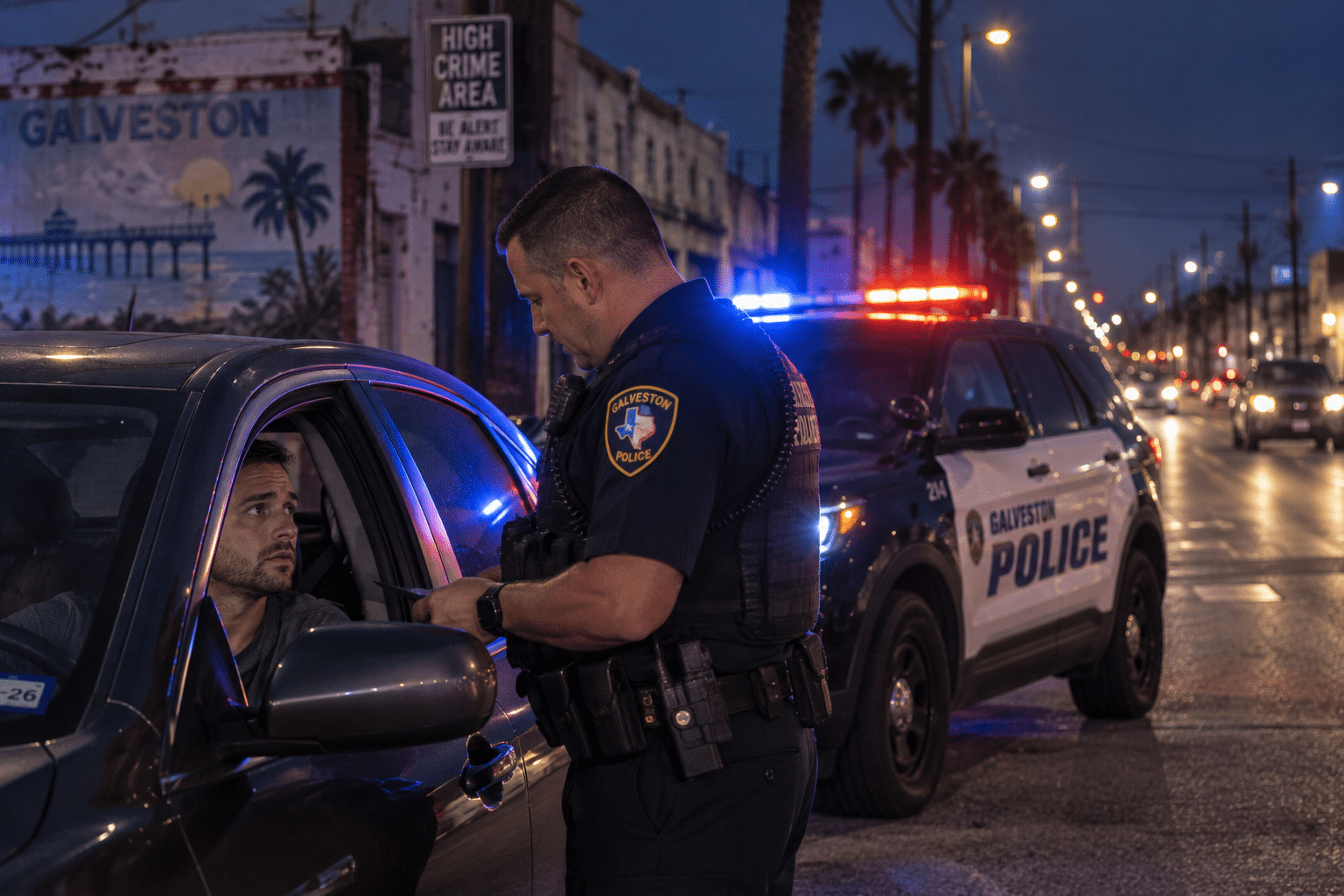
If you are walking down the street, standing outside a business, sitting in a parked car, or spending time in a neighborhood that police call a high-crime area, that alone does not give officers the legal right to stop you. Police may watch areas more closely if there have been recent reports of shootings, drug activity, burglaries, or robberies, but just being in that location is usually not enough for them to detain you.
The Fourth Amendment says officers need reasonable suspicion based on specific facts before they can stop someone for investigation. Texas law also protects you from unreasonable searches and seizures. If you are stopped by police in Galveston County or Houston, what matters most is not just where you were, but what facts the officer actually knew and saw before deciding to stop you.
Being In A High-Crime Area Is Not Automatically Reasonable Suspicion
Police can take the nature of an area into account when deciding if something seems suspicious, but the United States Supreme Court has said that just being in a high-crime neighborhood by itself does not create reasonable suspicion.
The main case on this issue is Illinois v. Wardlow, 528 U.S. 119 (2000). In that case, the Supreme Court looked at a situation where someone was in an area known for drug activity and suddenly ran away after seeing police. The Court decided that being in that location, combined with running away, could give police reasonable suspicion. But the Court did not say that just being in the neighborhood was enough. Instead, the area’s reputation was only one part of the bigger picture the officers had to consider.
That distinction matters. A person does not lose Fourth Amendment protections simply because the person lives in, works in, visits, or walks through a neighborhood associated with criminal activity. If police could detain anyone merely because of location, thousands of innocent residents and visitors could be subjected to investigative stops without individualized suspicion.
What Reasonable Suspicion Means During A Galveston Police Stop
The legal standard governing many street detentions comes from Terry v. Ohio, 392 U.S. 1 (1968). An officer may conduct a brief investigative detention when the officer has specific, articulable facts that reasonably suggest criminal activity is occurring, has occurred, or is about to occur.
Reasonable suspicion needs less proof than probable cause, but it still takes more than just an officer’s gut feeling. Courts look at all the facts and ask if the officer had a good reason to make the stop. The Supreme Court has said many times that reasonable suspicion depends on both what the police know and how trustworthy that information is.
For example, an officer might observe conduct matching the description of a recently reported burglary suspect, see someone repeatedly testing locked vehicle doors, or receive a sufficiently reliable report identifying a person engaged in criminal activity. Those facts may contribute to reasonable suspicion. Simply seeing someone standing on a public sidewalk late at night in a neighborhood where crimes have occurred generally presents a very different legal question.
Texas Law Also Protects Against Unreasonable Detentions
The Texas Constitution contains its own protection against unreasonable searches and seizures. Article I, Section 9 provides that people are secure in their persons, houses, papers, and possessions from unreasonable searches or seizures. Texas Code of Criminal Procedure Article 1.06 contains similar protections.
When we examine a Galveston criminal case involving a street detention, we look carefully at what happened before the officer initiated the stop. Police reports sometimes use general terms such as “high-crime area,” “known narcotics location,” or “suspicious behavior.” Those descriptions do not end the legal inquiry.
The real issue is what the officer actually observed and whether those observations reasonably connected the person being stopped to suspected criminal conduct. Courts are supposed to examine objective facts rather than simply accepting a broad label placed on a neighborhood.
Police Can Approach You Without Detaining You
Not every police encounter is legally considered a detention.
An officer generally may approach someone in a public place and ask questions. The officer might ask a person’s name, where the person is going, or whether the person witnessed something nearby. A consensual police encounter does not require reasonable suspicion because the person theoretically remains free to decline the conversation and leave.
The legal situation changes when police use authority or physical restraint in a way that would cause a reasonable person to believe that leaving is not permitted. An officer ordering someone to stop, blocking that person’s path, activating emergency equipment in certain circumstances, physically restraining the person, or otherwise communicating that compliance is mandatory may transform the interaction into an investigative detention.
That moment can become extremely important in a criminal case. If the officer did not have reasonable suspicion when the detention occurred, evidence discovered as a result may be subject to challenge.
Refusing To Answer Questions Is Not Automatically Suspicious
A person generally does not have to answer investigative questions during an otherwise consensual police encounter merely because an officer wants information.
The Supreme Court has recognized that refusing to cooperate with police during a consensual encounter does not, standing alone, create reasonable suspicion. In Wardlow, the Court distinguished a simple refusal to cooperate from unprovoked flight after noticing police.
That does not mean every encounter is simple. Police may already possess independent facts creating reasonable suspicion before approaching someone. If a lawful detention has already occurred, different legal rules may apply.
For defense purposes, we examine the exact sequence of events. We want to know what officers knew before the encounter, what questions were asked, whether commands were given, when the person was told to stop, and what happened afterward.
Walking Away From Police Is Different From Unprovoked Flight
People often ask whether they can simply walk away when police approach them.
During a truly consensual encounter, a person generally remains free to terminate the conversation. Walking away does not automatically establish criminal conduct. However, sudden and unprovoked flight can be treated differently.
In Illinois v. Wardlow, the Supreme Court held that sudden flight after noticing police was a relevant factor when combined with the defendant’s presence in an area known for heavy narcotics trafficking. The Court described flight as behavior that could reasonably contribute to an officer’s suspicion under the circumstances.
This is why criminal cases involving street stops are highly fact-specific. Calmly declining to answer a question and continuing down a sidewalk is not necessarily equivalent to running through an alley after seeing officers arrive at the scene of suspected criminal activity.
Can Police Frisk Me During A Street Stop?
A lawful investigative detention does not automatically authorize a full search.
Under Terry, an officer may conduct a limited pat-down for weapons when the officer reasonably believes that the detained person may be armed and dangerous. The purpose of the frisk is officer safety, not a general search for evidence.
That distinction can be important in drug and weapons cases. Officers may sometimes characterize a search as a protective frisk even though the circumstances did not reasonably suggest the presence of a weapon. We look carefully at why the officer claimed the frisk was necessary, what the officer touched, how intrusive the search became, and what was discovered.
Being detained in a neighborhood associated with crime does not automatically mean police can search your pockets, belongings, vehicle, or phone. Each additional intrusion must have its own legal justification.
When A Street Detention Turns Into An Arrest
An investigative detention is intended to be temporary and limited in scope. At some point, however, a detention can become so restrictive or prolonged that it effectively becomes an arrest.
An arrest generally requires probable cause, which is a higher standard than reasonable suspicion. Texas Code of Criminal Procedure Chapter 14 identifies circumstances in which officers may make warrantless arrests. For example, Article 14.01 allows a peace officer to arrest without a warrant for an offense committed in the officer’s presence or view, while Article 14.03 provides additional authority for warrantless arrests in specified situations.
If an officer begins with a questionable street stop and later arrests the person after discovering drugs, a firearm, or other evidence, we may examine whether the original detention was lawful. An arrest cannot necessarily cure an unconstitutional detention that produced the evidence used to establish probable cause.
Evidence From An Illegal Stop May Be Suppressed
One of the most important consequences of an unlawful detention is the possibility of excluding evidence from the criminal case.
Texas Code of Criminal Procedure Article 38.23 provides that evidence obtained in violation of the Texas Constitution, Texas law, the United States Constitution, or federal law generally cannot be admitted against an accused person at trial, subject to statutory exceptions.
Suppose an officer stops someone solely because the person is walking through an area labeled as high crime. During the detention, the officer discovers drugs or a weapon. If the defense establishes that reasonable suspicion did not exist when the seizure occurred, we may seek suppression of evidence obtained as a result of that detention.
Suppression issues can completely change the direction of a criminal case. If critical physical evidence or statements become inadmissible, the prosecution may be left with a substantially weaker case.
What We Examine When Challenging A High-Crime-Area Stop
We do not accept the phrase “high-crime area” as a substitute for factual analysis. We want to know exactly why the officer was there and exactly what the officer saw.
Body camera footage may show whether a police report accurately describes the encounter. Dispatch recordings may reveal what information officers had before approaching the defendant. Surveillance video, witness accounts, timestamps, and location evidence can help establish what actually occurred.
We also examine whether the police description of suspicious behavior makes sense when viewed in context. Conduct that appears unusual when summarized in a report may look completely innocent when the full video is reviewed. Standing near a closed store, sitting in a parked vehicle, talking with another person, carrying a backpack, or walking late at night may have perfectly lawful explanations.
The prosecution must defend the legality of the detention based on the facts, not merely the officer’s conclusion that something looked suspicious.
Why These Cases Require Close Review Of The Police Encounter
A street stop can become the foundation for serious criminal allegations. Drugs may be found after a frisk, a weapon may be discovered during a search, or statements made during the encounter may later be used by prosecutors.
We therefore focus on the beginning of the encounter rather than looking only at what police eventually discovered. Evidence found afterward does not retroactively create reasonable suspicion for a detention that was unlawful when it began.
If police stopped you in Galveston because they claimed you were in a high-crime area, we examine whether the officers had individualized facts connecting you to criminal activity. Location can matter, but it cannot automatically replace the constitutional requirement that police have an objective reason for detaining a particular person.
Call Mark Diaz & Associates If Police Stopped You In Galveston
A criminal charge that begins with a street detention should be examined from the moment police first approached you. If officers lacked reasonable suspicion, evidence discovered later may be subject to suppression, and that issue can have a major effect on the prosecution’s case. At Mark Diaz & Associates, we defend people accused of crimes in Galveston and throughout Houston, Texas, and we examine the constitutional basis for traffic stops, street detentions, searches, questioning, and arrests.
When you hire me, you work directly with me. My clients have my personal cell phone number because questions, emergencies, and concerns don’t always happen during business hours. You won’t be handed off to a junior associate or lost in a system where your case is one of dozens on a crowded docket. From arrest through resolution, I remain personally involved and accessible.
If police stopped, searched, or arrested you after claiming you were in a high-crime area, contact our Galveston criminal lawyers at Mark Diaz & Associates by calling 409-515-6170 to receive your free consultation.
