
Can A Passenger Be Charged If A Gun Is Found In The Vehicle?
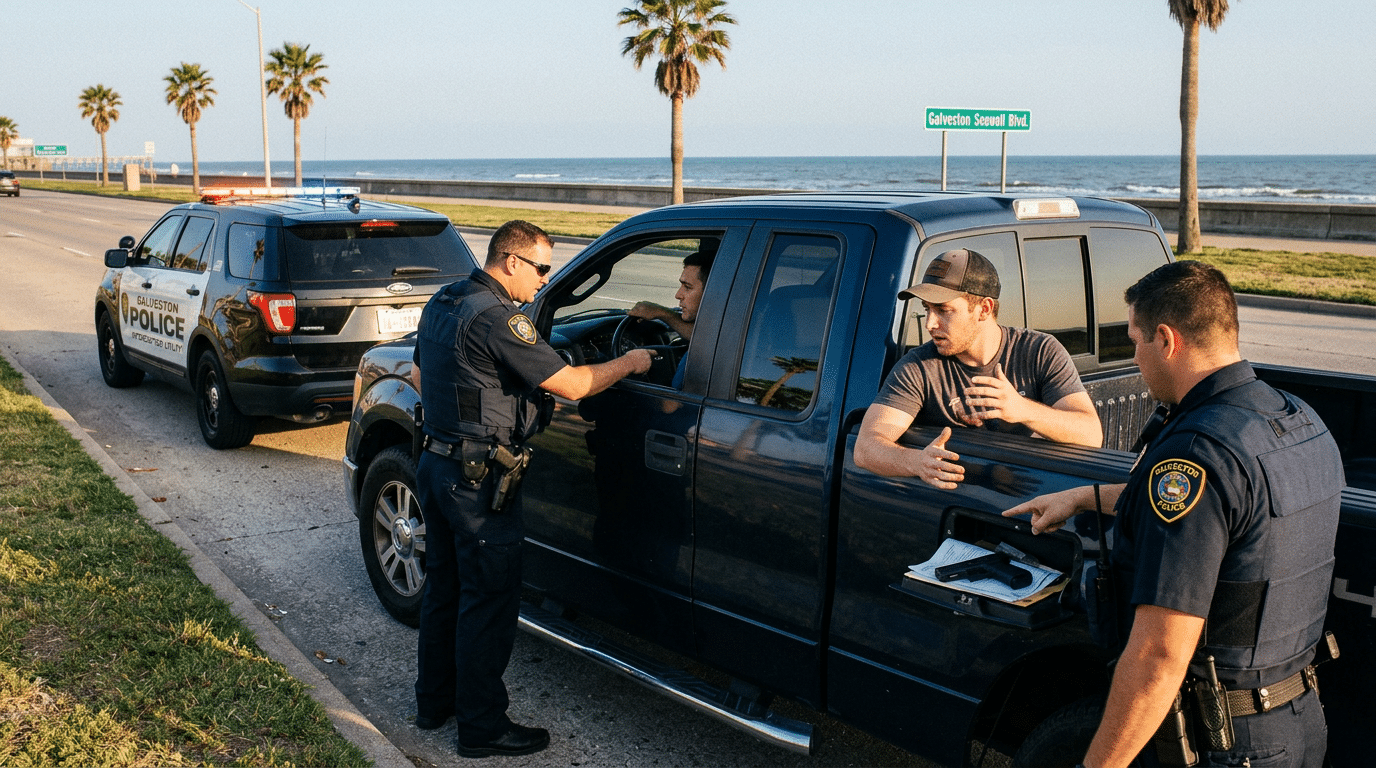
A traffic stop can become much more serious when police find a firearm somewhere inside the vehicle. If several people are in the car, officers may immediately begin asking who owns the gun, who knew it was there, and who had access to it. A passenger may even be arrested despite insisting that the firearm belongs to the driver or another occupant. Under Texas law, however, simply sitting near a gun does not automatically establish criminal possession.
Prosecutors generally must prove facts connecting the passenger to the firearm and showing that the passenger knowingly exercised care, custody, control, or management over it. When we defend a Galveston weapons case arising from a vehicle search, one of the first questions we examine is whether the evidence actually connects our client to the firearm or merely places our client in the same vehicle.
Being A Passenger Near A Gun Does Not Automatically Prove Possession
Texas law requires more than simple physical proximity to establish possession. Texas Penal Code § 6.01 provides that possession is voluntary when a person knowingly obtains or receives the item or is aware of having control over it for enough time to terminate that control. In other words, the State generally must prove both knowledge and some degree of control.
This distinction becomes especially important when multiple people occupy the vehicle. A passenger may be sitting inches away from a firearm without owning it, knowing it is there, or having any authority over it. Texas courts recognize that mere presence where contraband is found is not enough by itself to establish possession.
In a recent Texas appellate decision involving a passenger and a firearm, the court reiterated that the purpose of the “affirmative links” analysis is to prevent innocent people from being convicted merely because they happened to be close to the weapon. The prosecution must present evidence showing that the connection between the passenger and the firearm was more than accidental.
Prosecutors Look For Facts Connecting The Passenger To The Firearm
When a firearm is not found directly on a defendant, and the defendant does not have exclusive possession of the location where it is found, Texas courts look for additional facts connecting that person to the weapon.
The firearm’s location can matter a great deal. A gun found directly underneath the passenger seat may create a stronger prosecution argument than a firearm locked in the driver’s trunk. A firearm sitting openly beside the passenger can also raise different questions than one concealed inside another occupant’s bag.
Courts have considered facts such as whether the firearm was visible, whether the passenger was close enough to easily reach it, whether it was found on the passenger’s side of the vehicle, whether the passenger made statements connecting himself or herself to the gun, and whether the passenger behaved in a way prosecutors claim showed consciousness of guilt. Conflicting stories between occupants can also become part of the State’s case. Texas appellate courts repeatedly stress, however, that no single checklist determines possession. Courts look at the combined strength of all the evidence.
The Location Of The Gun Can Matter
Where police discover the firearm is often one of the most important facts we examine.
Suppose officers find a handgun underneath the front passenger seat where our client was sitting. Prosecutors may argue that the passenger’s proximity and ability to reach the weapon establish possession. That evidence may become more persuasive if officers also claim they saw the passenger reaching underneath the seat or if the passenger made statements indicating knowledge of the firearm.
The analysis changes when the firearm is found somewhere that the passenger had little or no obvious access to. A firearm inside the driver’s locked console, in luggage belonging to another occupant, or in a rear cargo area may make it harder for prosecutors to prove that a passenger knowingly exercised control over it.
A Galveston County case decided years ago illustrates why the distinction matters. The appellate court recognized that a gun located beneath a passenger’s seat created some circumstantial evidence, but the court also emphasized the weakness of relying on coincidence and proximity without stronger evidence connecting the passenger to the firearm.
Texas Unlawful Carrying Of A Weapon Laws Can Apply In Vehicle Cases
Texas Penal Code § 46.02 governs unlawful carrying of weapons under several circumstances. Texas generally allows many adults to possess handguns in vehicles, but that does not mean every person can legally possess every firearm in every situation.
Section 46.02 includes restrictions involving certain people and circumstances. For example, the statute addresses carrying a handgun in a motor vehicle when the person is engaged in certain criminal activity or is otherwise prohibited by law from possessing a firearm. It also contains rules regarding when a handgun may be carried in plain view.
Because Texas firearm laws depend heavily on the person’s status and surrounding circumstances, discovering a gun inside a vehicle does not automatically establish unlawful carrying. Police and prosecutors still must determine who allegedly possessed the firearm and whether that person’s possession violated a particular law.
A Prior Felony Conviction Can Make The Case Much More Serious
Texas Penal Code § 46.04 places restrictions on firearm possession by people with certain prior convictions. A person convicted of a felony may be prohibited from possessing a firearm under circumstances described by the statute.
For example, § 46.04 generally prohibits a person convicted of a felony from possessing a firearm before the fifth anniversary of release from confinement, parole, or community supervision, whichever is later. Additional restrictions can apply afterward depending on where possession occurs.
This makes the possession issue critical when a passenger has a prior felony conviction. Prosecutors cannot simply point to a gun somewhere in a shared vehicle and automatically establish unlawful possession. They still must prove that the passenger possessed the firearm within the meaning of Texas law.
Recent Texas appellate decisions continue to apply the affirmative-links analysis in felon-in-possession cases when a firearm is found in a place shared with others. The evidence must connect the defendant to the weapon rather than merely establish that the defendant was nearby.
Statements Made During The Traffic Stop Can Become Evidence
What everyone says during a vehicle stop can significantly influence a weapons investigation.
Officers may separate the occupants and ask each person who owns the firearm, whether they knew it was inside the vehicle, and when they last saw it. If the occupants provide conflicting answers, prosecutors may later use those inconsistencies as evidence.
Statements can also directly connect a passenger to the weapon. A passenger who says, “I put it under the seat earlier,” has created an obvious evidentiary problem that does not exist when the passenger consistently denies knowledge of the firearm.
For this reason, we caution people against trying to explain an unclear situation through lengthy roadside conversations. Officers are gathering evidence, and statements made during the encounter can later appear in police reports, body-camera recordings, and courtroom testimony.
Police Conduct During The Vehicle Search Should Also Be Examined
Even when police find a firearm, we still examine how they discovered it. The Fourth Amendment protects against unreasonable searches and seizures. Depending on the circumstances, officers may need consent, probable cause, a warrant, or another recognized legal basis before searching portions of a vehicle.
A lawful traffic stop does not automatically give police unrestricted authority to search every compartment and every container in the car. Whether the search was constitutional can become an important defense issue, particularly when the firearm was concealed rather than visible.
If officers discovered the gun through an unlawful search, we may seek suppression of that evidence. A weapons prosecution can change significantly if the State loses the ability to introduce the firearm or evidence obtained because of an unconstitutional search.
Drugs And Firearms Can Create Additional Criminal Exposure
Vehicle cases become more serious when police claim they found both firearms and controlled substances. Texas drug laws generally require proof that the defendant knowingly or intentionally possessed the controlled substance. The same shared-possession issues can therefore arise with drugs that arise with firearms. A passenger should not automatically be treated as possessing everything found inside a vehicle simply because he or she happened to be present.
However, prosecutors may attempt to use drugs, packaging materials, large amounts of cash, or other alleged contraband to strengthen their theory regarding the firearm. Whether those items actually belong to the passenger remains a separate evidentiary question that must be examined carefully.
Frequently Asked Questions About Guns Found In Vehicles In Texas
Can Police Arrest Every Person In The Car If They Find One Gun?
Police may detain or even arrest multiple occupants while investigating who possessed a firearm, but an arrest does not mean prosecutors can prove a criminal charge against every passenger. Texas law still requires evidence connecting the particular defendant to the firearm. If the gun was not found on the passenger and the passenger did not exclusively control the vehicle, prosecutors normally rely on circumstantial evidence showing knowledge and control. Courts have repeatedly held that mere presence near a firearm is not enough by itself.
What If The Gun Was Under My Passenger Seat?
A firearm under the passenger seat can create evidence of proximity and access, but location alone does not automatically establish guilt. Prosecutors may look for additional evidence, such as statements, gestures toward the seat, ownership information, fingerprints, DNA, ammunition found on the passenger, or other facts connecting the passenger to the firearm. We examine the full circumstances because someone can ride in a vehicle without knowing what another person previously placed beneath the seat.
What If The Driver Says The Gun Belongs To Me?
The driver’s accusation can become evidence, but it does not automatically prove possession beyond a reasonable doubt. We would examine the driver’s credibility, motive, prior statements, ownership records, physical evidence, body-camera footage, and whether the driver’s account changed during the investigation. In shared vehicle cases, conflicting statements between occupants are common, and prosecutors still must prove the accusation against the passenger with legally sufficient evidence.
Can I Be Charged If I Did Not Know The Gun Was In The Car?
Knowledge is an important part of possession under Texas law. Penal Code § 6.01 states that possession is voluntary when a person knowingly obtains or receives an item or is aware of having control over it long enough to terminate that control. If a passenger genuinely did not know the firearm existed, that lack of knowledge may directly undermine the prosecution’s possession theory.
Speak With Mark Diaz & Associates About A Galveston Weapons Charge
Being inside a vehicle where police discover a firearm does not automatically mean you possessed that weapon. Texas prosecutors generally must prove much more than proximity. We examine whether the State can establish knowledge, access, control, and a meaningful connection between our client and the gun. We also review the legality of the traffic stop and vehicle search because constitutional violations may affect whether the firearm can be used as evidence.
Mark Diaz & Associates represents people facing weapons charges and other criminal allegations in Galveston and throughout Houston, Texas. When you hire me, you work directly with me. My clients have my personal cell phone number because questions, emergencies, and concerns don’t always happen during business hours. You won’t be handed off to a junior associate or lost in a system where your case is one of dozens on a crowded docket. From arrest through resolution, I remain personally involved and accessible. Call our Galveston gun crime attorney at Mark Diaz & Associates, at 409-515-6170 to schedule your free consultation.
