
What Is DWI With A Child Passenger In Texas?
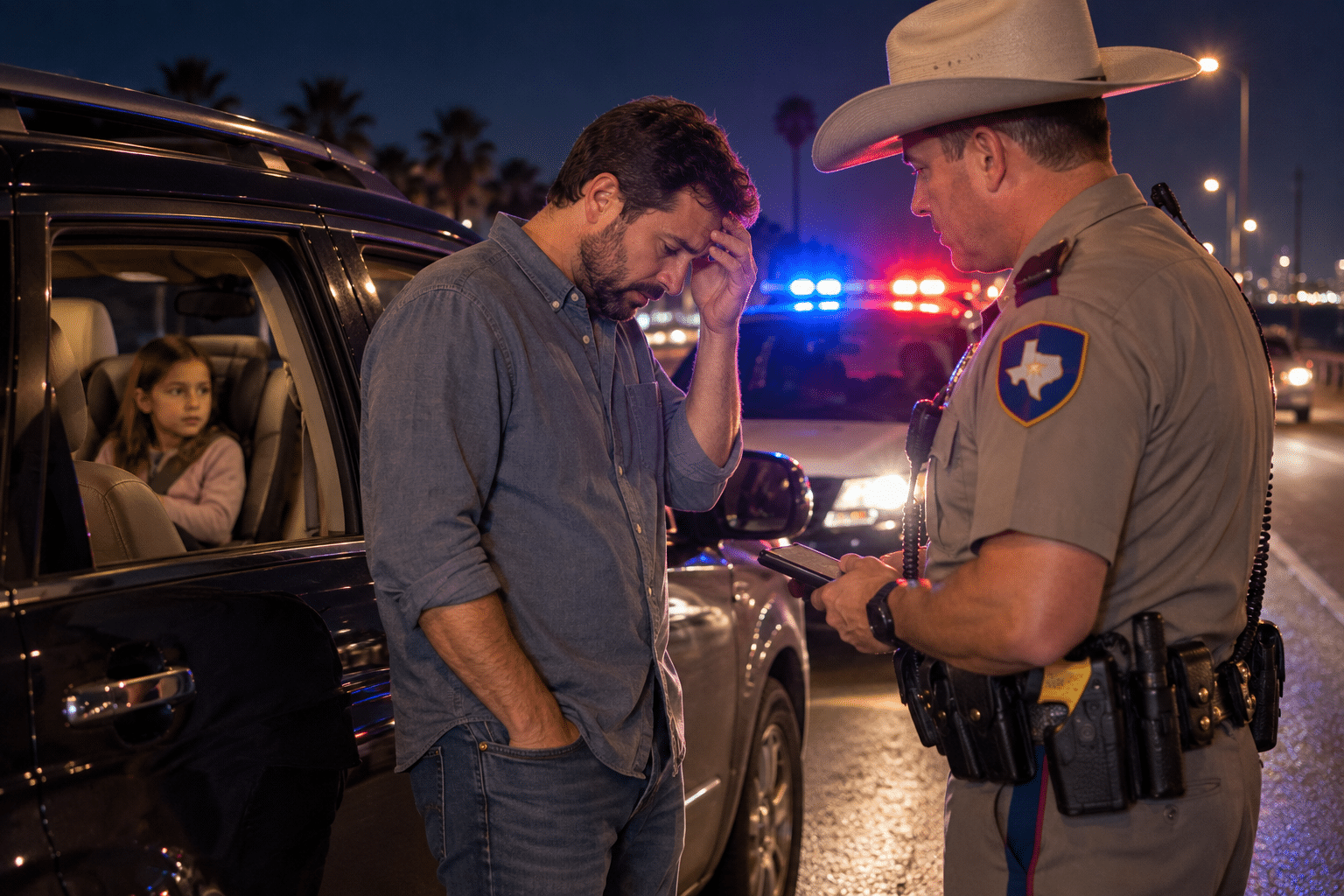
Getting arrested for DWI in Galveston County is already serious, but it becomes even more severe if a child is in the car. Texas law treats driving while intoxicated with a passenger under 15 as a separate felony. This means a person who might have faced a misdemeanor DWI could instead be charged with a state jail felony. Such a case can impact your freedom, driver’s license, job, finances, and family. If you’ve been arrested in Galveston or Houston, it’s important to know what the State must prove to defend yourself.
How Texas Defines DWI With A Child Passenger
Texas Penal Code § 49.045 states that a person commits Driving While Intoxicated With Child Passenger when the person is intoxicated while operating a motor vehicle in a public place, and the vehicle contains a passenger who is younger than 15 years old. The statute classifies the offense as a state jail felony.
This charge is not the same as a typical first-time DWI, which is usually a misdemeanor. Having a child under 15 in the car changes the charge to a felony. Prosecutors do not have to show that the child was hurt or that there was an accident. If they can prove that an intoxicated person drove in a public place with a child under 15 in the car, that can be enough for a felony charge.
What Does Intoxicated Mean Under Texas Law?
Texas does not limit DWI prosecutions to drivers with a blood alcohol concentration of 0.08 or higher. Under Texas Penal Code § 49.01, a person is considered intoxicated if the person does not have the normal use of mental or physical faculties because of alcohol, drugs, controlled substances, dangerous drugs, another substance, or a combination of substances. A person is also legally intoxicated if the person has an alcohol concentration of 0.08 or more.
This difference matters because prosecutors can still bring a DWI case even if your breath or blood test is below 0.08, or if there is no test result at all. Police may use things like your driving, speech, balance, field sobriety tests, body-camera video, statements, or even smells as evidence. We look at all of this evidence carefully instead of just assuming an arrest means someone was intoxicated.
What Are The Penalties For DWI With A Child Passenger?
Because DWI with a child passenger is a state jail felony, the potential punishment is substantially greater than the punishment for a typical first DWI. Under Texas Penal Code § 12.35, a state jail felony is generally punishable by confinement for at least 180 days and not more than two years. The court may also impose a fine of up to $10,000.
A felony conviction can affect your life in many ways beyond the court’s sentence. It can impact your job options, professional licenses, housing, background checks, gun rights, and more. These effects can last long after the case is over.
For that reason, we look at much more than the immediate possibility of jail. We consider how the charge could affect the client’s career, family responsibilities, driving privileges, and long-term record when developing a defense strategy.
Can A DWI With A Child Passenger Affect Your Driver’s License?
Yes. A DWI arrest can create both a criminal case and a separate driver’s license issue. Texas Transportation Code § 521.344 provides for license suspension following certain intoxication-related convictions, including a conviction under Texas Penal Code § 49.045. Depending on the circumstances and applicable exceptions, the suspension connected to a conviction may generally range from 90 days to one year.
There may also be an Administrative License Revocation proceeding arising from a failed or refused chemical test. For example, Texas Transportation Code § 724.035 provides for a 180-day suspension following certain first refusals to provide a requested specimen, with longer consequences possible when the driver’s record contains qualifying prior alcohol- or drug-related enforcement contacts. A request for a hearing after a refusal generally must be received within 15 days after notice.
These deadlines can move independently from the criminal prosecution. We therefore consider the license issue early rather than waiting for the criminal case to reach court.
Will An Ignition Interlock Device Be Required?
An ignition interlock requirement may arise very early in a child-passenger DWI case. Article 17.441 of the Texas Code of Criminal Procedure addresses ignition interlock conditions for defendants released on bond in certain intoxication cases, including charges under Penal Code § 49.045.
An ignition interlock device requires the driver to provide a breath sample before the vehicle will start and may require additional samples while the vehicle is being operated. The specific conditions imposed can depend on the court, the facts of the case, and whether a statutory exception applies.
We review bond conditions carefully because violating them can create additional problems while the original criminal charge is still pending.
Could The Case Lead To Other Allegations Involving The Child?
A DWI with a child passenger charge is already a separate felony offense, but the underlying facts may cause law enforcement or prosecutors to examine whether other laws could apply. Texas Penal Code § 22.041, for example, addresses conduct that places a child in imminent danger of death, bodily injury, or physical or mental impairment. Whether that statute applies depends on the specific facts and evidence rather than simply on the existence of a DWI arrest.
Family-related consequences may also become a concern in some cases. An arrest involving a child can result in questions about custody, supervision, or reports to child-protection authorities. Those matters are separate from the State’s obligation to prove the DWI charge, but they can greatly increase the stress placed on a parent or family.
How We Examine The Evidence In A Child Passenger DWI Case
A felony allegation should never be treated as proven simply because an arrest was made. We examine whether the officer had lawful grounds for the traffic stop or detention, whether there was probable cause for the arrest, and whether the evidence actually establishes intoxication.
We may review body-camera footage, dash-camera footage, breath-test records, blood-test documentation, laboratory records, field sobriety testing, dispatch recordings, witness statements, vehicle video, medical information, and the timing of alcohol consumption. When blood was taken, we may examine how the sample was obtained, stored, transported, tested, and documented.
We also compare what officers wrote in their reports with what the video evidence actually shows. Small inconsistencies can become important when the State’s case depends heavily on subjective observations.
Can A DWI With A Child Passenger Charge Be Defended?
Yes. The fact that a charge is a felony does not remove the State’s burden of proof. Prosecutors still must prove that the accused was operating a motor vehicle in a public place, was legally intoxicated, and had a passenger younger than 15 in the vehicle.
The defense will depend on the evidence. There may be disputes over whether the traffic stop was lawful, whether the driver was actually intoxicated, whether field sobriety testing was administered correctly, whether a blood or breath result is reliable, or whether police observations are supported by video.
Every case is different. Our job is to examine what the State can actually prove, identify weaknesses or constitutional issues, and determine what options may be available under the circumstances.
Frequently Asked Questions About DWI With A Child Passenger In Texas
Is DWI With A Child Passenger Always A Felony In Texas?
Under Texas Penal Code § 49.045, DWI with a child passenger is classified as a state jail felony when the driver is intoxicated while operating a motor vehicle in a public place and a passenger younger than 15 is inside the vehicle. This classification applies even when the person has never been convicted of DWI before.
That makes the child passenger element especially important. A person who might otherwise be facing a misdemeanor first DWI can instead face felony prosecution. The prosecution still has to prove all required elements beyond a reasonable doubt, including intoxication and the age of the passenger.
Does The Child Have To Be Injured For Someone To Be Charged?
No. Texas Penal Code § 49.045 does not require prosecutors to prove that the child was physically injured. The statute focuses on intoxicated operation of a motor vehicle in a public place while a passenger younger than 15 is in the vehicle.
A lack of injury does not automatically defeat the charge. However, the complete factual circumstances still matter when we evaluate the criminal case, possible additional allegations, bond conditions, and potential resolutions.
What If My Blood Alcohol Level Was Below 0.08?
A BAC below 0.08 does not automatically prevent a DWI prosecution. Texas Penal Code § 49.01 allows the State to attempt to prove intoxication by showing that a person did not have the normal use of mental or physical faculties because of alcohol, drugs, another substance, or a combination of substances.
This means prosecutors may rely on officer observations, video, driving behavior, field sobriety testing, statements, or other evidence. We examine whether those observations are reliable and whether they are consistent with the objective evidence.
What If I Refuse A Breath Or Blood Test?
A refusal can create a separate administrative driver’s license issue. Under Texas Transportation Code § 724.035, a refusal can result in a 180-day driver’s license suspension in certain first-refusal situations, while qualifying prior alcohol- or drug-related enforcement contacts can increase the suspension period.
A refusal does not mean that the State automatically wins the criminal case. Police may seek a warrant for a blood sample, and prosecutors may rely on other evidence of alleged intoxication. The legality of the stop, arrest, warrant, blood draw, and testing procedures may all require review.
Can I Lose My Driver’s License After A Conviction?
A conviction under Texas Penal Code § 49.045 can lead to a driver’s license suspension. Texas Transportation Code § 521.344 addresses suspensions for intoxication offenses and includes DWI with a child passenger. For many defendants, the applicable statutory range following conviction can be 90 days to one year, although other provisions and circumstances can affect the outcome.
The administrative suspension connected to a failed or refused test is a separate matter. Because those proceedings operate on different deadlines, addressing the driver’s license issue promptly can be important.
Can A First-Time DWI Still Result In A Child Passenger Felony Charge?
Yes. No prior DWI conviction is required for prosecution under Texas Penal Code § 49.045. If the State alleges that a person was intoxicated while operating a motor vehicle in a public place and had a passenger younger than 15 inside, the case can be filed as a state jail felony even if the driver has no prior DWI record.
A clean criminal history may still be relevant when attorneys discuss bond conditions, negotiations, sentencing, or other case issues, but it does not change the statutory classification of the alleged offense.
Can Police Use Body-Camera Video Against Me?
Yes, but body-camera footage can also help the defense. Prosecutors may use video to support claims about speech, balance, behavior, field sobriety performance, or statements made at the scene. We can use the same footage to determine whether the officer’s written account accurately reflects what happened.
Video may show that a driver communicated clearly, followed instructions, walked normally, or performed differently from the way the officer described the encounter. It can also reveal problems with the traffic stop, arrest, testing instructions, or questioning.
What Should I Do After A DWI With A Child Passenger Arrest?
The most important practical concern is protecting both the criminal case and any driver’s license rights that may be subject to short deadlines. Statements about the arrest should be made cautiously because comments to police, prosecutors, insurers, employers, or on social media may later become evidence.
We also recommend preserving any evidence that may disappear, including receipts, surveillance footage, phone records, location data, photographs, witness information, and details concerning when food, alcohol, or medications were consumed. Evidence that appears minor shortly after an arrest can become important once the State’s timeline is examined closely.
Speak With Mark Diaz & Associates About A Texas DWI With A Child Passenger Charge
A DWI with a child passenger allegation puts much more at stake than an ordinary traffic-related arrest. You may be facing a state jail felony, possible confinement, a substantial fine, driver’s license consequences, ignition interlock conditions, and long-term problems associated with a felony record. We believe these cases require a careful review of the stop, arrest, testing procedures, video evidence, witness accounts, and every element prosecutors must prove.
At Mark Diaz & Associates, we represent people accused of serious criminal offenses in Galveston and throughout Houston, Texas. When you hire our firm, you receive direct attention from the lawyer handling your case. Our clients are given direct access because questions, emergencies, and concerns do not always occur during ordinary business hours. You will not simply be handed off and forgotten in a system where your case receives little individual attention. From the arrest through the resolution of the case, we remain personally involved, accessible, and focused on protecting your rights.
If you or someone you care about has been arrested for DWI with a child passenger in Texas, contact our Galveston DWI attorneys at Mark Diaz & Associates by calling 409-515-6170 to receive your free consultation. We represent clients in Galveston and throughout Houston, Texas, and we can review the charge, the evidence, the driver’s license issues, and the defense options that may apply to your case.
