
What Happens If Customs Finds Drugs In Your Luggage?
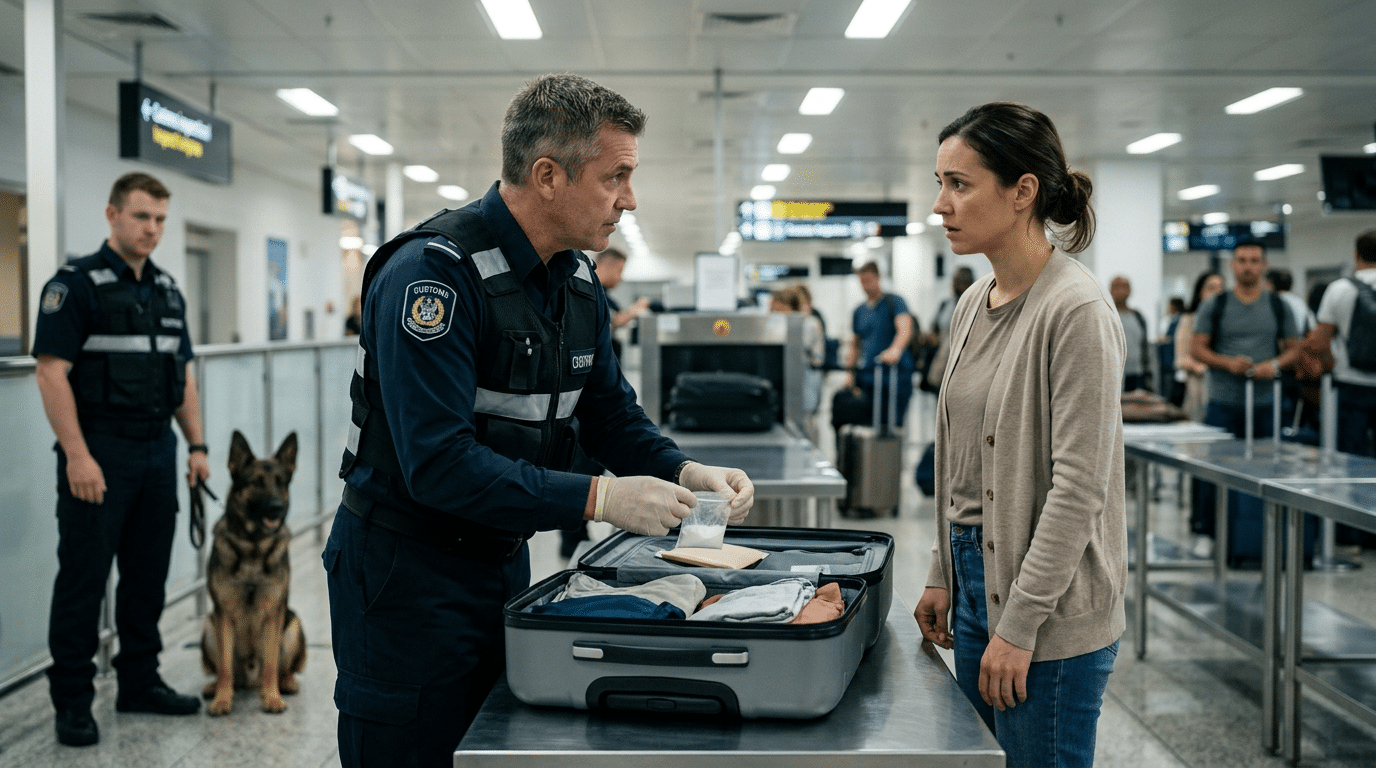
If customs officers find drugs in your luggage, a normal trip can quickly become a criminal investigation. Officers might detain you, ask questions, separate you from your group, and keep you from leaving while they figure out what the substance is and who knew about it. In Galveston, this situation can lead to felony drug possession charges, accusations of intent to deliver, or even federal charges if the luggage came from another country.
However, just finding drugs in a suitcase does not automatically mean the person carrying it knew about them. When we handle these cases, we first look at whether the government can prove knowledge, possession, and control beyond a reasonable doubt.
Customs Officers Have Broad Authority To Search Luggage
International travelers need to know that customs inspections are not the same as regular police searches. U.S. Customs and Border Protection has wide authority to inspect people, baggage, and goods coming into the country. Federal rules say that baggage arriving in U.S. customs territory can be inspected, and CBP explains that travelers and their belongings may be searched at the border or similar locations.
This means officers usually do not need the same level of probable cause or a search warrant that police would need to search luggage away from the border. At airports with international arrivals, customs officers can send a traveler for extra screening and check their luggage more closely before they leave the customs area.
Even if a customs search is legal, it does not automatically mean the traveler committed a drug crime. Prosecutors still need to prove all parts of the offense.
Texas Prosecutors Must Prove Knowing Possession
Texas drug possession laws generally require proof that a person knowingly or intentionally possessed a controlled substance. Texas Health and Safety Code § 481.002 defines possession in terms of actual care, custody, control, or management. The specific criminal statute that applies depends on the penalty group assigned to the drug.
For example, Texas Health and Safety Code § 481.115 addresses possession of substances in Penalty Group 1, which includes many drugs capable of producing very serious felony charges. Other controlled substances may fall under § 481.116, § 481.117, or § 481.118, depending on their classification. Marijuana possession is addressed separately under Texas Health and Safety Code § 481.121.
Finding drugs in someone’s luggage is strong evidence, but it is not always final. We carefully check who packed the bag, who owned it, who had access, if the bag changed hands during the trip, if someone else put something inside, and whether there is proof that the accused knew about the drugs.
Drug Type And Weight Can Dramatically Affect The Charge
In Texas, drug penalties can get much harsher as the weight of the substance goes up. The type of drug also matters because Texas puts drugs into different penalty groups, and each group has its own weight limits and punishment ranges.
A small amount of drugs might lead to a lower-level charge, but a larger amount can result in a much more serious felony. If customs officers find several packages, large amounts, hidden compartments, vacuum-sealed bags, or other signs of distribution, investigators may start looking for evidence of trafficking or delivery instead of just personal possession.
We do not automatically accept the government’s reported weight or lab results. Drug testing, chain of custody, packaging weight, how mixtures are calculated, and lab procedures can all be important when the amount of the substance affects the seriousness of the charge.
Customs Cases Can Also Lead To Federal Drug Charges
A customs drug investigation frequently raises federal issues because the alleged conduct involves bringing a controlled substance into the United States. Under 21 U.S.C. § 952, federal law restricts the importation of controlled substances into the United States. Section 960 makes it a federal crime to knowingly or intentionally import certain controlled substances contrary to federal law and establishes penalties based in part on the substance and quantity involved.
Federal prosecutors may also use 21 U.S.C. § 841 when they allege that a person knowingly possessed controlled substances with intent to distribute them.
This difference is important. A traveler might think the case is only about Texas law, but later find out that federal agents are involved or that the case has been sent for federal prosecution. When we review a case, we find out which agency did the investigation, where the seizure happened, and which prosecutor is likely to file charges.
Statements Made During Customs Questioning Can Affect The Case
Travelers often believe they can talk their way out of the situation. That decision can create additional problems. Investigators may ask who packed the suitcase, whether anyone gave the traveler anything to carry, where the traveler stayed, who purchased the ticket, and whether the traveler knew what was inside a particular package.
An inaccurate guess or nervous explanation can later be portrayed as evidence of guilt. We examine exactly what was asked, what was said, whether questioning became custodial, and whether constitutional protections were implicated once the interaction moved beyond routine customs processing and into a criminal investigation.
A person facing questioning over suspected drugs should understand that the government may preserve statements and compare them against baggage records, travel data, phone evidence, surveillance footage, and statements from other passengers.
Possession With Intent To Deliver Can Make The Case More Serious
Texas prosecutors may seek charges beyond simple possession when the circumstances suggest distribution. Texas Health and Safety Code § 481.112 addresses manufacture or delivery offenses involving certain Penalty Group 1 substances. Prosecutors commonly examine quantity, packaging, cash, communications, travel patterns, and other evidence when attempting to prove an intent to deliver.
Quantity alone does not tell the entire story. We examine whether the government actually has evidence establishing an intent to distribute rather than simply relying on assumptions based on the amount recovered.
The distinction can substantially affect potential punishment and the defense strategy.
A Customs Drug Arrest Requires Immediate Legal Attention
A customs drug case can develop quickly because multiple agencies may become involved. CBP officers may turn a traveler over to another federal agency or local law enforcement, and evidence collected during the customs inspection may later become central to a state or federal prosecution.
We begin by identifying exactly where the luggage was searched, which officers participated, what was seized, what statements were made, and whether investigators claim there is evidence connecting our client to the drugs. We also examine the laboratory evidence, chain of custody, luggage ownership, travel records, communications, and every circumstance surrounding the alleged possession.
The presence of drugs in luggage creates a serious accusation. It does not eliminate the government’s burden to prove that the accused knowingly committed the offense.
Frequently Asked Questions About Drugs Found In Luggage By Customs
Will I Automatically Be Arrested If Customs Finds Drugs In My Suitcase?
Not necessarily, although arrest or detention is a serious possibility. What happens may depend on the type and quantity of the substance, whether officers believe you knowingly possessed it, where the inspection occurred, and which law enforcement agencies become involved. Customs officers may detain you while they investigate and may refer the matter to federal agents or state or local authorities.
The most important legal issue is not simply where the drugs were found. Prosecutors must establish the elements of the offense they eventually charge. Under Texas law, possession offenses generally require knowing or intentional possession. When drugs are found in a suitcase, we examine whether there is evidence establishing that the traveler actually knew they were there.
What If Someone Else Put The Drugs In My Luggage?
That can be a major issue in the defense. Texas possession law focuses on knowing or intentional possession, not merely physical proximity to a controlled substance. If another person placed drugs inside your luggage without your knowledge, the government still has to prove the required mental state.
We would examine who had access to the suitcase, when it was packed, whether it was ever left unattended, whether anyone asked you to transport an item, and whether another traveler had access to the bag. We would also look for evidence the prosecution may use to claim knowledge, such as messages, statements, travel arrangements, financial records, or unusual conduct during the trip.
A suitcase bearing your name does not by itself answer every question about who knew what was inside it.
Can Customs Search My Luggage Without A Warrant?
At an international border or its functional equivalent, customs officers have much broader search authority than police ordinarily have during a routine investigation away from the border. Federal regulations make arriving baggage subject to customs inspection, and CBP describes border-search authority as applying to persons and merchandise entering the country.
That does not mean every action taken by officers is beyond legal review. The circumstances surrounding detention, questioning, electronic-device searches, prolonged investigation, and later law-enforcement activity can still raise legal issues. We examine the entire encounter rather than assuming that every investigative step was automatically lawful simply because it began at customs.
Could I Face Federal Charges Instead Of Texas Charges?
Yes. International drug importation is specifically regulated by federal law. Title 21 U.S.C. § 952 restricts unlawful importation of controlled substances, while § 960 establishes criminal penalties for knowingly or intentionally importing certain controlled substances in violation of federal law.
A person may therefore face federal prosecution even when the seizure occurs in Texas. Depending on the facts, state charges may also be possible. We determine which agencies are investigating, which prosecutor has the case, and whether the allegations concern possession, importation, distribution, or several offenses.
Federal drug cases can carry severe penalties, particularly when substantial quantities or certain controlled substances are involved.
What If The Drugs Were Hidden Inside Something I Agreed To Carry?
These cases are highly fact specific. Someone may agree to carry a suitcase, package, gift, food item, container, or other object for another person without knowing drugs have been concealed inside it. The central question may become whether the government can prove the traveler knew the concealed substance was there.
Investigators may look at who gave you the item, how well you knew that person, whether you were paid, whether the package appeared unusual, what you were told about its contents, and what communications occurred before the trip. None of those facts should be considered in isolation.
When we defend this type of allegation, we reconstruct the events before the trip and look for evidence supporting or contradicting the government’s claim of knowledge.
Does The Amount Of Drugs Found In My Luggage Matter?
Yes. Quantity can have a major effect on the potential charge and punishment under both Texas and federal law. Texas controlled-substance statutes establish different penalties based on the applicable penalty group and the weight of the substance.
A larger quantity may also cause prosecutors to investigate whether the drugs were intended for distribution rather than personal possession. That does not mean intent to distribute is automatically established. Packaging, communications, cash, travel patterns, and other circumstances may become relevant.
We also scrutinize how the substance was weighed and tested because even relatively small differences in weight can matter when a case sits near a statutory threshold.
Speak With A Galveston Criminal Defense Lawyer About A Customs Drug Investigation
If customs officers found drugs in your luggage, the case may involve Texas controlled-substance laws, federal drug laws, or both. The government may already be collecting statements, travel records, phone evidence, surveillance footage, laboratory results, and information about who packed or handled the luggage. Mark Diaz & Associates can review the circumstances of the search, the government’s evidence of knowing possession, the alleged drug quantity, and whether prosecutors are pursuing possession, delivery, trafficking, or federal importation charges.
When you hire Mark Diaz & Associates, you receive direct involvement in your defense. Our clients have direct access to their attorney because questions, emergencies, and concerns do not always arise during ordinary business hours. You will not simply be handed off and left wondering who is responsible for your case. From the investigation or arrest through the resolution of the case, we remain personally involved, accessible, and focused on the evidence the government must prove.
Mark Diaz & Associates represents people facing criminal charges in Galveston and throughout Houston, Texas. To discuss a customs drug seizure or other criminal charge in a free consultation, contact our Galveston federal drug trafficking lawyers at Mark Diaz & Associates by calling 409-515-6170 to schedule your free consultation.
