
Can You Be Charged With a Felony in Texas for Possessing Chemicals Used to Manufacture Methamphetamine?
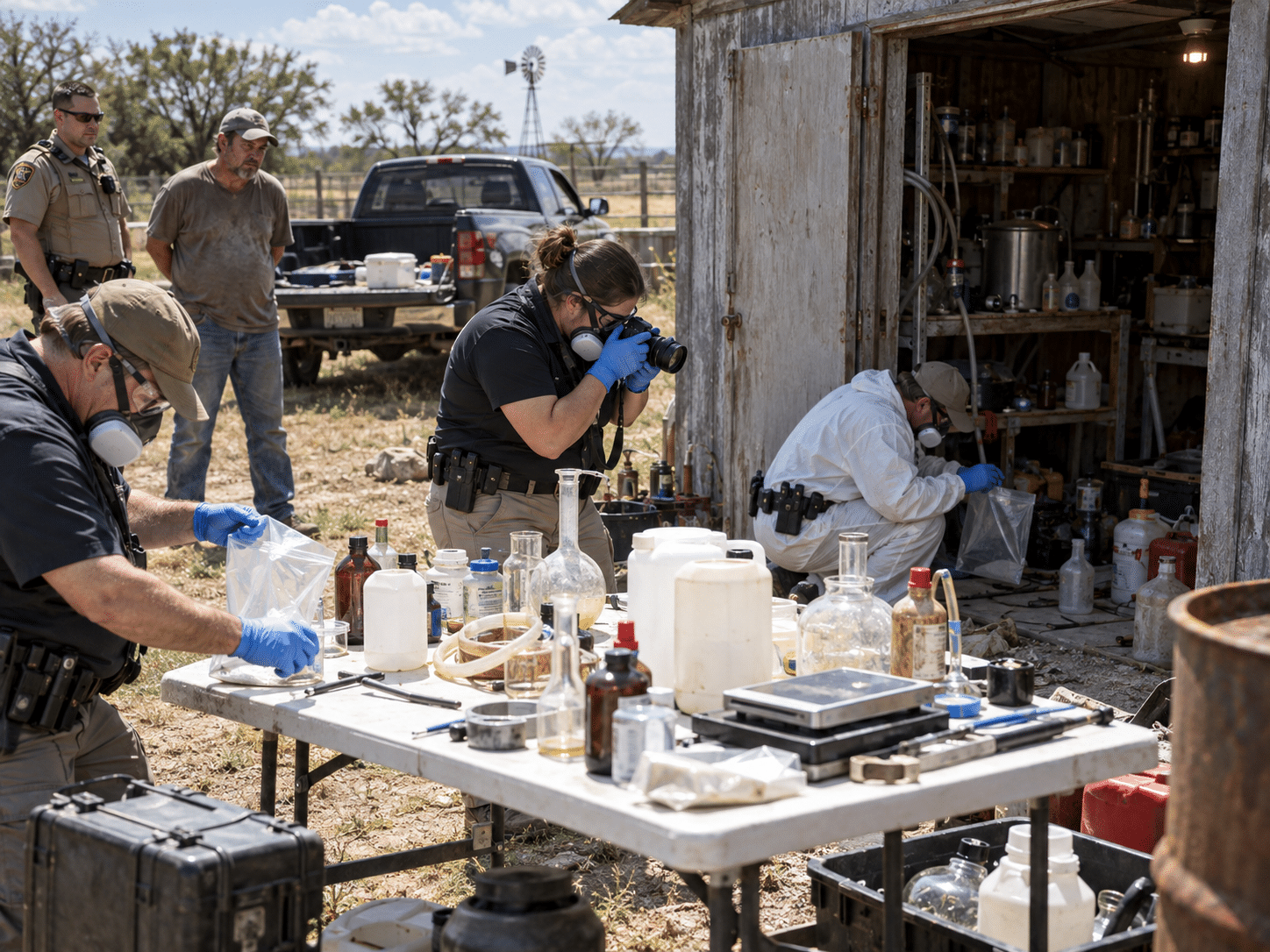
In Galveston, having certain chemicals linked to methamphetamine production can result in a felony charge, even if police do not find any finished methamphetamine. However, not everyone who has a chemical that could be used to make meth is committing a crime. Many of these chemicals have legal uses, and prosecutors must still prove the required intent under Texas law. The details of each case are important. We carefully review what was found, where it was located, how it was stored, who could access it, and whether there is real evidence of intent to illegally make methamphetamine.
Methamphetamine is classified as a Penalty Group 1 controlled substance under Texas Health and Safety Code § 481.102. This matters because having or transporting certain chemicals with the intent to make a Penalty Group 1 substance can be charged as a serious felony.
Texas Law Targets Possession Of Certain Chemicals With Intent To Manufacture Drugs
Texas Health and Safety Code § 481.124 makes it illegal for a person, with the intent to unlawfully manufacture a controlled substance, to possess or transport certain substances. The statute applies to anhydrous ammonia, an immediate precursor, or a chemical precursor or additional chemical substance identified under Texas law.
The phrase “with intent to unlawfully manufacture” is very important. The State usually cannot prove this crime just by showing someone had a common chemical that could be used to make drugs. Prosecutors must show that the person intended to use it to make a controlled substance.
This difference is often key to the defense. Someone might have chemicals for farming, car repairs, cleaning, manufacturing, construction, or other legal reasons. We look at whether the prosecution has real evidence of criminal intent or is just guessing based on situations that could have a harmless explanation.
Methamphetamine Is A Penalty Group 1 Controlled Substance
Texas Health and Safety Code § 481.102 specifically places methamphetamine, including its salts, optical isomers, and salts of optical isomers, in Penalty Group 1. The same provision also addresses certain combinations of chemicals associated with methamphetamine production, including phenylacetone and methylamine when possessed together with intent to manufacture methamphetamine.
Since methamphetamine is in Penalty Group 1, breaking § 481.124 with the intent to make meth can be charged as a second-degree felony. Texas law treats having or moving certain chemicals with the intent to make a Penalty Group 1 drug as a second-degree felony.
A second-degree felony is a serious charge. If convicted, a person could face a long prison sentence, large fines, and the long-term effects of having a felony record.
Texas Law Creates Certain Presumptions About Intent
Section 481.124 has rules that can make methamphetamine cases especially serious. Texas law allows intent to make meth to be assumed in certain situations, such as when specific substances, amounts, storage methods, or combinations are involved.
For example, the statute addresses possession or transport of anhydrous ammonia in a container that was not designed and manufactured to lawfully hold or transport it. It also addresses lithium metal removed from a battery and stored in certain liquids, as well as combinations involving phenylacetic acid or specified quantities of ephedrine or pseudoephedrine together with other substances commonly associated with methamphetamine production.
A legal presumption can strongly influence how prosecutors handle the case, but it does not mean every claim is automatically true. We check if the law’s exact conditions were met, if police identified the substances correctly, and if the accused knowingly had or controlled them.
Police May Rely On More Than The Chemicals Themselves
In many investigations, police do not rely solely on the presence of chemicals. They may also point to laboratory equipment, unusual containers, ventilation systems, digital scales, written instructions, messages, purchase records, surveillance, or statements made during questioning.
Prosecutors may argue that several otherwise lawful items become suspicious when found together. We evaluate that evidence individually and as a whole. The presence of household supplies or tools does not automatically prove that a person intended to manufacture methamphetamine.
Ownership is also important. If several people live in a home, use a garage, share a vehicle, or have access to a storage area, the State may have difficulty proving who actually possessed the chemicals or equipment. The fact that an item was found on property connected to a defendant does not always establish knowing possession.
Constructive Possession Can Become A Major Issue
Police do not need to find a chemical in someone’s hand or pocket to allege possession. Prosecutors may rely on constructive possession, meaning they claim the person exercised care, custody, control, or management over the item even though it was not physically on that person’s body.
These cases often arise when police search houses, garages, workshops, barns, vehicles, hotel rooms, or storage units. If several people had access to the area, we look for evidence connecting the accused specifically to the chemicals. That can include fingerprints, receipts, keys, personal belongings, statements, text messages, or evidence showing who controlled the location.
The weaker that connection is, the harder it may be for the State to prove that the accused knowingly possessed the substances at issue.
Search Warrants And Police Searches Must Be Reviewed
Many chemical-possession cases begin with a search warrant. Police may rely on surveillance, confidential informants, utility records, purchases, trash searches, or other investigative methods before asking a judge to authorize a search.
We examine the affidavit supporting the warrant and whether officers stayed within the lawful scope of the search. If evidence was obtained through an unconstitutional search or seizure, a defense attorney may seek to suppress that evidence.
The legality of the search can affect the entire prosecution. If critical chemicals, equipment, phones, or statements are excluded from evidence, the State’s theory of illegal manufacturing may become much harder to prove.
Actual Methamphetamine Production Can Lead To Separate Charges
If police claim methamphetamine was actually manufactured, prosecutors may pursue charges under Texas Health and Safety Code § 481.112. That statute prohibits knowingly manufacturing, delivering, or possessing with intent to deliver a substance listed in Penalty Group 1.
The potential punishment under § 481.112 depends heavily on the aggregate weight of the controlled substance, including adulterants or dilutants. Larger quantities can produce dramatically higher sentencing ranges.
A chemical-possession investigation can therefore grow into a much broader case. We determine whether the evidence actually supports a completed manufacturing allegation, an alleged attempt, or only possession of materials that prosecutors claim were intended for future use.
Statements To Police Can Become Important Evidence
People sometimes try to explain chemicals or equipment immediately after police arrive. That can create problems if the explanation is incomplete, inaccurate, or later taken out of context.
Investigators may ask who purchased the chemicals, what they were used for, who had access to the property, and whether the accused knows anyone involved with methamphetamine. Those answers may later be used to support the prosecution’s theory of intent.
We generally want to know exactly what was said, whether questioning occurred before or after an arrest, and whether any constitutional issues arose during the interrogation. Statements can become some of the most important evidence in a case involving alleged intent.
Frequently Asked Questions About Possessing Chemicals Used To Manufacture Methamphetamine In Texas
Can I Be Charged Even If Police Never Find Any Methamphetamine?
Yes. Texas Health and Safety Code § 481.124 does not require police to recover finished methamphetamine before prosecutors can pursue a charge. The statute focuses on possession or transport of certain chemicals combined with an intent to unlawfully manufacture a controlled substance.
That does not mean the State automatically has a strong case. Prosecutors still have to establish the required connection between the chemicals and an alleged unlawful manufacturing purpose. We examine whether there is evidence of planning, equipment, communications, prior purchases, or other circumstances that the State claims demonstrate intent.
If the chemicals have legitimate uses and there is little evidence connecting them to methamphetamine production, that can become an important defense issue.
Is Possessing Pseudoephedrine Automatically A Felony In Texas?
No. Pseudoephedrine is found in legitimate medications, so possession by itself does not automatically establish a drug-manufacturing offense. The State must prove the elements of the particular statute being charged.
However, Texas Health and Safety Code § 481.124 identifies certain quantities and combinations of pseudoephedrine or ephedrine with other substances that may support a statutory presumption of intent to manufacture methamphetamine.
The exact amount, packaging, location, and presence of other substances can therefore matter. We do not assume that the State’s characterization of the evidence is correct without reviewing what officers actually found.
What If The Chemicals Belonged To Someone Else?
Ownership and possession are not always the same issue. Prosecutors may claim constructive possession even when the defendant did not personally purchase or own the chemicals.
If chemicals were found in a shared residence, garage, vehicle, or storage unit, we look at who had access and control over that location. Evidence connecting the accused directly to the items may become especially important when several people could have possessed them.
A defendant should not be convicted simply because illegal materials were found somewhere nearby. The State must prove the required connection between the person and the alleged contraband.
What Is The Penalty For Possessing Chemicals With Intent To Manufacture Methamphetamine?
Because methamphetamine is classified in Penalty Group 1 under Texas Health and Safety Code § 481.102, possession or transport of qualifying chemicals with intent to manufacture methamphetamine can be charged as a second-degree felony under § 481.124.
A second-degree felony carries serious potential consequences under Texas law. The exact exposure in an individual case can also depend on other charges, prior convictions, alleged conduct, and whether prosecutors accuse the defendant of actually manufacturing or delivering a controlled substance.
We evaluate every charge separately because a chemical-possession allegation can sometimes appear alongside additional offenses involving drugs, weapons, children, or other alleged conduct.
Can Police Use My Purchase History Against Me?
Yes. Investigators may seek receipts, online purchase records, store surveillance, financial records, or other evidence showing that someone acquired chemicals or equipment associated with drug production.
The significance of those records depends on context. Purchasing a chemical with legitimate household, commercial, agricultural, or industrial uses does not automatically prove criminal intent.
We examine whether the State is relying on actual evidence of unlawful planning or simply treating lawful purchases as suspicious because of what police later found.
Can Text Messages Be Used To Prove Intent To Manufacture Methamphetamine?
Yes. Text messages, social media messages, email, and other electronic communications may be used by prosecutors to argue that a person planned or participated in drug manufacturing.
The meaning of a message can be disputed. Slang, incomplete conversations, messages sent by another person, and statements taken out of context can create misleading impressions.
We also examine how investigators obtained the device or account information and whether the search complied with constitutional requirements. Digital evidence can be powerful, but it must still be authenticated and connected to the accused.
Call Our Galveston Methamphetamine Manufacturing Defense Lawyers
An allegation involving chemicals used to manufacture methamphetamine can expose a person to a serious felony prosecution even when police do not recover finished drugs. Texas Health and Safety Code § 481.124 allows prosecutors to pursue charges based on possession or transportation of certain substances when they believe those materials were intended for unlawful drug manufacturing. Because methamphetamine is a Penalty Group 1 controlled substance, the potential consequences can be severe.
At Mark Diaz & Associates, we examine the entire investigation. We look at the alleged chemicals, laboratory testing, search warrants, statements, digital evidence, ownership of the property, access to the location, and the prosecution’s evidence of intent. We also look closely at whether the State is trying to turn lawful possession of ordinary materials into evidence of a criminal manufacturing operation.
When you hire Mark Diaz & Associates, you work directly with your attorney. Our clients have direct access, including personal cell phone contact, because questions, emergencies, and concerns do not always occur during ordinary office hours. You will not simply be handed off to a junior associate or lost in a system where your case becomes one file among many. From the investigation and arrest through the final resolution, we remain personally involved and accessible.
Mark Diaz & Associates represents clients in Galveston and throughout Houston, Texas. If you are under investigation or have been charged with possessing chemicals with intent to manufacture methamphetamine, contact our Galveston fentanyl drug crime lawyers by calling 409-515-6170 to schedule your free consultation.
