
Can Federal Agents Search Your Phone Without A Warrant?
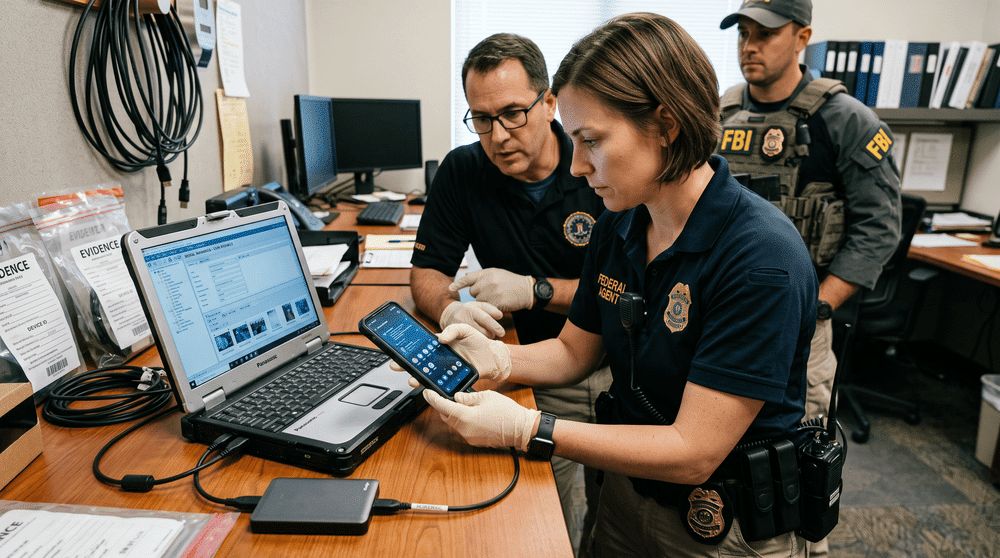
A cellphone can contain years of private information, including photographs, text messages, emails, location history, financial records, social media communications, and contacts. When federal agents seize a phone during an investigation or arrest, one of the first questions we examine is whether they had lawful authority to search its digital contents. In most ordinary criminal investigations, an arrest by itself does not give federal agents unrestricted authority to open a phone and examine what is stored inside.
The Fourth Amendment generally protects a cellphone’s digital contents from unreasonable government searches. Texas law also provides specific protections for cellphone searches conducted by peace officers. Whether evidence obtained from a phone can be used against you may depend on the warrant, how the device was obtained, whether you gave consent, and whether an exception to the warrant requirement applied.
The Fourth Amendment Generally Requires A Warrant To Search A Cellphone
The starting point is the Fourth Amendment to the United States Constitution. Federal investigators, including agents from the FBI, DEA, ATF, Homeland Security Investigations, and other federal agencies, ordinarily must comply with the Fourth Amendment when searching private digital information.
The United States Supreme Court addressed cellphone searches directly in Riley v. California, 573 U.S. 373 (2014). Police had searched digital information stored on a cellphone after arresting its owner. The Supreme Court held that the traditional rule allowing officers to search items found on an arrested person did not generally permit officers to search a cellphone’s digital contents without a warrant.
The Court recognized that modern phones are fundamentally different from ordinary objects carried in a pocket. They can contain enormous amounts of highly personal information covering almost every aspect of a person’s life. In practical terms, this means federal agents may be able to seize and secure a phone after an arrest while they seek legal authority to examine it, but seizing the device does not automatically authorize a search of its contents.
Texas Law Also Protects The Contents Of A Cellphone
Texas has a statute specifically addressing cellphone searches. Texas Code of Criminal Procedure Article 18.0215 states that a peace officer generally may not search a person’s cellphone or other wireless communications device merely because that person has been lawfully arrested. A warrant application must identify the device and establish probable cause to believe that criminal activity has occurred, is occurring, or will occur and that searching the device is likely to produce evidence relating to that activity.
This Texas statute is particularly important when state or local authorities are involved in an investigation. Federal agents operate primarily under federal constitutional and statutory rules, so the precise legal analysis can differ when a federal agency conducts the search. When federal and Texas authorities work together, however, we examine exactly who conducted the search, under what authority, how the evidence was obtained, and where the prosecution is taking place.
Federal Agents May Search A Phone If You Give Valid Consent
Consent is one of the most important exceptions to the warrant requirement. Texas Code of Criminal Procedure Article 18.0215(d)(1) expressly permits a warrantless cellphone search when the owner or possessor consents.
This is why conversations with investigators can have serious consequences. An agent may ask, “Do you mind if I take a look at your phone?” A person may agree without realizing that the search could expose months or years of messages, photographs, browser activity, app data, or other information.
Consent also creates factual questions that can later become important. We may examine whether consent was actually voluntary, what agents said before receiving permission, whether the person had authority to consent, and whether investigators exceeded the scope of the permission they were given.
Agreeing to hand an agent a phone does not necessarily mean consenting to every possible forensic examination of the device. The specific words and circumstances matter.
Emergency Circumstances Can Affect The Warrant Requirement
Courts recognize that genuine emergencies can sometimes justify immediate government action without waiting for a warrant. Texas law expressly addresses certain circumstances in Article 18.0215(d), including an immediate life-threatening situation and situations involving a cellphone possessed by a fugitive wanted on a felony arrest warrant. Texas law generally requires officers relying on those particular exceptions to seek a warrant as soon as practicable afterward.
The existence of an emergency does not automatically permit investigators to examine every piece of information stored on a device. The government may still have to show why immediate access was reasonably necessary under the particular circumstances.
We look closely at what investigators knew when they searched the phone, what emergency they claimed existed, what information they were trying to obtain, and how far the search extended.
A Cellphone Search Warrant Is Not Unlimited Authority
Obtaining a warrant does not necessarily end the Fourth Amendment inquiry. A search warrant must be supported by probable cause and must sufficiently describe what investigators are authorized to search for and seize.
Texas Code of Criminal Procedure Article 18.0215 requires the warrant application to identify the cellphone or wireless device and state facts establishing probable cause that criminal activity occurred or will occur and that searching the device is likely to produce evidence connected with that activity.
For example, a warrant issued during a narcotics investigation might authorize investigators to look for communications, photographs, transaction records, location information, or other evidence related to suspected drug activity. Defense counsel can examine whether the supporting affidavit established probable cause and whether investigators remained within the lawful scope of the warrant.
Digital searches can become especially significant because forensic software may allow investigators to recover deleted messages, photographs, application data, internet history, and other information that is not immediately visible when someone manually opens the phone.
Location Information Can Receive Separate Constitutional Protection
Sometimes investigators do not physically search the phone at all. Instead, they seek information associated with the device from a wireless provider or another company.
In Carpenter v. United States, 585 U.S. 296 (2018), the United States Supreme Court held that the government’s acquisition of historical cell-site location information can constitute a Fourth Amendment search. The Court recognized that extensive cellphone location records can reveal a detailed picture of a person’s movements over time.
The legal rules for stored phone contents, historical location records, cloud information, and records maintained by third parties are not always identical. We therefore identify exactly what information investigators obtained and the legal process they used to get it.
Border Searches Are Treated Differently In Texas
Galveston and Houston cases can sometimes involve international travel, immigration enforcement, ports, airports, or investigations connected with the border. Border searches are governed by rules that differ significantly from ordinary searches conducted after an arrest.
The Fifth Circuit, whose decisions govern federal cases in Texas, held in United States v. Castillo, 70 F.4th 894 (5th Cir. 2023), that a manual cellphone search at the international border may be conducted without individualized suspicion. The court noted that more intrusive forensic cellphone searches present additional constitutional issues and that federal appellate courts have differed over the exact standard applicable to those searches.
This distinction matters. A person should not assume that the ordinary rule from Riley applies in exactly the same manner at an international border or port of entry.
Illegally Obtained Phone Evidence May Be Challenged
When phone evidence becomes part of a Texas criminal prosecution, Texas Code of Criminal Procedure Article 38.23 can become significant. It provides that evidence obtained in violation of the United States Constitution, federal law, the Texas Constitution, or Texas law generally may not be admitted against an accused, subject to statutory exceptions, including the provision addressing objective good-faith reliance on a warrant issued by a neutral magistrate based on probable cause.
A defense attorney may file a motion to suppress and challenge how investigators obtained the phone, whether a valid warrant existed, whether probable cause supported that warrant, whether an exception applied, or whether investigators exceeded the permitted scope of the search.
Phone evidence can become central to federal drug investigations, conspiracy cases, firearms prosecutions, fraud investigations, trafficking allegations, and many other serious criminal cases. When that happens, the legality of the search deserves careful examination.
Frequently Asked Questions About Federal Agents Searching Cellphones
Can The FBI Search My Phone Just Because I Was Arrested?
Ordinarily, an arrest alone does not permit agents to search the digital contents of your phone. The Supreme Court’s decision in Riley v. California generally requires law enforcement officers to obtain a search warrant before examining digital information stored on a cellphone.
Agents may take possession of the phone and secure it while attempting to obtain a warrant. That is different from opening applications, reading messages, viewing photographs, or performing a forensic extraction of the device. If federal investigators searched your phone after an arrest, we would examine whether they obtained a warrant, received valid consent, or relied on another recognized exception.
Can I Refuse To Let Federal Agents Search My Phone?
If investigators are asking for your consent rather than acting under a valid warrant or another lawful authority, you generally do not have to voluntarily give them permission to search the device. You may clearly state that you do not consent to the search.
You should not physically interfere with an officer or agent who takes possession of a phone. Whether the government has lawful authority to search it can be challenged through the court system. Consent can eliminate an issue that might otherwise require investigators to obtain a warrant, so what was said during the encounter can become extremely important later.
What If Federal Agents Already Have A Search Warrant?
A warrant gives agents legal authority to conduct the search described in the warrant, but it does not automatically permit an unlimited investigation of everything connected with the device. We may review the warrant itself, the affidavit supporting it, the crimes investigators claimed they were investigating, the categories of evidence authorized for seizure, and how the actual search was performed.
A warrant can also be challenged when the affidavit did not establish probable cause or when other constitutional defects exist. Whether suppression is available depends heavily on the facts and applicable law.
Can Agents Recover Deleted Text Messages And Photos?
Potentially. Modern forensic tools can sometimes recover deleted information or locate data that is not visible during an ordinary manual inspection of a phone. Investigators may also obtain related information from cloud services, service providers, other devices, or people who participated in the communications.
The fact that investigators possess sophisticated forensic technology does not eliminate Fourth Amendment restrictions. We still examine whether they had lawful authority to obtain and examine the information.
Speak With A Galveston Criminal Defense Lawyer About A Cellphone Search
If federal agents have seized or searched your cellphone, the details of that search can directly affect your criminal case. At Mark Diaz & Associates, we can review how investigators obtained the device, whether a warrant existed, what the warrant authorized, whether consent was claimed, what information investigators extracted, and whether there is a legal basis to challenge the evidence.
When you hire me, you work directly with me. My clients have my personal cell phone number because questions, emergencies, and concerns do not always happen during business hours. You will not be handed off to a junior associate or lost in a system where your case is simply one of dozens on a crowded docket. From arrest through resolution, I remain personally involved and accessible.
Mark Diaz & Associates represents clients in Galveston and throughout Houston, Texas. If you are facing a state or federal criminal investigation involving cellphone evidence, contact our Galveston federal criminal attorney at Mark Diaz & Associates by calling 409-515-6170 to schedule your free consultation.
