
Can You Be Charged With Drug Trafficking If Drugs Were Found In Someone Else’s Vehicle?
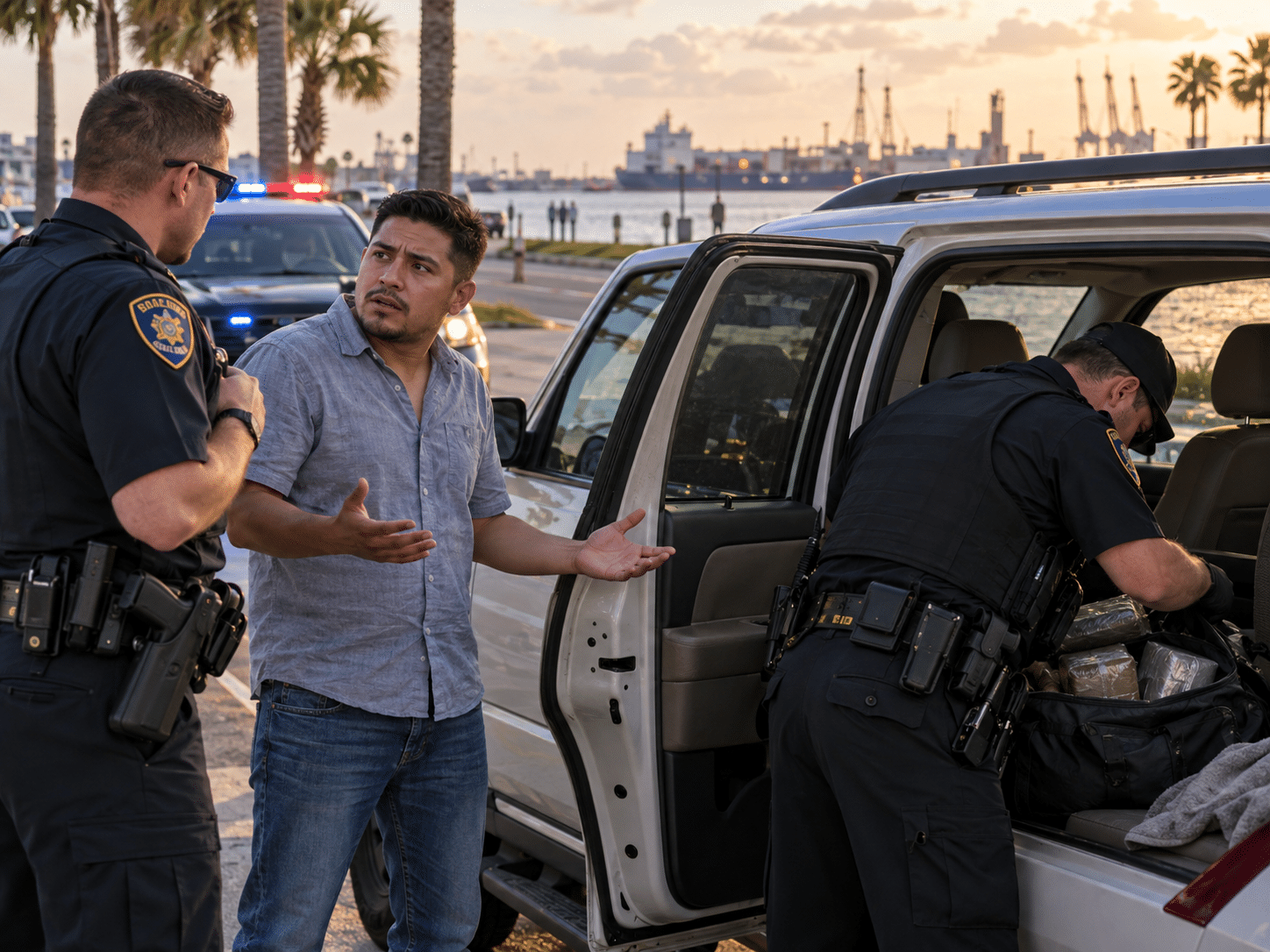
A routine traffic stop can quickly turn into a drug investigation, even if you do not own the car. Police might find drugs like cocaine, methamphetamine, fentanyl, or other controlled substances in places such as the trunk, console, backpack, hidden compartment, or under a seat, and then question everyone in the vehicle. Sometimes, a passenger or someone temporarily driving the car can be arrested, even if the car belongs to someone else.
In Galveston, prosecutors do not need to find drugs in your pocket to accuse you of possessing them or possessing them with intent to deliver. However, just being in a car where drugs are found does not automatically mean you are criminally responsible. When we handle these cases, we look closely at whether the State can actually link our client to the drugs and prove they knowingly possessed them beyond a reasonable doubt.
Texas Drug Trafficking Charges Often Involve Possession With Intent To Deliver
Texas law does not have a single statute called “drug trafficking” that covers every trafficking case. Often, prosecutors charge people with manufacturing or delivering a controlled substance, or with possession with intent to deliver.
Texas Health and Safety Code § 481.112 applies to the manufacture, delivery, or possession with intent to deliver certain Penalty Group 1 controlled substances. The offense requires proof that the accused knowingly manufactured, delivered, or possessed the controlled substance with intent to deliver it. The seriousness of the charge depends heavily on the type and aggregate weight of the substance, including adulterants and dilutants. Texas law also contains separate provisions for other penalty groups and for Penalty Group 1-B substances.
If police find a large amount of drugs in a car, they may suspect the drugs were meant for distribution, not just personal use. Still, the State must prove that a specific person knowingly possessed the drugs and intended to deliver them.
Being In The Vehicle Is Not The Same As Possessing The Drugs
In Texas, possession means having actual care, custody, control, or management of something. If drugs are found on someone’s body, it is usually easier for prosecutors to prove possession. Cases involving vehicles are more complicated because several people might have access to the car.
Texas courts have made it clear that just being near drugs is not enough to prove possession. If someone does not have exclusive control over the place where the drugs were found, prosecutors usually need more facts that directly connect that person to the drugs. This rule helps protect innocent passengers or bystanders from being convicted just because someone else’s drugs were nearby.
This issue is especially important if the accused did not own or rent the vehicle and had no control over where the drugs were hidden.
Prosecutors May Rely On Affirmative Links
No single fact automatically proves constructive possession. Courts look at all the circumstances and how strongly the evidence connects the accused to the drugs.
Relevant evidence may include whether the drugs were in plain view, how close the accused was to the drugs, whether the drugs were easily accessible, whether the accused made incriminating statements, whether officers observed an attempt to hide something, whether drug paraphernalia was present, and whether the accused had a right to possess or control the vehicle. Texas courts have also considered flight, unusual gestures, the odor of drugs, possession of other contraband, and whether the drugs were located in an enclosed area associated with the accused.
The What matters most is how strong the links are, not how many there are. A prosecutor cannot just list many weak facts and claim it proves knowing possession. Courts look at whether all the evidence together reasonably shows the accused knew about the drugs and had control over them.
Passengers Can Be Charged Even When They Do Not Own The Vehicle
A passenger can be arrested and charged if drugs are found in someone else’s car. Whether or not they own the vehicle is just one factor considered.
For example, police may argue that a passenger knowingly possessed drugs when the contraband was found underneath that passenger’s seat, inside a bag linked to that passenger, or next to personal belongings. Statements, text messages, fingerprints, phone records, or other evidence may strengthen the government’s claim.
However, if drugs are hidden in a locked trunk, secret compartment, or someone else’s bag, the situation can be very different. If our client does not own the vehicle and there is no evidence linking them to the hidden drugs, we would strongly challenge whether the prosecution can prove knowing possession.
A Driver Can Also Be Accused Even If The Car Belongs To Someone Else
Driving another person’s car does not automatically make the driver legally responsible for everything inside it. Prosecutors may nevertheless argue that a driver exercised control over the vehicle and therefore knew about contraband hidden inside.
Texas appellate decisions show why the details matter. Courts have looked at whether a driver had access to the area containing the drugs, knew what else was stored there, had recently driven the vehicle, possessed large amounts of cash, or was connected to other evidence associated with drug activity. Those circumstances may be used to establish the required link between the accused and the contraband.
We examine who owned the vehicle, who regularly drove it, how long our client had been inside it, who packed the vehicle, and whether other people had access to the areas where police found the drugs.
Drug Quantity Can Turn A Possession Case Into A Much More Serious Case
Drug quantity can dramatically affect how prosecutors approach the case. A small amount may result in a simple possession allegation, while a larger amount may prompt an accusation that the drugs were intended for distribution.
Texas Health and Safety Code § 481.112 establishes escalating penalties for manufacture, delivery, and possession with intent to deliver Penalty Group 1 substances. Texas also has separate provisions for substances classified under other penalty groups. The type of drug and its aggregate weight can determine whether the accusation is a state jail felony, second-degree felony, first-degree felony, or an offense carrying even greater sentencing exposure under the statute.
We also examine how law enforcement calculated the weight. Laboratory testing, packaging, adulterants or dilutants, and chain-of-custody issues may become significant when the alleged amount places the case near a statutory threshold.
Evidence Of Intent To Deliver Can Go Beyond The Drugs Themselves
Possession of drugs does not automatically prove intent to deliver them. Prosecutors may try to establish intent through surrounding evidence.
They may point to individually packaged drugs, scales, ledgers, large amounts of cash, multiple phones, messages discussing transactions, or evidence of repeated travel. Phone records and text messages may become particularly important when police claim multiple occupants were working together.
We examine whether these items actually belonged to our client and whether they genuinely establish an intent to distribute. In a vehicle occupied by several people, ownership and access to each piece of evidence can become critical.
Statements During A Traffic Stop Can Affect The Case
Statements made on the side of the road can become some of the most important evidence in a drug prosecution. Officers may separate occupants and ask each person who owns the vehicle, who packed certain bags, where everyone is traveling, and whether anyone knows about the drugs.
People sometimes answer quickly because they believe cooperation will prevent an arrest. Nervousness or confusion can produce statements that officers later characterize as inconsistent.
When we review the case, we examine body-camera footage, dash-camera recordings, written reports, and any recorded interviews. We want to know exactly what our client said, what the other occupants said, and whether the officers’ later description accurately reflects the encounter.
Federal Drug Charges May Also Be Possible
Some vehicle drug cases can move beyond Texas state court. Federal authorities may become involved when investigators allege interstate transportation, large-scale distribution, organized trafficking, or activity involving a broader drug conspiracy.
Federal prosecutors frequently use 21 U.S.C. § 841 for possession with intent to distribute controlled substances and 21 U.S.C. § 846 for drug conspiracies. A person does not necessarily have to personally own or physically handle the drugs to be accused of participating in a federal conspiracy.
That possibility makes it particularly important to understand whether investigators view the traffic stop as an isolated event or part of a larger investigation.
Frequently Asked Questions About Drugs Found In Someone Else’s Vehicle
Can I Be Arrested If Drugs Are Found In A Car That Does Not Belong To Me?
Yes. Police may arrest more than one occupant when they believe the evidence connects several people to the drugs. An arrest, however, is not the same as proof beyond a reasonable doubt.
When the accused does not exclusively control the vehicle, Texas courts require evidence connecting that person to the contraband rather than relying solely on proximity. We examine where the drugs were found, who controlled that area of the vehicle, whether our client had access to the drugs, and whether any additional evidence supports the State’s theory.
A passenger who had no knowledge that drugs were hidden inside another person’s car may have a very different defense from a person who possessed a bag containing the drugs.
What If The Driver Says The Drugs Belong To Me?
Another person’s accusation can become evidence, but it does not automatically prove guilt. We would examine why that person made the statement, whether the person was trying to avoid prosecution, whether the account changed over time, and whether physical evidence supports the accusation.
Police and prosecutors may compare the statement with text messages, fingerprints, DNA, surveillance, phone records, travel information, and the location of the drugs. If the accusation stands alone and conflicts with other evidence, credibility may become a significant issue.
People facing their own criminal exposure sometimes have strong reasons to shift blame. That is why we do not evaluate a drug case solely from the accusation of another occupant.
What If The Drugs Were Hidden In The Trunk?
Drugs hidden in a trunk can still result in criminal charges, but the location may be important to the defense. Prosecutors would need evidence showing that the accused knew the drugs were there and exercised control over them.
For a passenger with no ownership interest in the vehicle, no key to the trunk, and no connection to the container holding the drugs, the prosecution may face substantial questions about knowing possession. A driver or owner may present different circumstances, but vehicle control alone does not necessarily establish knowledge of every concealed item.
We examine whether the trunk was accessible, who loaded it, whose belongings were stored there, and whether anyone made statements identifying ownership of the drugs.
Can Everyone In The Vehicle Be Charged With The Same Drugs?
Potentially, yes. Texas law allows more than one person to possess the same contraband if the evidence establishes joint possession. The prosecution still must prove the required connection between each individual defendant and the drugs.
Texas courts have made clear that merely being present where drugs are found is not enough. Additional evidence must support a reasonable inference that each accused person knew about the contraband and exercised control over it.
That means the evidence against one occupant may be substantially stronger or weaker than the evidence against another.
Can A Large Amount Of Drugs Automatically Prove Trafficking?
No. A large quantity can be important evidence, but quantity by itself does not answer every question. Prosecutors still must establish knowing possession and the elements of the particular manufacture, delivery, or possession-with-intent offense charged.
They may argue that the quantity is inconsistent with personal use and combine that fact with packaging, cash, communications, scales, or other evidence. We examine whether those additional items are actually tied to our client.
The distinction matters because possession with intent to deliver can carry much more serious penalties than simple possession under Texas law.
What If I Did Not Know Drugs Were In The Vehicle?
Lack of knowledge can be central to the defense. Texas possession law requires more than accidental proximity to contraband.
When several people use a car or when the vehicle belongs to someone else, we investigate whether our client had any realistic reason to know drugs were present. Hidden compartments, another person’s luggage, recently borrowed vehicles, rental vehicles, and cars shared among several people can all create factual questions about knowledge and control.
Texas courts use the affirmative-links analysis precisely because a person can be close to someone else’s drugs without knowingly possessing them.
Speak With A Galveston Criminal Defense Lawyer About A Drug Trafficking Charge
If you were arrested after police found drugs in someone else’s vehicle, the case should not be reduced to the simple fact that you happened to be inside the car. The State must prove the elements of the offense against you personally. At Mark Diaz & Associates, we examine who owned the vehicle, where the drugs were located, who had access to them, what each occupant said, what officers captured on body cameras, and whether the evidence truly establishes knowing possession or intent to deliver.
We also look closely at the traffic stop and search itself. A drug case can change substantially when evidence was obtained through an unlawful detention, unsupported search, questionable consent, or other constitutional violation. Every stage of the encounter deserves careful review when your freedom and record are at stake.
When you hire Mark Diaz & Associates, you work directly with your attorney. Our clients have personal access because questions, emergencies, and concerns do not always happen during business hours. You will not simply be handed off to a junior associate or lost in a system where your case becomes another file on a crowded docket. From arrest through resolution, we remain personally involved, accessible, and focused on protecting your rights.
Mark Diaz & Associates represents clients facing drug trafficking, possession with intent to deliver, controlled substance, conspiracy, and other criminal charges in Galveston and throughout Houston, Texas. Call our Galveston federal drug crime lawyers by calling 409-515-6170 to schedule your free consultation.
