
Drug Dealing Near A School Criminal Charge In Galveston
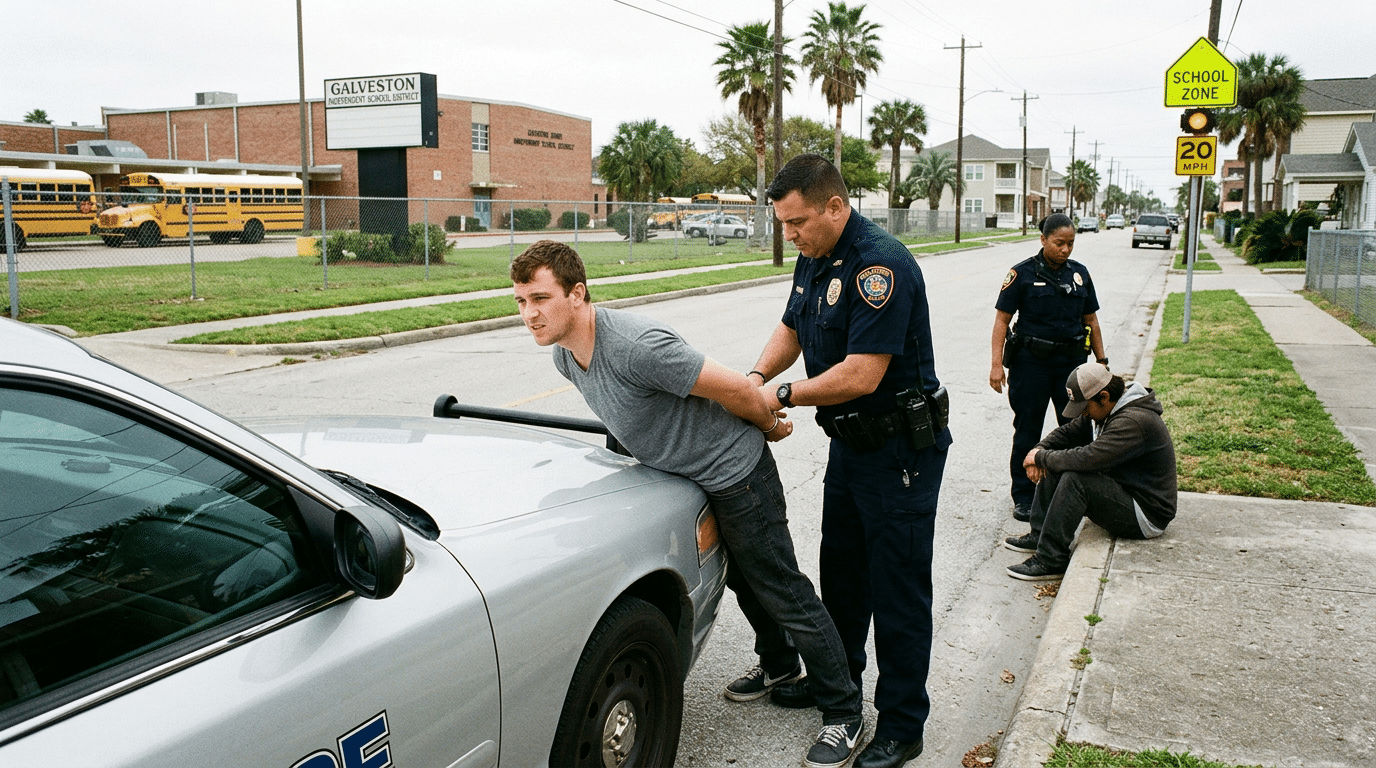
Prosecutors respond especially strongly to accusations of drug activity near schools. Texas has set tougher penalties for drug offenses in drug-free zones, which can greatly increase the consequences. Many people are surprised to find out they can face more serious charges even if no children were present or if the alleged activity happened outside school hours. A drug-free zone allegation can turn a serious case into one with much longer prison time, higher fines, and more restrictions. If you have been arrested or investigated for drug dealing near a school in Galveston County, it is important to know what the law says, what the prosecution must prove, and what defenses you may have.
Understanding Texas Drug-Free Zone Laws
Texas has special laws that increase penalties for certain drug crimes committed in places where children are likely to be. The main law for these enhancements is Texas Health and Safety Code § 481.134.
In Texas, a drug-free zone usually means any area within 1,000 feet of schools, playgrounds, youth centers, public pools, and video arcades. Some enhancements also apply within 300 feet of other specific places. The distance is measured from the property line, not the building itself.
One key fact is that prosecutors do not have to prove children were present when the alleged offense happened. They also do not need to show that the accused meant to sell drugs to children. If the offense took place within the prohibited distance and fits the law, enhanced punishment can apply.
Because of this, people can face drug-free zone charges even if the alleged conduct happened late at night, during school breaks, or in places where no students were around.
What Constitutes Drug Dealing Under Texas Law?
Drug dealing charges can arise from many different circumstances. In some cases, police claim they observed an actual drug transaction. In other situations, officers may allege that the quantity of drugs, packaging materials, scales, cash, text messages, or other evidence indicates an intent to distribute controlled substances.
Texas Health and Safety Code § 481.112 addresses the manufacture or delivery of controlled substances. The term “delivery” includes actual transfers, constructive transfers, and offers to sell certain controlled substances.
Prosecutors often use indirect evidence to argue someone planned to sell drugs instead of just having them for personal use. This difference matters because delivery charges usually have much tougher penalties than possession.
If prosecutors add a drug-free zone enhancement, the risks go up even more. A case that already has serious prison time can become much worse just because of where the alleged offense happened.
How Drug-Free Zone Enhancements Increase Criminal Penalties
Texas Health and Safety Code § 481.134 provides enhanced punishment ranges for many drug offenses committed within drug-free zones.
The effect of the enhancement depends on the underlying offense. In many situations, the enhancement increases the level of the offense by one degree. A third-degree felony may become punishable as a second-degree felony. A second-degree felony may be punished as a first-degree felony. The resulting increase can add years or even decades to a potential prison sentence.
The law may also impose mandatory minimum periods of incarceration before a defendant becomes eligible for parole. This can significantly affect plea negotiations and sentencing outcomes.
Since these enhancements can greatly increase punishment, prosecutors often spend a lot of effort proving the alleged offense happened within the required distance of a school or other protected place.
How Prosecutors Attempt To Prove The Drug-Free Zone Allegation
The State bears the burden of proving the drug-free zone enhancement beyond a reasonable doubt. Although prosecutors often present maps, measurements, and testimony from law enforcement officers, these allegations are not automatically established simply because they appear in a charging document.
In many cases, prosecutors rely upon geographic information systems, city maps, aerial photographs, survey data, or testimony regarding measurements taken by investigators. The accuracy of those measurements can become a critical issue.
We frequently examine whether the State properly identified the protected location, whether the measurements were accurate, whether the alleged offense location was correctly determined, and whether the evidence satisfies statutory requirements.
A mistake involving distances, property boundaries, or mapping technology can create significant issues for the prosecution. These cases often require a careful review of technical evidence rather than simply accepting the government’s conclusions.
School Zone Cases Often Involve Search And Seizure Issues
Many drug-dealing investigations begin with traffic stops, vehicle searches, search warrants, confidential informants, or undercover operations. The legality of those investigative methods can have a major impact on the outcome of the case.
The Fourth Amendment to the United States Constitution and Article I, Section 9 of the Texas Constitution protect individuals from unreasonable searches and seizures. Evidence obtained through unlawful police conduct may be subject to suppression.
For example, a defense challenge may focus on whether officers had legal justification for a traffic stop, whether a search warrant was properly supported by probable cause, whether police exceeded the scope of a search, or whether statements were obtained in violation of constitutional protections.
If key evidence is excluded, the prosecution’s case can weaken substantially. In some situations, suppression issues can result in reduced charges or dismissal.
The Serious Consequences Of A Conviction
A conviction for drug dealing near a school can have consequences extending far beyond incarceration.
Many individuals face lengthy prison sentences, substantial fines, probation restrictions, professional licensing issues, employment difficulties, housing challenges, and damage to their personal reputation. A felony drug conviction can affect educational opportunities, professional certifications, and future career prospects for years after a sentence has been completed.
Individuals who are not United States citizens may also face serious immigration consequences. Certain felony drug convictions can lead to removal proceedings, inadmissibility issues, and other immigration-related penalties.
Because the collateral consequences can be so severe, it is important to evaluate every aspect of the prosecution’s evidence and every available defense strategy.
Common Defense Strategies In Drug-Free Zone Cases
Every criminal case presents unique facts, and no single defense applies to every situation. However, several issues frequently arise in drug-free zone prosecutions.
One common defense involves challenging whether the defendant actually possessed the alleged controlled substance. Prosecutors must establish a legally sufficient connection between the accused and the drugs.
Another defense may involve contesting the allegation that the accused intended to deliver or distribute the substance. Possession alone does not automatically establish an intent to sell drugs.
In some cases, the focus turns to the accuracy of the drug-free zone allegation itself. If the State cannot prove that the offense occurred within the required distance of a protected area, the enhancement may not apply.
Constitutional challenges involving searches, seizures, interrogations, and warrants also frequently play a significant role. A successful suppression motion can dramatically change the direction of a criminal case.
Why Early Legal Representation Matters
Drug-free zone cases often move quickly. Evidence may need to be preserved, witnesses may need to be interviewed, and investigative materials may require immediate review.
The earlier a defense attorney becomes involved, the greater the opportunity to identify weaknesses in the prosecution’s evidence. Early intervention may also help prevent damaging statements, preserve favorable evidence, and position the case for the strongest possible defense.
Prosecutors frequently treat drug dealing near a school allegations as high-priority cases. Having experienced legal representation from the outset can make a significant difference in how the case develops.
Protecting Your Future Against Serious Drug Allegations
A charge involving alleged drug dealing near a school should never be viewed as a routine criminal matter. Texas prosecutors aggressively pursue these cases because of the enhanced penalties available under the drug-free zone statutes. The consequences can include years of incarceration, substantial fines, and long-term effects on virtually every aspect of a person’s life.
When we defend these cases, we carefully examine the evidence, challenge unsupported assumptions, investigate constitutional issues, and hold the prosecution to its burden of proof. Every allegation must be scrutinized, and every available defense should be explored. A criminal charge is not a conviction, and the government must prove every element of its case beyond a reasonable doubt.
Frequently Asked Questions About Drug Dealing Near A School Charges In Texas
Can I Be Charged Even If No Children Were Present?
Yes. Texas Health and Safety Code § 481.134 does not require prosecutors to prove that children were present during the alleged offense. The enhancement generally focuses on the location of the offense rather than the presence of minors. As a result, an allegation may arise even if the incident occurred at night, on a weekend, or when school was not in session.
Does The Prosecutor Have To Prove I Knew I Was Near A School?
Not necessarily. In many drug-free zone prosecutions, the State is not required to prove that the defendant knew the protected location was nearby. The primary issue is often whether the offense occurred within the statutorily defined distance from the protected property.
How Is The Distance Measured In A Drug-Free Zone Case?
The distance is generally measured from the property line of the protected facility rather than from the building itself. Prosecutors often rely on maps, surveys, aerial photographs, or testimony from investigators. The accuracy of those measurements can become an important issue in the defense of the case.
Can A Drug-Free Zone Enhancement Be Challenged?
Yes. The enhancement can be challenged if the evidence regarding location, measurements, mapping methods, or property boundaries is unreliable or insufficient. Every aspect of the State’s proof should be carefully reviewed before accepting the allegation as accurate.
What If The Drugs Were Not Mine?
The prosecution must prove that you knowingly possessed the controlled substance. If the drugs were found in a vehicle, residence, or location shared by multiple people, the State may face challenges in proving that you exercised care, custody, control, or management over the substance.
Can Police Use Text Messages As Evidence Of Drug Dealing?
Yes. Prosecutors frequently use text messages, social media communications, call records, and electronic data to argue that a defendant intended to sell or deliver controlled substances. However, the interpretation of those communications can often be disputed, and context may be critical.
Is Drug Dealing Near A School Always A Felony?
Most delivery-related offenses associated with drug-free zone allegations involve felony charges. The specific level of offense depends upon the type and quantity of the controlled substance, along with any applicable enhancements under Texas law.
Should I Speak To The Police If I Am Under Investigation?
In most situations, it is wise to consult an attorney before answering questions from law enforcement. Statements made during an investigation can later be used as evidence in court. Exercising your constitutional rights and obtaining legal advice before speaking with investigators is often an important step in protecting yourself.
Contact Mark Diaz & Associates For Help With Drug Dealing Near A School Charges
Drug dealing near a school allegations can expose you to some of the harshest penalties available under Texas drug laws. Prosecutors often pursue these cases aggressively, and the consequences of a conviction can affect your freedom, career, reputation, and future opportunities.
At Mark Diaz & Associates, we carefully investigate every aspect of the prosecution’s case, challenge unlawful searches and seizures, examine the accuracy of drug-free zone allegations, and work to protect our clients’ rights at every stage of the proceedings.
When you hire me, you work directly with me. My clients have my personal cell phone number because questions, emergencies, and concerns don’t always happen during business hours. You won’t be handed off to a junior associate or lost in a system where your case is one of dozens on a crowded docket. From arrest through resolution, I remain personally involved and accessible.
If you have been arrested or are under investigation for drug dealing near a school in Galveston or anywhere in Houston, contact our Galveston drug crime lawyer at Mark Diaz & Associates today by calling 409-515-6170. We represent clients in Galveston and throughout all of the city of Houston, Texas, and we are prepared to fight for your rights and your future.
