
Drug Manufacturing Charges After Police Find A Lab In Your Home
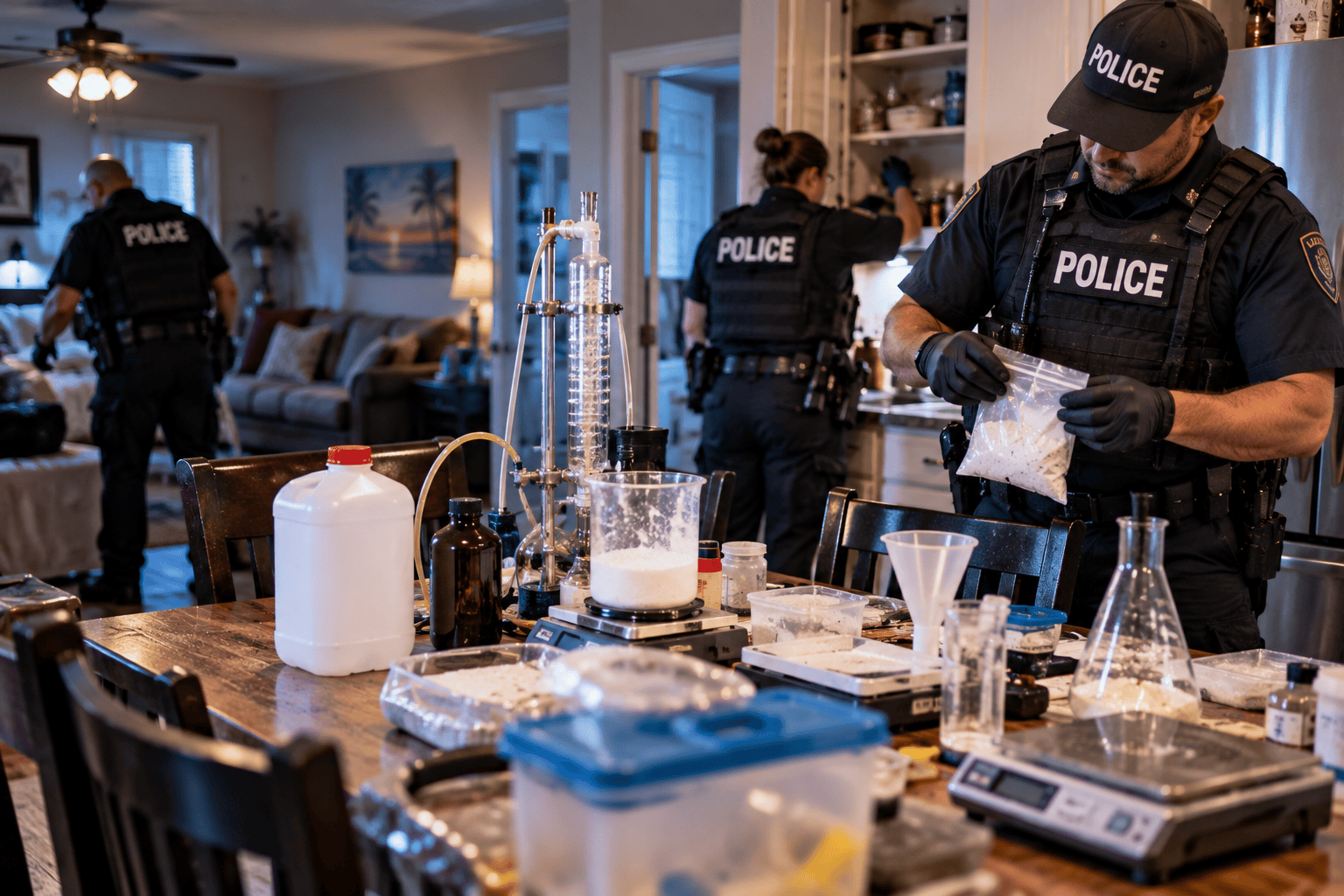
Police finding what they believe is a drug lab inside your home can lead to some of the most serious controlled substance charges available under Texas law. Investigators may seize chemicals, glassware, scales, packaging, medications, electronic devices, and other items they believe show that controlled substances were being produced. They may also question everyone who lives at the property and try to connect each person to the suspected operation. But finding laboratory equipment or chemicals inside a residence does not automatically prove that every person in the home committed drug manufacturing.
When we defend these cases in Galveston, we focus on what the State can actually prove about the alleged substance, the manufacturing activity, the accused person’s knowledge and intent, and whether the search that uncovered the evidence was lawful.
What Texas Law Considers Drug Manufacturing
Texas Health and Safety Code § 481.002 defines “manufacture” broadly. The term generally covers the production, preparation, propagation, compounding, conversion, or processing of a controlled substance, whether done directly or indirectly. Texas law can therefore reach conduct that occurs before a finished illegal drug is produced.
That definition matters because prosecutors do not always need to claim that police found completed drugs ready for sale. They may argue that the chemicals, equipment, partially processed substances, recipes, or other evidence show that someone was engaged in manufacturing.
We look carefully at what police actually found and whether those items have legitimate uses. The presence of common household chemicals, laboratory glassware, containers, or tools does not necessarily establish a criminal operation. Context, location, quantity, fingerprints, DNA, communications, and other evidence can become important when prosecutors try to connect ordinary objects to alleged drug production.
Texas Drug Manufacturing Charges Can Be Filed Under Section 481.112
Texas Health and Safety Code § 481.112 makes it an offense to knowingly manufacture, deliver, or possess with intent to deliver certain controlled substances in Penalty Group 1 or Penalty Group 1-B. The punishment level depends heavily on the substance involved and its aggregate weight, including adulterants or dilutants.
This can make manufacturing allegations especially serious. A case involving a relatively low weight may still result in a felony charge, while larger quantities can expose a defendant to dramatically higher punishment ranges.
The State still has to prove the required mental state. Prosecutors cannot simply point to a residence and assume that everyone who lives there knowingly participated in manufacturing. We examine who controlled the area where the alleged lab was found, who had access to it, whose fingerprints or DNA were present, and whether there are messages, purchases, surveillance, admissions, or other evidence tying our client to the alleged activity.
Possessing Certain Chemicals Can Create A Separate Charge
Texas law also criminalizes certain conduct involving chemicals used to manufacture controlled substances. Under Texas Health and Safety Code § 481.124, a person commits an offense if, with the intent to unlawfully manufacture a controlled substance, the person possesses or transports anhydrous ammonia, an immediate precursor, or certain designated chemical precursors.
The statute contains specific provisions that may allow prosecutors to argue that intent to manufacture methamphetamine can be presumed from particular combinations of chemicals or substances found in a container, vehicle, or building. Those statutory presumptions can make the details of the search extremely important.
We do not treat the presence of a chemical as proof of criminal intent. Many substances have lawful commercial, agricultural, medical, or household uses. The defense may depend on why the substance was present, how it was stored, what other materials were nearby, and whether the State can prove an actual intent to manufacture an illegal drug.
Living In The House Does Not Automatically Make You Guilty
One of the most important issues in a home-based manufacturing case is control over the place where the suspected lab was found. A residence may be occupied by spouses, relatives, roommates, tenants, guests, or other people who have different levels of access to different rooms.
Police may arrest more than one person initially, but the State ultimately has to prove each defendant’s criminal responsibility. We look at whether the suspected lab was in a private bedroom, locked garage, shed, basement, closet, or common area. We also examine who owned or rented the property, whose belongings were near the evidence, and whether anyone else admitted responsibility.
A person’s name on a lease, deed, or utility bill can be evidence of a connection to the property, but it does not automatically establish knowing participation in drug manufacturing.
Police Often Use Digital Evidence To Build Manufacturing Cases
Drug manufacturing investigations increasingly depend on electronic evidence. Police may seek search warrants for phones, computers, cloud accounts, online shopping histories, text messages, social media communications, and location information.
Investigators may look for purchases of precursor chemicals, laboratory equipment, pill presses, containers, solvents, scales, or other items they believe are associated with drug production. They may also search communications for discussions about recipes, quantities, buyers, suppliers, or production schedules.
Digital evidence must still be interpreted in context. A purchase receipt does not necessarily prove criminal intent, and a message can be misunderstood when viewed without the surrounding conversation. We examine how the evidence was obtained, who actually controlled the device or account, and whether the government’s interpretation is supported by the complete record.
Search Warrants Can Become A Major Defense Issue
Many manufacturing cases begin with a search warrant. Police may rely on confidential informants, surveillance, controlled purchases, unusual chemical purchases, utility records, odors, trash searches, or other information to establish probable cause.
We review the affidavit used to obtain the warrant and compare it with what officers actually did during the search. Important issues can include whether the warrant accurately described the place to be searched, whether officers exceeded its scope, whether information in the affidavit was stale or unreliable, and whether the government properly established probable cause.
If evidence was obtained in violation of constitutional protections, a defense attorney may seek to suppress that evidence. When the alleged laboratory and the substances seized from the home form the core of the prosecution’s case, suppression issues can have a significant effect on how the case proceeds.
The Weight Of The Controlled Substance Can Determine The Potential Penalty
Texas manufacturing penalties are heavily driven by the type and aggregate weight of the controlled substance. Section 481.112 establishes escalating felony levels based on the amount involved for covered Penalty Group 1 substances.
Texas felony punishment ranges can include lengthy terms of imprisonment. For example, a second-degree felony generally carries two to 20 years in prison, while a third-degree felony generally carries two to 10 years. A state jail felony generally carries 180 days to two years in a state jail facility. Texas law also permits substantial fines in felony cases.
Higher-level drug offenses can carry punishment ranges beyond these ordinary felony classifications. Because weight can determine the charge, we examine laboratory reports, testing procedures, mixture calculations, and whether substances that should not have been included were counted toward the alleged aggregate weight.
Police May Also Claim There Was An Intent To Deliver
When officers find significant quantities of drugs, packaging materials, scales, cash, customer communications, or records of transactions, prosecutors may allege that the drugs were not merely being manufactured but were also intended for distribution.
Texas Health and Safety Code § 481.112 expressly covers manufacture, delivery, and possession with intent to deliver certain controlled substances.
An allegation of intent to deliver should not be accepted simply because police found plastic bags, scales, or cash. Those items can have innocent explanations. We look at the complete evidence and whether prosecutors can actually connect those items to a drug distribution operation.
A Drug Lab Allegation Requires A Close Examination Of The Evidence
A suspected laboratory can make a case appear overwhelming at first. Photographs of chemicals, equipment, protective gear, containers, or unfinished substances can create a powerful impression before anyone determines who actually controlled those items or what they were being used for.
We focus on the evidence needed to prove each legal element. That means examining possession, knowledge, intent, chemical testing, laboratory procedures, witness credibility, search warrants, digital evidence, and the physical location of everything police seized.
A serious accusation deserves a defense based on evidence rather than assumptions about what police believe they found.
Frequently Asked Questions About Drug Manufacturing Charges
Can I Be Charged With Drug Manufacturing If Police Never Found Finished Drugs?
Yes, depending on the evidence. Texas law defines manufacturing broadly and does not always require police to discover a finished controlled substance ready for distribution. Prosecutors may rely on chemicals, precursor substances, equipment, partially processed material, instructions, and other evidence to claim that manufacturing was occurring. Texas Health and Safety Code § 481.002 provides the statutory definition of manufacturing, while § 481.112 covers manufacturing certain controlled substances.
The government still must prove the required elements of the offense. We examine whether the materials were actually capable of being used to produce the alleged drug and whether there is evidence connecting our client to the manufacturing process. A collection of chemicals or household items does not automatically establish illegal manufacturing.
Can Everyone Living In The House Be Charged?
Police may initially detain or arrest several people, but simply living in the same house does not automatically make every resident guilty of manufacturing drugs. Prosecutors must establish each defendant’s connection to the illegal activity and prove the required knowledge and intent.
We look closely at where the lab was found and who had access to that location. A locked room controlled by one person presents a different factual situation than equipment sitting openly in a common kitchen or garage. Personal belongings, fingerprints, DNA, messages, admissions, surveillance, and other evidence may all become important in determining whether the State can connect a particular resident to the alleged operation.
What If The Lab Belonged To My Roommate?
A roommate’s ownership or control of the suspected laboratory can be highly relevant. If another person controlled the room or area where the equipment and drugs were found, the State may have difficulty proving that you knowingly participated in manufacturing.
Prosecutors may still look for evidence showing that you helped purchase chemicals, provided money, assisted with production, communicated with buyers, or otherwise participated. We examine whether there is actual evidence of involvement rather than guilt based solely on association.
The fact that two people share an address does not mean they share criminal responsibility for everything that happens inside the property.
Can I Be Charged For Having Chemicals But No Drugs?
Possibly. Texas Health and Safety Code § 481.124 creates an offense involving possession or transportation of certain chemicals when they are possessed with the intent to unlawfully manufacture a controlled substance. The statute covers specific precursor substances and includes provisions directed at materials commonly associated with methamphetamine production.
Intent is crucial. Many chemicals have lawful purposes, so their presence alone may not establish a crime. We examine the type of chemical, quantity, storage method, surrounding items, purchase history, and any statements or communications prosecutors claim show manufacturing intent.
Can Police Search My House Because They Smell Chemicals?
An unusual odor may become part of an officer’s probable-cause argument, but whether police can lawfully enter and search a home depends on the circumstances. Officers commonly seek a search warrant before conducting a detailed search of a residence, although recognized exceptions to the warrant requirement may sometimes apply.
If police obtained a warrant, we review the affidavit used to support it. We want to know what officers claimed they observed, whether an informant supplied information, whether that information was reliable, and whether the facts were current enough to establish probable cause.
An unlawful search can create grounds to ask the court to suppress evidence obtained as a result.
What Evidence Do Prosecutors Use To Prove I Was Manufacturing Drugs?
Prosecutors may use far more than the physical equipment found inside a home. Evidence can include controlled substances, precursor chemicals, laboratory testing, fingerprints, DNA, surveillance, witness statements, phone messages, internet searches, purchase histories, receipts, photographs, and admissions.
They may also try to prove that the accused had control over the room or area where the suspected lab was located. Lease documents, keys, mail, clothing, personal property, and digital devices may be used to establish a connection to the location.
We evaluate each piece of evidence independently and as part of the entire case. The question is not whether police can assemble a suspicious-looking collection of evidence, but whether the State can prove every required element beyond a reasonable doubt.
Speak With A Galveston Criminal Defense Lawyer About Drug Manufacturing Charges
If police found what they claim is a drug lab in your home, the case can quickly become a serious felony prosecution. The State may rely on chemicals, equipment, controlled substances, phone records, purchasing history, witness statements, and the location of the alleged laboratory to claim that you knowingly participated in manufacturing drugs.
At Mark Diaz & Associates, we examine the search, the warrant, laboratory testing, alleged drug weight, possession issues, digital evidence, and the State’s evidence of intent. We also determine whether prosecutors can actually connect you personally to the suspected manufacturing operation rather than relying on the fact that you lived at or were present in the home.
When you hire Mark Diaz & Associates, you work directly with your attorney. Our clients have personal access to their attorney because questions, emergencies, and concerns do not always happen during business hours. You will not simply be handed off to a junior associate or left wondering who is handling your defense. From arrest through the resolution of the case, we remain personally involved and accessible.
Mark Diaz & Associates represents people accused of serious drug crimes in Galveston and throughout Houston, Texas. To discuss drug manufacturing charges during a free consultation, contact our Galveston federal drug crime attorney at Mark Diaz & Associates by calling 409-515-6170 to schedule your free consultation.
