
Expunction vs. Nondisclosure in Texas: Which Can Clear or Seal Your Criminal Record?
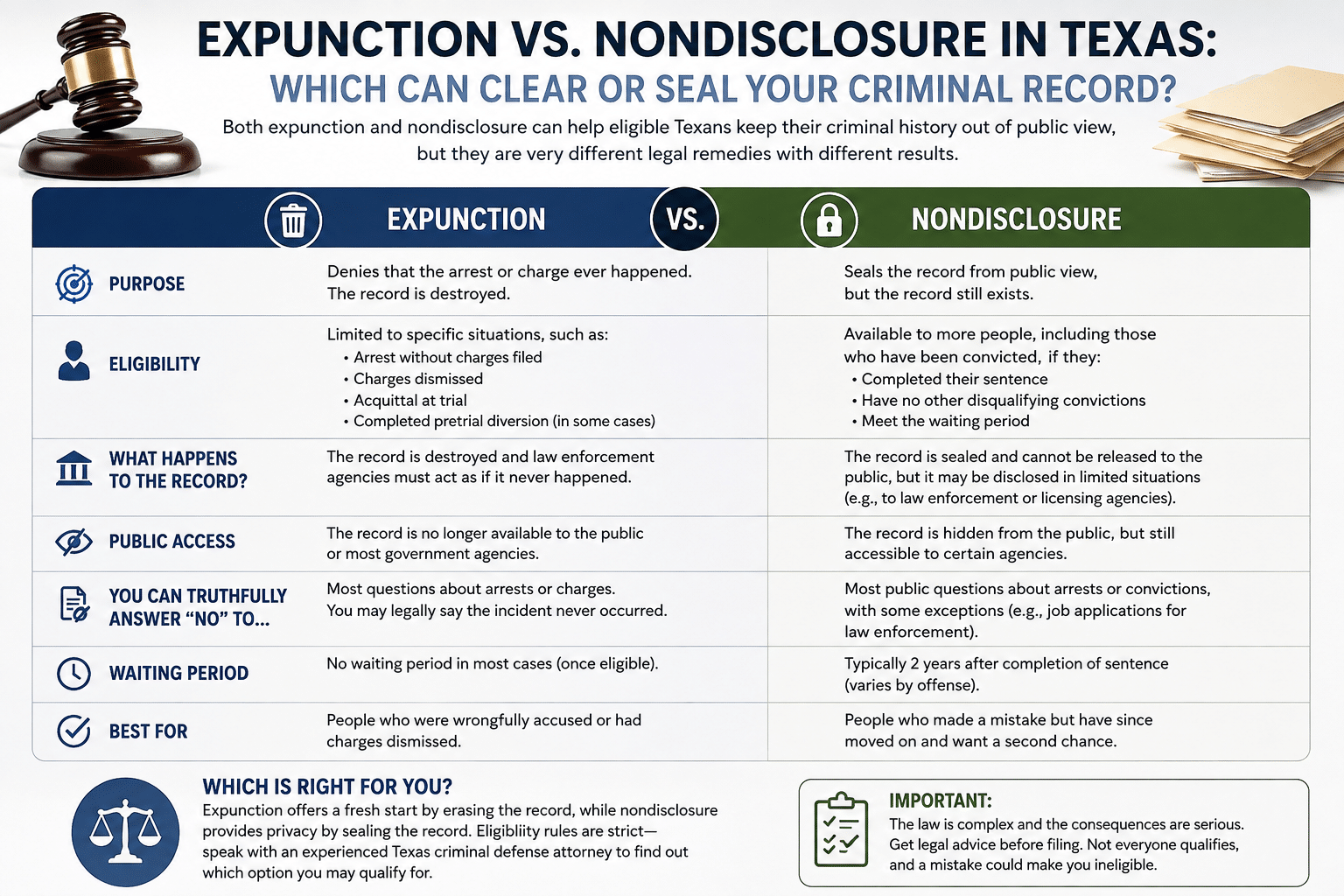
A criminal record can affect your life long after your case is over. Employers, landlords, licensing agencies, lenders, and others may find arrest or court information in a background check, even if you were not convicted. In Texas, there are two main ways to get relief: expunction and an order of nondisclosure. These are different, and picking the wrong one can waste time or lead to disappointment. When we review a record-clearing case in Galveston County, we look at how the case ended, whether you meet the legal requirements, and if expunction or nondisclosure is an option.
What Is The Difference Between Expunction And Nondisclosure In Texas?
Expunction is usually the stronger option. Texas Code of Criminal Procedure Chapter 55A sets the rules for expunction. If you qualify and the court grants it, government records about your arrest are usually destroyed or returned as the law requires. In some cases, Texas law lets you deny the arrest happened, except for certain legal exceptions.
An order of nondisclosure works differently. Subchapter E-1 of Texas Government Code Chapter 411 covers nondisclosure. Instead of destroying the record, this order limits who can see your criminal history. Some government agencies and other groups named in the law can still access the information.
When Can A Criminal Record Be Expunged In Texas?
Not every arrest or criminal case can be expunged. Whether you qualify depends a lot on what happened after your arrest.
Chapter 55A of the Texas Code of Criminal Procedure provides several statutory grounds for expunction. Depending on the circumstances, relief may be available when a person was acquitted, pardoned, arrested but never charged, charged and later had the case dismissed, or otherwise falls within one of the specific categories created by Texas law. The statute contains detailed conditions and exceptions, which is why the result of the case alone does not always answer whether expunction is available.
For example, just because prosecutors dismissed a charge does not mean the record can be expunged right away. We need to know why the case was dismissed, if another charge came from the same incident, if the statute of limitations still matters, and if any other legal rules apply.
This is important for anyone who thinks that “dismissed” always means “erased.” Texas law does not work that way.
Can An Arrest Be Expunged If You Were Never Convicted?
In many cases, an arrest that never resulted in a conviction may qualify for expunction, but the circumstances matter.
Texas law provides expunction procedures for certain people who were arrested and released without a final conviction and who meet the statutory requirements under Chapter 55A. Different waiting periods and conditions can apply depending upon the offense and procedural history.
That’s why we look at the whole case record, not just one entry. The original arrest, charges, dismissal papers, plea history, related offenses, and final outcome all play a role in deciding if you qualify.
This review is especially important if you had more than one charge from a single arrest. Even if one charge ended well, it does not always mean every record from that arrest can be expunged.
What Does An Order Of Nondisclosure Do?
An order of nondisclosure usually limits who in the public can see your criminal history. The record is not destroyed like with expunction. Instead, access is restricted under Texas Government Code Chapter 411.
For many people, this still makes a real difference. Private employers, landlords, and the general public will have much less access to your record once the order is in place.
However, nondisclosure should never be described as making a criminal record disappear completely. Texas law permits disclosure of nondisclosed information to specified criminal justice agencies and other governmental or regulatory entities identified by statute.
This difference is important if you work in a regulated job, want a professional license, apply for government positions, or deal with agencies that can access sealed records.
Who May Qualify For Nondisclosure In Texas?
Eligibility for nondisclosure depends on the offense, the disposition of the case, the person’s criminal history, and the specific section of Subchapter E-1 that applies.
Texas has created several nondisclosure procedures rather than one universal rule. Some provisions apply to qualifying defendants who successfully complete deferred adjudication community supervision. Other provisions may apply to certain misdemeanor convictions or other specific situations if the statutory requirements are satisfied.
Certain offenses are excluded from nondisclosure eligibility. Criminal history can also affect whether a person qualifies, and some statutes impose waiting periods before a petition may be filed.
We look closely at the actual offense of record and the final disposition. Two people charged with offenses that sound similar may have completely different eligibility because one received a dismissal while another completed deferred adjudication or was convicted.
Deferred Adjudication Does Not Automatically Clear Your Record
One of the most common misunderstandings we encounter involves deferred adjudication.
Deferred adjudication can allow a defendant to complete community supervision without a final adjudication of guilt under the terms of the applicable Texas law. But successfully completing deferred adjudication does not ordinarily mean that every record of the arrest and prosecution vanishes automatically.
For qualifying cases, nondisclosure may be available after deferred adjudication. Texas Government Code Chapter 411 contains several provisions governing when a defendant may receive or petition for nondisclosure after completing deferred adjudication.
Whether the person qualifies depends on the offense and criminal history. That is why we do not tell clients that deferred adjudication is the same thing as an expunction. It is not.
Can A Texas Conviction Be Expunged?
A common question is whether a person can simply wait several years and then have a conviction expunged. Texas generally does not provide broad expunction eligibility merely because time has passed after an ordinary conviction.
Chapter 55A identifies the circumstances under which expunction is authorized. Certain convictions may become eligible because of a pardon or another specific statutory basis, but a standard conviction does not become expungable simply because it is old.
That does not necessarily mean there is no possible form of record relief. Depending on the offense and circumstances, nondisclosure may be worth evaluating. The important point is that expunction and nondisclosure have different eligibility requirements, and neither should be assumed to apply without reviewing the record.
Expunction Can Be More Powerful Than Nondisclosure
When a person qualifies for expunction, it is generally the more complete form of relief because the process addresses the underlying criminal records themselves rather than merely limiting public disclosure.
That can be especially valuable after an arrest that ended in an acquittal, qualifying dismissal, pardon, or another disposition covered by Chapter 55A.
Nondisclosure can still provide substantial protection, but the record continues to exist and may remain available to entities authorized by Texas law.
This difference is why we first determine whether expunction is legally possible before treating nondisclosure as the preferred remedy. If the stronger remedy is available, that may have a much greater long-term effect on background checks and public access.
Why Criminal Records Can Affect Employment And Professional Opportunities
A criminal record can influence far more than a future criminal case. Employers routinely use background checks, and licensing boards may consider an applicant’s criminal history when permitted by law.
An arrest record can also create questions even where the underlying charge was dismissed. Someone reviewing a background report may see an arrest without immediately understanding the final disposition.
Obtaining lawful record relief can reduce that problem. An expunction can remove qualifying records, while nondisclosure can restrict public access to qualifying information. Neither remedy changes every consequence in every setting, but both may substantially improve the way the record appears to ordinary background-screening sources.
For professionals, business owners, healthcare workers, educators, commercial drivers, and others whose livelihood depends on reputation or licensing, determining whether record relief is available can be especially important.
Why The Details Of The Original Case Matter
Record-clearing cases are heavily dependent on procedural history.
We want to know exactly what offense was charged, whether other offenses arose from the same arrest, whether the case was dismissed, whether deferred adjudication was completed, whether a conviction occurred, and whether the person has other criminal history.
Even the precise Penal Code section involved can determine whether nondisclosure is prohibited or subject to additional restrictions.
This is why online eligibility charts can be misleading. They may provide a general starting point, but they cannot substitute for reviewing the court record and applying the current statute to the facts of the individual case.
Filing For Expunction Or Nondisclosure In Galveston
Texas law establishes separate procedures for obtaining an expunction and obtaining an order of nondisclosure. Depending on the particular statute, a petition may need to be filed with the appropriate court, notice may need to be given, and the court must determine whether the statutory requirements have been satisfied.
Texas law also imposes filing fees in certain expunction proceedings. For example, the Code of Criminal Procedure includes a $100 filing fee for specified ex parte expunction petitions, in addition to other possible court-related costs.
The important issue is not simply filing paperwork. The petition needs to match the correct statutory ground and accurately identify the records, agencies, and underlying case involved.
A mistake can delay relief or result in a petition being denied. Before filing, we determine which
Speak With Mark Diaz & Associates About Clearing Or Sealing A Texas Criminal Record
A past arrest or criminal case should not continue creating unnecessary problems if Texas law provides a lawful way to remove or restrict access to the record. The first question is whether you qualify for expunction, nondisclosure, or another form of relief. At Mark Diaz & Associates, we review the original case, the disposition, your criminal history, and the applicable Texas statutes before determining the proper procedure.
When you hire me, you work directly with me. My clients have my personal cell phone number because questions, emergencies, and concerns don’t always happen during business hours. You won’t be handed off to a junior associate or lost in a system where your case is one of dozens on a crowded docket. From arrest through resolution, I remain personally involved and accessible.
If you want to find out whether your Texas criminal record may qualify for expunction or nondisclosure, contact our Galveston criminal defense lawyers at Mark Diaz & Associates by calling 409-515-6170 to receive your free consultation. We represent clients in Galveston and throughout the city of Houston, Texas, and we can review the history of your case and explain which form of record relief may be available under Texas law.
