
What Evidence Do Police Need To Prove Drug Manufacturing In Texas?
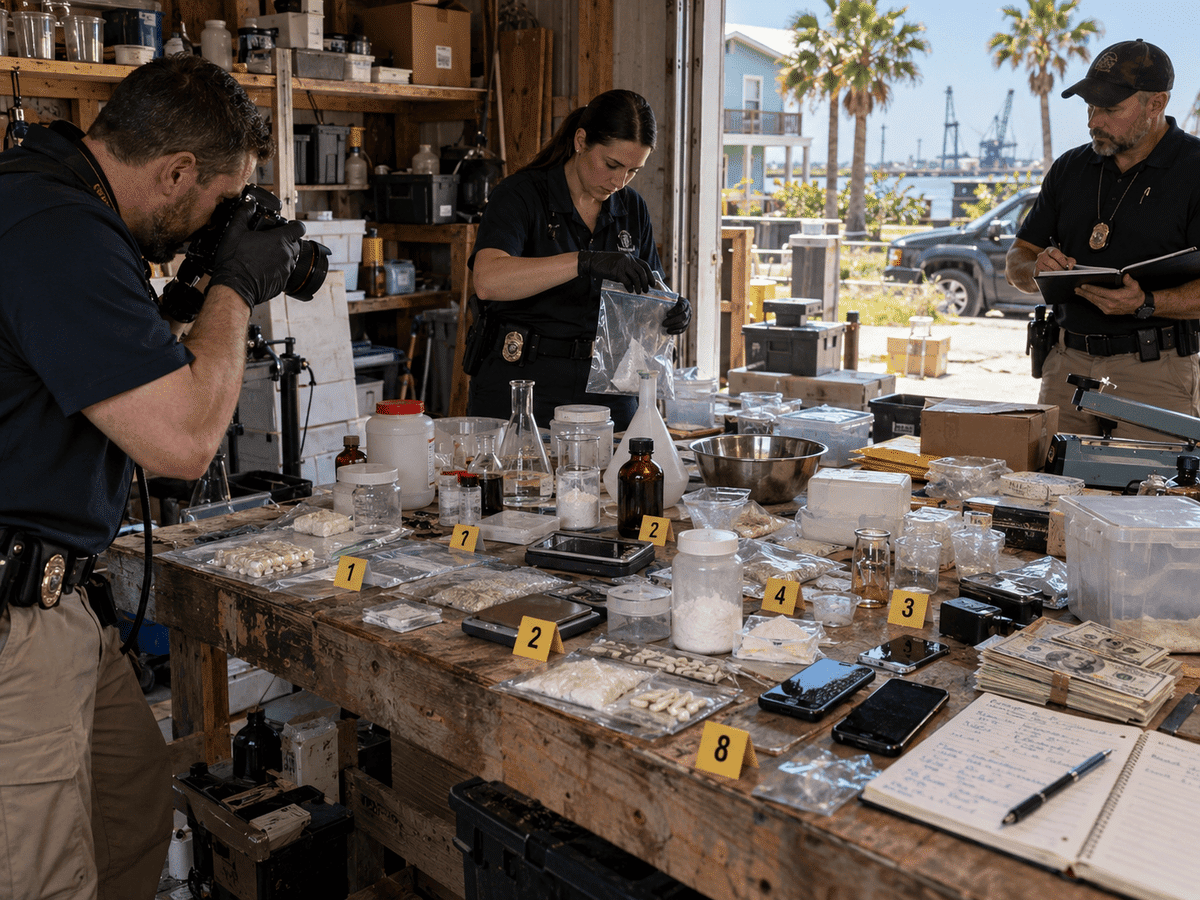
A drug manufacturing charge can start with less evidence than most people think. Police might find chemicals, equipment, unfinished substances, packaging, digital messages, or other items they believe are linked to illegal drug production. However, this does not mean the State can automatically prove someone knowingly made a controlled substance. Texas law requires prosecutors to prove certain elements of the crime, and the evidence must connect the accused to the alleged manufacturing.
When we defend these cases in Galveston, we carefully check if the State has proof of actual manufacturing, knowledge, intent, control over the place, and a clear link between our client and the items police found.
Texas Law Requires Proof Of Knowing Drug Manufacturing
Texas Health and Safety Code § 481.112 makes it a crime to knowingly manufacture, deliver, or possess with intent to deliver a controlled substance in Penalty Group 1. This group includes substances that can lead to serious felony charges. The type of charge and punishment depend mostly on what the substance is and how much of it there is.
The word “knowingly” matters a lot. The State usually needs to show more than just finding illegal substances or drug-making materials near the accused. Prosecutors try to prove the defendant knew what was going on and was involved in making, preparing, processing, packaging, or producing the controlled substance.
Texas Health and Safety Code § 481.002 contains the definitions used throughout the Texas Controlled Substances Act. The statutory framework treats manufacturing broadly, meaning investigators do not necessarily need to find a completed batch of drugs before an allegation can develop.
Police Often Rely On Chemicals, Equipment, And Laboratory Materials
In many manufacturing cases, police collect chemicals and equipment during a search. Depending on the type of substance, they might take glassware, heating tools, scales, containers, chemical compounds, pill presses, mixers, safety gear, packaging supplies, or other items they think were used to make drugs.
Those items are not automatically illegal. Many chemicals, tools, and pieces of laboratory equipment have legitimate uses. The important question is whether the State can connect those items to unlawful drug production and to the person charged with the crime.
Texas Health and Safety Code § 481.124 separately addresses possession or transportation of certain chemicals with intent to unlawfully manufacture a controlled substance. The statute applies to items such as anhydrous ammonia, immediate precursors, and designated chemical precursors when they are possessed or transported with the required unlawful intent.
When we look at this kind of evidence, we check if the chemicals were actually controlled precursors, if they were stored or used in a suspicious way, and if there is other proof that our client meant to use them to make drugs. If officers find an alleged drug laboratory inside a house, apartment, garage, warehouse, hotel room, storage unit, or vehicle, prosecutors may attempt to connect the person who owns or occupies that location to everything found inside it.
That connection is not always enough.
Several people may have access to a residence or business. A garage may be shared. A storage unit may be used by more than one person. A defendant may own property that another person occupies. A vehicle may have multiple drivers. The State still needs evidence connecting the accused to the illegal activity rather than relying entirely on physical proximity.
We look at leases, ownership records, keys, fingerprints, DNA, surveillance video, witness statements, utility records, mail, personal belongings, and other evidence that may show who actually controlled the area where the alleged manufacturing occurred.
Text Messages And Phone Evidence Can Become Central To The Case
Modern drug investigations often depend heavily on digital evidence. Police may search phones, computers, cloud accounts, social media accounts, payment applications, and messaging platforms for communications they believe show drug production.
Prosecutors may rely on messages discussing chemicals, quantities, recipes, equipment, buyers, deliveries, payments, or planned production. Photos and videos can also become important if investigators claim they depict drugs, manufacturing equipment, or locations associated with the operation.
Digital evidence still requires context. A message may be misunderstood. A device may be shared. A photograph does not necessarily establish who created the substance shown in it. We examine who controlled the device, how the evidence was obtained, whether the search was lawful, and whether the State can authenticate and properly interpret the communications it intends to use.
Police May Use Purchase Records To Build A Manufacturing Case
Investigators sometimes trace the purchase of chemicals, equipment, containers, pill presses, laboratory supplies, or other materials. Online shopping records, store surveillance footage, receipts, shipping records, credit card statements, and bank records may all become part of the investigation.
The fact that someone purchased an item does not automatically prove criminal intent. Many materials that could be used in drug production also have lawful uses. The prosecution generally needs to place those purchases into a broader factual context.
For that reason, we examine whether the alleged purchases actually match the substances or equipment found during the search, who placed the orders, where the products were delivered, and whether there is evidence connecting those materials to actual manufacturing activity.
The State May Try To Prove Manufacturing Through Witnesses
Police do not always need physical evidence showing every stage of drug production. Witness testimony can also play a major role. A roommate, friend, confidential informant, alleged customer, co-defendant, or cooperating witness may claim that the accused manufactured drugs or helped someone else do so.
That testimony must be examined carefully. Witnesses may have criminal charges of their own, financial motives, plea agreements, personal disputes, or reasons to shift blame.
Texas Penal Code § 7.01 and § 7.02 also allow criminal responsibility in certain circumstances for the conduct of another person. Someone who intentionally promotes or assists an offense by soliciting, encouraging, directing, aiding, or attempting to aid another person may face prosecution even if that person did not personally perform every physical step of the manufacturing process.
That makes the accused person’s intent especially important when the State claims several people participated in the operation.
Drug Weight Can Dramatically Change The Potential Punishment
The amount of the controlled substance can substantially affect the seriousness of a manufacturing charge. Under Texas Health and Safety Code § 481.112, manufacturing less than one gram of a Penalty Group 1 substance is generally a state jail felony. One gram or more but less than four grams can result in a second-degree felony, while four grams or more but less than 200 grams can result in a first-degree felony. Larger amounts can carry enhanced minimum prison terms and very large fines.
Because weight matters so much, we do not automatically accept the quantity alleged in a police report. Laboratory testing, mixture calculations, adulterants, dilutants, container contents, and chain-of-custody issues can affect how the State arrives at the alleged amount.
A few grams can make a significant legal difference.
Manufacturing Around Children Can Increase The Consequences
Texas law also provides additional punishment consequences when certain manufacturing offenses occur in the presence of a child. Texas Health and Safety Code § 481.1122 applies when a person is convicted of manufacturing a Penalty Group 1 controlled substance and a child younger than 18 was present on the premises when the offense occurred. Depending on the underlying amount, the statute can increase the degree of the offense or raise mandatory minimum prison terms and maximum fines.
These allegations can therefore become even more serious when police claim children were inside the home, apartment, hotel room, or other location where manufacturing allegedly occurred.
We examine whether the child was actually present during the alleged manufacturing activity and whether the State can establish the statutory requirements for the enhancement.
Frequently Asked Questions About Texas Drug Manufacturing Charges
Can I Be Charged With Drug Manufacturing If Police Never Found Finished Drugs?
Yes, depending on the facts. Texas law does not necessarily require police to walk into a room and find a completed batch of controlled substances ready for sale. Prosecutors may attempt to prove unlawful manufacturing through precursor chemicals, equipment, partially processed substances, residue, laboratory evidence, communications, purchase records, and witness testimony.
Texas Health and Safety Code § 481.124 can also make possession or transportation of certain precursor chemicals a crime when prosecutors prove the required intent to unlawfully manufacture a controlled substance.
The defense issue is whether the evidence actually establishes unlawful intent. Chemicals and equipment may have legitimate uses, and merely possessing an item associated with drug production does not necessarily establish the required criminal intent.
What If The Drug Lab Was In My House But Belonged To Someone Else?
The location of the alleged laboratory can create suspicion, but ownership of the property does not automatically establish guilt. The State still needs evidence connecting you to the illegal activity.
We would examine who lived at the property, who controlled the particular room or area, who purchased the materials, whose fingerprints or DNA were present, what digital communications exist, and whether witnesses can credibly identify who was responsible for the operation.
A case may become particularly complicated when several adults live in the same residence. Prosecutors may attempt to use circumstantial evidence to connect several people to the operation, which makes it important to evaluate each person’s individual conduct rather than treating everyone present as equally responsible.
Can Police Use My Internet Searches Against Me?
Potentially. Search history involving drug recipes, chemical processes, pill presses, precursor chemicals, or manufacturing methods may become evidence if police lawfully obtain access to the device or account.
Search history alone does not necessarily establish that someone manufactured drugs. People search for subjects for many reasons. The prosecution usually tries to combine digital searches with other evidence, such as chemical purchases, equipment, controlled substances, messages, financial records, or physical evidence discovered during a search.
We examine whether the evidence was legally obtained and whether the State can reliably connect the searches to the accused rather than merely to a shared device or account.
Can I Be Charged For Helping Someone Else Manufacture Drugs?
Yes. Texas law allows prosecution under the law of parties in certain circumstances. Under Texas Penal Code § 7.02, a person may be criminally responsible if, acting with intent to promote or assist an offense, that person solicits, encourages, directs, aids, or attempts to aid another person in committing it.
That does not mean being present or knowing someone involved in drugs automatically makes you guilty. The prosecution still needs evidence showing the level of intent and assistance required by the statute.
We examine exactly what the accused allegedly did. Giving someone an ordinary ride is different from knowingly transporting manufacturing chemicals. Living in the same home is different from knowingly buying equipment for an illegal operation.
What Evidence Is Most Important In A Drug Manufacturing Defense?
There is rarely one piece of evidence that decides every case. The strongest issues often involve who controlled the location, who owned the chemicals or equipment, whether drugs were actually being produced, what laboratory testing shows, what digital communications say, and whether prosecutors can prove knowing participation.
Search and seizure issues can also matter. If evidence was obtained through an unlawful search, there may be grounds to challenge its use in court.
We also examine weaknesses that may not appear in the initial police report, including inconsistent witness accounts, missing fingerprints, shared property, innocent explanations for equipment, gaps in surveillance, problems with laboratory testing, and unreliable cooperating witnesses.
Speak With Mark Diaz & Associates About A Drug Manufacturing Charge
A Texas drug manufacturing allegation can carry consequences far beyond an ordinary possession case. Police may build the case using chemicals, equipment, phone records, witnesses, laboratory reports, financial evidence, search history, and assumptions about who controlled the property. We examine each piece of that evidence and determine whether it actually proves knowing participation in unlawful manufacturing.
When you hire Mark Diaz & Associates, you work directly with your attorney. Our clients have direct access because questions, emergencies, and concerns do not always arise during ordinary business hours. You will not be handed off to a junior associate or lost in a system where your case is simply one more file on a crowded docket. From the investigation or arrest through resolution, we remain personally involved, accessible, and focused on protecting your interests.
Mark Diaz & Associates represents people facing drug manufacturing charges and other criminal allegations in Galveston and throughout Houston, Texas. If police have searched your property, seized chemicals or equipment, or accused you of manufacturing controlled substances, contact our Galveston drug manufacturing defense attorney at Mark Diaz & Associates by calling 409-515-6170 to schedule your free consultation.
