
What Happens If Police Find Drug Manufacturing Equipment or Chemical Precursors in Your Home in Galveston?
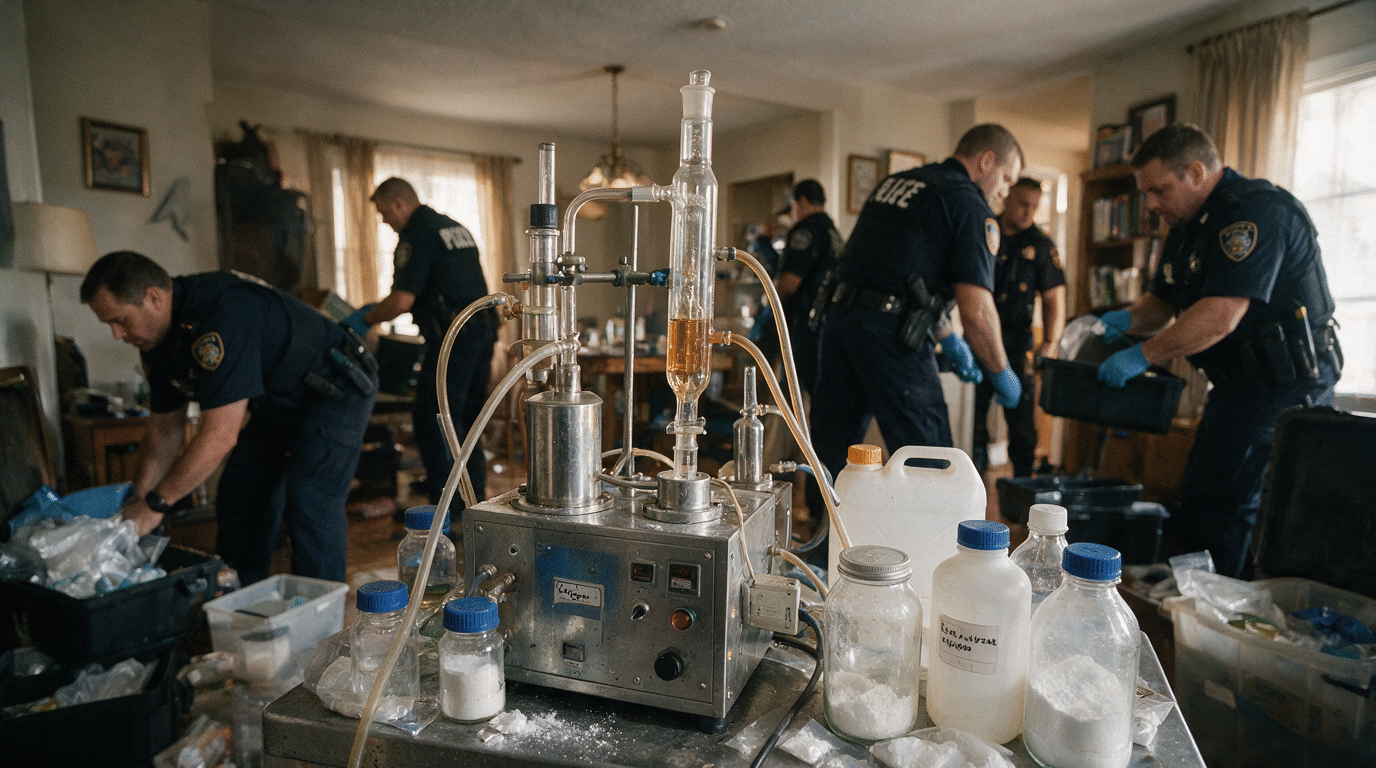
A police search of a Galveston home can become much more serious when officers believe they have found chemicals, glassware, containers, scales, heating equipment, or other items associated with making controlled substances. Police do not necessarily need to find a finished batch of illegal drugs before investigators begin pursuing a manufacturing case. Texas law allows prosecutors to rely on chemicals, equipment, the way items are stored, statements, electronic evidence, and other circumstances when trying to prove an intent to manufacture.
At the same time, many chemicals and pieces of laboratory equipment have perfectly lawful uses, so their presence in a home does not automatically establish a crime. When we defend someone accused of drug manufacturing, we focus closely on what police actually found, why it was present, who controlled the area, and whether the prosecution can prove the required intent beyond a reasonable doubt.
Texas Law Separates Manufacturing From Simple Drug Possession
Texas law treats manufacturing a controlled substance differently from merely possessing one. Under Texas Health and Safety Code § 481.112, a person commits an offense if the person knowingly manufactures, delivers, or possesses with intent to deliver a substance listed in Penalty Group 1. Penalty Group 1 includes methamphetamine and many other controlled substances that can carry serious felony penalties.
The amount and type of controlled substance can significantly affect punishment. Under § 481.112, manufacturing less than one gram of a Penalty Group 1 substance is generally a state jail felony, while larger amounts can result in second-degree or first-degree felony exposure. At the highest weight levels, the statute authorizes greatly increased minimum prison terms and substantial fines.
Other controlled substances are governed by separate provisions. Texas Health and Safety Code §§ 481.1121, 481.1123, 481.113, and 481.114 address manufacturing or delivery offenses involving other penalty groups. For that reason, we first determine exactly what substance investigators claim was being produced before evaluating the potential charge and punishment.
Chemical Precursors Can Lead To Charges Without Finished Drugs
One of the most important laws in these cases is Texas Health and Safety Code § 481.124. That statute makes it an offense to possess or transport certain chemicals with the intent to unlawfully manufacture a controlled substance. Covered materials can include anhydrous ammonia, immediate precursors, chemical precursors, and other substances designated by the Texas Department of Public Safety.
The prosecution therefore does not always need to show that an illegal drug was successfully produced. The government may argue that chemicals found inside the home were being gathered or stored for future manufacturing.
Intent is critical. A household chemical, industrial product, solvent, medicine, or laboratory substance does not automatically become illegal merely because it can be used in drug production. We examine whether the prosecution has reliable evidence showing that the chemicals were actually possessed for an unlawful manufacturing purpose rather than for legitimate household, business, agricultural, mechanical, educational, or other uses.
Texas Law Contains Special Rules For Suspected Methamphetamine Manufacturing
Section 481.124 contains several provisions aimed specifically at methamphetamine production. Texas law permits an inference of unlawful manufacturing intent under certain circumstances involving particular chemicals, substances, containers, and combinations of materials. For example, the statute addresses anhydrous ammonia stored in an improper container and certain combinations involving ephedrine or pseudoephedrine together with substances commonly associated with methamphetamine production.
The statute also refers to combinations of materials such as lithium or sodium metal, red phosphorus, iodine, acids, solvents, petroleum distillates, and particular types of equipment. These cases are highly dependent on the exact facts because many individual substances can have lawful purposes when viewed separately.
When police claim they found a methamphetamine laboratory, we examine the complete inventory of what was seized. We also look at where each item was located, whether the materials were actually capable of being used together, whether residue was detected, and whether forensic testing supports the officers’ conclusions.
Laboratory Equipment Is Not Automatically Evidence Of A Crime
Texas Health and Safety Code § 481.002 defines “chemical laboratory apparatus” broadly. The definition includes certain condensers, distilling equipment, vacuum dryers, flasks, tableting machines, encapsulating machines, funnels, extractors, heaters, and other equipment designed, made, or adapted to manufacture controlled substances.
Many of those items can also have lawful scientific, industrial, educational, pharmaceutical, hobby, or commercial purposes. A flask sitting on a shelf does not establish that someone was manufacturing methamphetamine, fentanyl, or another controlled substance.
Context becomes important. Investigators may focus on whether equipment contains drug residue, whether chemicals consistent with a known manufacturing method were located nearby, whether instructions were found, or whether communications suggest illegal production. We examine whether the government’s interpretation of the equipment is supported by forensic evidence rather than assumptions.
Police Must Connect The Equipment And Chemicals To You
The fact that suspicious materials were found inside a house does not necessarily prove that every person who lives there possessed or controlled them. Texas drug cases frequently involve questions of actual care, custody, control, or management.
If several people live in a home, prosecutors may need evidence linking a particular person to the room, garage, shed, container, or other area where the materials were located. We may examine lease records, ownership records, fingerprints, DNA evidence, keys, personal belongings, surveillance footage, phone records, and witness statements.
This issue can be especially important in homes shared by roommates, relatives, romantic partners, or temporary guests. Ownership of the residence does not automatically establish knowledge of everything another person may have placed inside it.
Phones And Digital Records Can Become Major Evidence
Modern drug manufacturing investigations often extend beyond the physical evidence seized from a house. Police may seek search warrants for phones, computers, cloud accounts, text messages, photographs, internet searches, online purchases, financial records, and social media communications.
Prosecutors may use online orders for chemicals or laboratory equipment as circumstantial evidence. They may also rely on messages discussing prices, quantities, recipes, deliveries, customers, or supplies.
We look closely at who actually controlled the device or account and whether the communications have been accurately interpreted. A search history, isolated text message, or online purchase does not necessarily prove criminal intent without additional context.
The Search Warrant Can Become A Major Defense Issue
Many manufacturing cases begin when police execute a search warrant at a house. The Fourth Amendment to the United States Constitution requires search warrants to be supported by probable cause and to particularly describe the place to be searched and the things to be seized.
We examine the affidavit officers used to obtain the warrant. Information supplied by confidential informants, surveillance observations, controlled purchases, trash searches, utility records, or statements from other suspects may have been used to establish probable cause.
We also review whether officers remained within the lawful scope of the warrant during the search. When evidence is obtained through an unconstitutional search or seizure, a defense attorney may seek suppression of that evidence, depending on the circumstances.
Children In The Home Can Increase The Consequences
Texas law provides additional punishment in some manufacturing cases when a child is present. Texas Health and Safety Code § 481.1122 applies to manufacturing offenses involving Penalty Group 1 substances when a child younger than 18 was present on the premises.
Depending on the underlying offense, the statute can increase the applicable punishment or raise mandatory minimum terms. This can make a manufacturing investigation involving a family residence considerably more serious.
Separate allegations may also arise if authorities believe children were exposed to dangerous chemicals or unsafe conditions. For that reason, the presence of minors can affect both the criminal investigation and other legal proceedings involving the household.
Frequently Asked Questions About Drug Manufacturing Charges In Galveston
Can I Be Charged With Drug Manufacturing If Police Never Find Finished Drugs?
Yes, depending on the evidence. Texas Health and Safety Code § 481.124 allows prosecutors to pursue charges involving possession or transportation of certain chemicals when they contend those chemicals were possessed with the intent to unlawfully manufacture a controlled substance. This means investigators may build a case around precursors and other evidence even if no completed drug product is recovered.
That does not eliminate the prosecution’s burden of proving criminal intent. Chemicals that have ordinary household, agricultural, industrial, or commercial uses do not establish unlawful manufacturing merely because police find them in the same home. We examine why the materials were present, how they were stored, whether there was any actual manufacturing activity, and whether the government can connect them to our client.
Is It Illegal To Own Laboratory Glassware Or Chemical Equipment In Texas?
Not simply because an item qualifies as laboratory equipment. Texas Health and Safety Code § 481.002 defines chemical laboratory apparatus to include many types of flasks, funnels, condensers, heaters, and related devices. Some of those items have legitimate uses in education, industry, science, hobbies, and other lawful activities.
The legal problem generally arises from the surrounding circumstances and the alleged intent. Police may claim that a collection of equipment, chemicals, drug residue, written instructions, digital evidence, or other items demonstrates illegal manufacturing. We examine the equipment individually and together to determine whether the prosecution’s theory is supported by evidence.
What Happens If The Chemicals Belong To My Roommate?
That fact can be extremely important. The government ordinarily must establish a connection between you and the contraband or materials at issue rather than merely showing that you lived somewhere where police found them.
If several people had access to the home, garage, bedroom, or storage space, we may examine who controlled the area and whose belongings were found nearby. Evidence such as fingerprints, messages, receipts, keys, photographs, or witness testimony can become important. We also look for evidence showing that another resident exercised exclusive control over the materials.
Can Police Charge Everyone Who Lives In The House?
Police can arrest more than one person when they believe several occupants participated in illegal conduct, but living in the same house does not automatically make every resident criminally responsible. Prosecutors still have to establish the required elements against each defendant.
In a shared residence, the ability to connect a particular person to the alleged manufacturing operation can become one of the central issues. We examine access to the location, ownership of the materials, statements made during the search, digital records, and other evidence that prosecutors claim links each person to the alleged activity.
Can Buying Pseudoephedrine Lead To A Drug Manufacturing Investigation?
It can under certain circumstances, particularly when investigators claim that pseudoephedrine was obtained or possessed as part of a methamphetamine manufacturing operation. Texas Health and Safety Code § 481.124 specifically addresses certain quantities of products containing ephedrine or pseudoephedrine when combined with other substances or equipment associated with methamphetamine production.
Possession of a lawful medication by itself does not prove that someone intended to manufacture methamphetamine. Investigators may look at purchasing patterns, quantities, other chemicals, laboratory materials, communications, and statements. We consider the entire factual picture rather than treating a single lawful purchase as proof of a felony.
Speak With A Galveston Criminal Defense Lawyer About A Drug Manufacturing Investigation
If police found chemicals, laboratory equipment, suspected precursors, or other materials in your Galveston home, the investigation may already be moving toward serious felony allegations. Drug manufacturing cases often involve search warrants, forensic testing, electronic evidence, alleged precursor chemicals, statements from other people, and complicated questions about who actually possessed or controlled the property. At Mark Diaz & Associates, we examine the evidence from the beginning rather than accepting law enforcement’s description of what they believe they found.
When you hire us, you work directly with your attorney. Our clients have direct access, including a personal cell phone number, because questions, emergencies, and concerns do not always arise during normal business hours. You will not simply be handed off to a junior associate or become another file sitting on a crowded docket. From the investigation and arrest through the resolution of the case, we remain personally involved, accessible, and prepared to challenge the prosecution’s evidence.
Mark Diaz & Associates represents people facing drug manufacturing, controlled-substance, and other serious criminal charges in Galveston and throughout Houston, Texas. Contact our Galveston federal drug crime lawyers by calling 409-515-6170 to schedule your free consultation and discuss the allegations, the search of your property, and the legal options available in your case.
