
What Happens If Police Seize Your Phone In A Child Pornography Investigation?
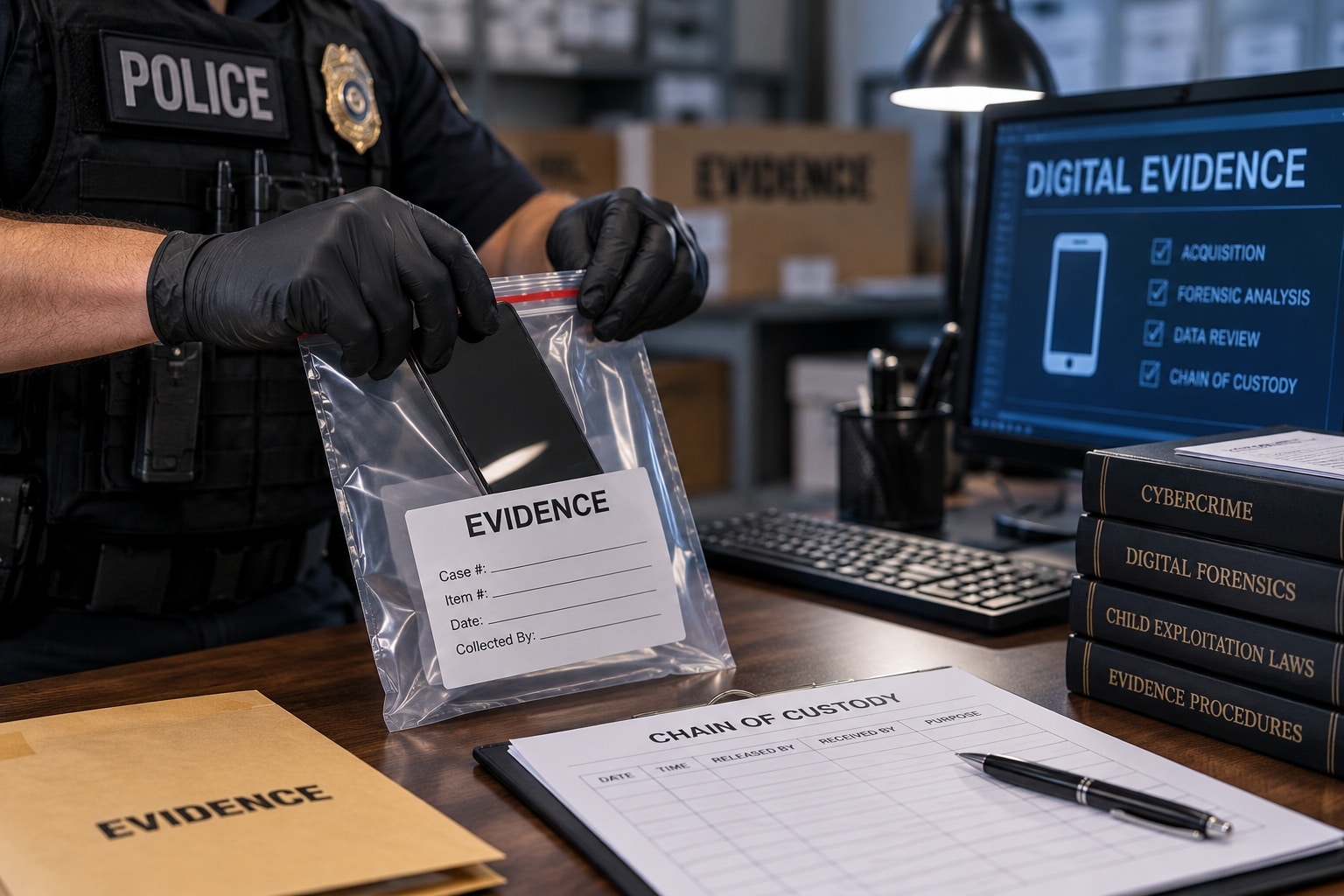
When police seize a phone during a child pornography investigation, the device may become one of the most important pieces of evidence in the entire case. Investigators may believe the phone contains images, videos, messages, browsing activity, cloud-account information, file-sharing records, or other digital evidence connected to an alleged offense. The seizure itself does not prove that a crime occurred, and police do not automatically have unlimited authority to examine everything stored on the device. Constitutional protections still apply, and investigators generally must establish a lawful basis to take the phone and search its digital contents. When we defend someone in Galveston County who has had a phone seized, we examine how police obtained the device, what the warrant authorized, what investigators actually searched, and whether the evidence supports the elements required by Texas law.
Police May Seize A Phone Before They Search Its Contents
There is an important legal difference between physically taking possession of a phone and searching the information stored inside it. Police may sometimes seize a device while obtaining a search warrant or may take possession of it pursuant to an existing warrant. Texas Code of Criminal Procedure Article 18.02 authorizes search warrants for certain property and evidence connected to criminal offenses, including property that constitutes evidence tending to show that a particular person committed an offense.
In Riley v. California, 573 U.S. 373 (2014), the United States Supreme Court made clear that police generally must obtain a warrant before searching the digital contents of a cell phone seized during an arrest. The Court recognized that modern phones contain enormous amounts of private personal information that differ significantly from ordinary physical objects carried by a person. That means an arrest may permit officers to secure the phone, but it does not ordinarily give them unrestricted access to photographs, messages, applications, email, and other stored data.
A Search Warrant Must Be Supported By Probable Cause
A search warrant cannot lawfully be based on mere curiosity or an unsupported belief that incriminating material might be found on a device. The Fourth Amendment and Article 1.06 of the Texas Code of Criminal Procedure protect against unreasonable searches and seizures and require warrants to be supported by probable cause.
In a child pornography investigation, officers may rely on information from internet service providers, online platforms, CyberTipline reports, file-sharing investigations, IP address information, statements from witnesses, or other evidence when seeking a warrant. We examine whether the affidavit actually established a factual connection between the alleged criminal activity and the phone being searched. A warrant for a digital device should not become permission to conduct an unlimited search unrelated to the alleged offense.
Investigators May Conduct A Detailed Forensic Examination
Once police have lawful authority to search a phone, the examination may be much more extensive than simply opening the photo application. Digital forensic tools can potentially identify photographs, videos, communications, application data, internet activity, metadata, downloaded files, and information associated with cloud services. Investigators may also examine whether files were received, stored, accessed, shared, transmitted, or deleted.
Deleted does not always mean permanently gone. Depending on the device, operating system, encryption, storage conditions, and other technical factors, forensic examiners may recover information that is no longer visible through normal use of the phone. They may also compare timestamps and account records to determine when a file appeared on the device and whether there is evidence that someone intentionally accessed or retained it.
Those details matter because the prosecution must prove more than the fact that an image existed somewhere on a device.
Texas Law Requires Proof Of Knowing Or Intentional Conduct
Texas Penal Code § 43.26 addresses possession and promotion of child pornography. Under the version of the statute currently in effect, a person can commit an offense by intentionally or knowingly possessing, or intentionally or knowingly accessing with intent to view, visual material depicting a child engaging in sexual conduct when the required statutory knowledge concerning the child’s age is established. Texas law also separately addresses computer-generated depictions and promotion-related conduct.
This mental-state requirement can become critical in a phone case. A file may have been received automatically, stored in a cache, downloaded by another user, synchronized from another account, or placed on the device without the owner’s knowledge. The prosecution may argue that search history, messages, file organization, repeated access, or other digital activity proves knowing possession. We examine the same evidence to determine whether it actually establishes intentional or knowing conduct beyond a reasonable doubt.
The Number And Nature Of Images Can Affect The Charges
Texas significantly revised Penal Code § 43.26 effective September 1, 2025. Under the current statute, possession involving an actual child generally begins as a third-degree felony under § 43.26(c-1), but the offense can increase to a second-degree or first-degree felony depending on factors that include the number of depictions, prior convictions, and the nature of the depicted conduct. Additional enhancement provisions can apply when the depicted child is younger than 10.
The statute separately addresses computer-generated material, with different punishment provisions. These distinctions make careful forensic review particularly important because investigators may classify and count files in ways that directly affect the potential level of the charge. The date of the alleged conduct also matters because offenses occurring before September 1, 2025 may be governed by an earlier version of the statute.
Promotion Allegations Can Create Even More Serious Exposure
A forensic examination may reveal evidence that police interpret as sharing or distributing files rather than merely possessing them. Texas Penal Code § 43.26 separately criminalizes intentionally or knowingly promoting or possessing with intent to promote qualifying material. The statutory definition of promotion can encompass conduct such as giving, transferring, transmitting, publishing, distributing, or otherwise disseminating prohibited material. Current Texas law treats promotion involving an actual child as a first-degree felony, subject to additional punishment provisions in certain circumstances.
Messages, file-sharing applications, cloud links, uploads, sent attachments, and account records may therefore become major pieces of evidence. We look closely at whether the accused actually controlled the relevant account, whether files were intentionally transmitted, and whether investigators can connect the activity to the person charged.
Cloud Accounts May Be Investigated Separately
Seizing a phone does not necessarily limit the investigation to information physically stored on that device. Investigators may seek records or content from email providers, cloud-storage services, social media companies, and other online platforms.
Texas Code of Criminal Procedure Article 18B.354 allows a district judge to issue a warrant for electronic customer data held in electronic storage when the supporting affidavit establishes probable cause that a specific offense was committed and that the requested electronic data constitutes evidence of that offense or evidence that a particular person committed it. The warrant is limited to the electronic customer data described in the supporting affidavit.
This means a phone seizure can become part of a much broader digital investigation involving multiple accounts and service providers.
A Phone Search Can Be Challenged In Court
When digital evidence becomes central to the prosecution, we examine whether the phone was lawfully seized, whether the warrant affidavit established probable cause, whether the warrant sufficiently described what could be searched, and whether investigators remained within the lawful scope of their authority.
We also examine whether the prosecution can prove who actually possessed or controlled the device and its accounts. Shared phones, shared cloud storage, multiple user profiles, family accounts, automatic synchronization, and compromised accounts can all raise factual questions about attribution.
A serious accusation should never be reduced to the statement that illegal material was “found on the phone.” The real questions are how it got there, who knew about it, who controlled it, whether anyone intentionally accessed it, and whether the government’s digital evidence proves each required element of the offense.
Frequently Asked Questions About Police Seizing A Phone In A Child Pornography Investigation
Can Police Search My Phone Just Because They Arrested Me?
Generally, an arrest alone does not give police unrestricted authority to search the digital contents of your phone. In Riley v. California, the United States Supreme Court held that officers generally must obtain a warrant before searching digital information stored on a cell phone seized incident to arrest. Police may physically secure the device while an investigation continues, but a forensic examination ordinarily requires lawful search authority.
There are limited exceptions to the warrant requirement, and each case depends on its facts. When we examine a phone search, we determine whether police relied on a warrant, consent, exigent circumstances, or another claimed exception and whether that justification actually permitted the search that occurred.
What Happens After Police Take My Phone?
The phone may be secured and transferred to investigators trained in digital evidence collection. If officers have a valid warrant, a forensic examiner may attempt to extract and review information that falls within the authorized scope of the search. Depending on the investigation, police may examine stored media, communications, applications, account information, metadata, browsing activity, and other digital records.
Investigators may also use information from the phone to identify cloud accounts or online services and then seek additional warrants or records. A phone seizure can therefore become one part of a larger investigation rather than an isolated examination of a single device.
Can Police Recover Deleted Photos Or Videos?
Sometimes. Whether deleted information can be recovered depends on the device, operating system, encryption, storage conditions, how the data was deleted, and what forensic tools are available. A deleted file may sometimes leave behind metadata, thumbnails, database entries, cloud copies, synchronization records, or other digital traces.
The existence of a recovered file still does not automatically establish knowing possession. We examine when the file was created or downloaded, whether it was opened, whether it was intentionally saved, how long it remained on the device, and whether another person or application could have placed it there.
What If Someone Else Used My Phone?
Access by another person can be extremely important. The prosecution must connect the prohibited conduct to the person accused, not merely to a physical device. A phone may be shared with a spouse, partner, family member, coworker, or another person, and accounts may sometimes be accessed from multiple devices.
Forensic evidence may help identify who was using the phone at a particular time. Passwords, messages, login history, account records, photographs, device activity, location information, and other evidence can become relevant when determining whether the State can prove knowing possession or intentional access.
Can A Child Pornography Conviction Require Sex Offender Registration In Texas?
Yes. Texas Code of Criminal Procedure Article 62.001 identifies a conviction under Penal Code § 43.26 as a reportable conviction or adjudication for purposes of the Texas Sex Offender Registration Program.
Registration consequences can be extremely significant and may continue well beyond any prison sentence, probation term, or fine. Because the precise requirements can depend on the conviction and other circumstances, we evaluate registration exposure as part of the defense strategy rather than treating it as an issue to address only after a plea or conviction.
Should I Explain To Police How The Files Got On My Phone?
Speaking with investigators without first obtaining legal advice can create serious problems. A person may believe that providing an explanation will clear up the situation, but statements can be compared against forensic evidence and later used by prosecutors. Small inconsistencies may become significant once investigators obtain account records, timestamps, messages, or other digital data.
We generally want to understand what evidence exists before our client makes decisions that could affect the defense. The government’s ability to seize and examine a device does not eliminate your right to remain silent or your right to legal counsel.
Call Mark Diaz & Associates About A Child Pornography Investigation In Galveston
A seized phone can contain years of personal information, but the presence of a file on a device does not by itself answer every question that Texas law requires the prosecution to prove. We examine the search warrant, the forensic process, ownership and access to the device, account activity, timestamps, file locations, cloud synchronization, communications, and the government’s evidence concerning knowledge and intent. When constitutional or evidentiary problems exist, we address them directly and determine whether digital evidence can be challenged or suppressed.
Mark Diaz & Associates represents clients facing serious criminal allegations in Galveston and throughout Houston, Texas. Child pornography investigations can move quickly from a device seizure to search warrants, forensic examinations, interviews, additional digital searches, and felony charges. Early legal representation gives us an opportunity to assess what police are doing, protect our client’s rights, and begin examining the evidence before assumptions harden into the government’s theory of the case.
When you hire me, you work directly with me. My clients have my personal cell phone number because questions, emergencies, and concerns don’t always happen during business hours. You won’t be handed off to a junior associate or lost in a system where your case is one of dozens on a crowded docket. From arrest through resolution, I remain personally involved and accessible.
If police seized your phone or you believe you are the subject of a child pornography investigation, call our Galveston sex crime attorney at Mark Diaz & Associates today by calling 409-515-6170 to schedule your free consultation.
