
What Happens When Police Find Drugs During a Traffic Stop in Texas?
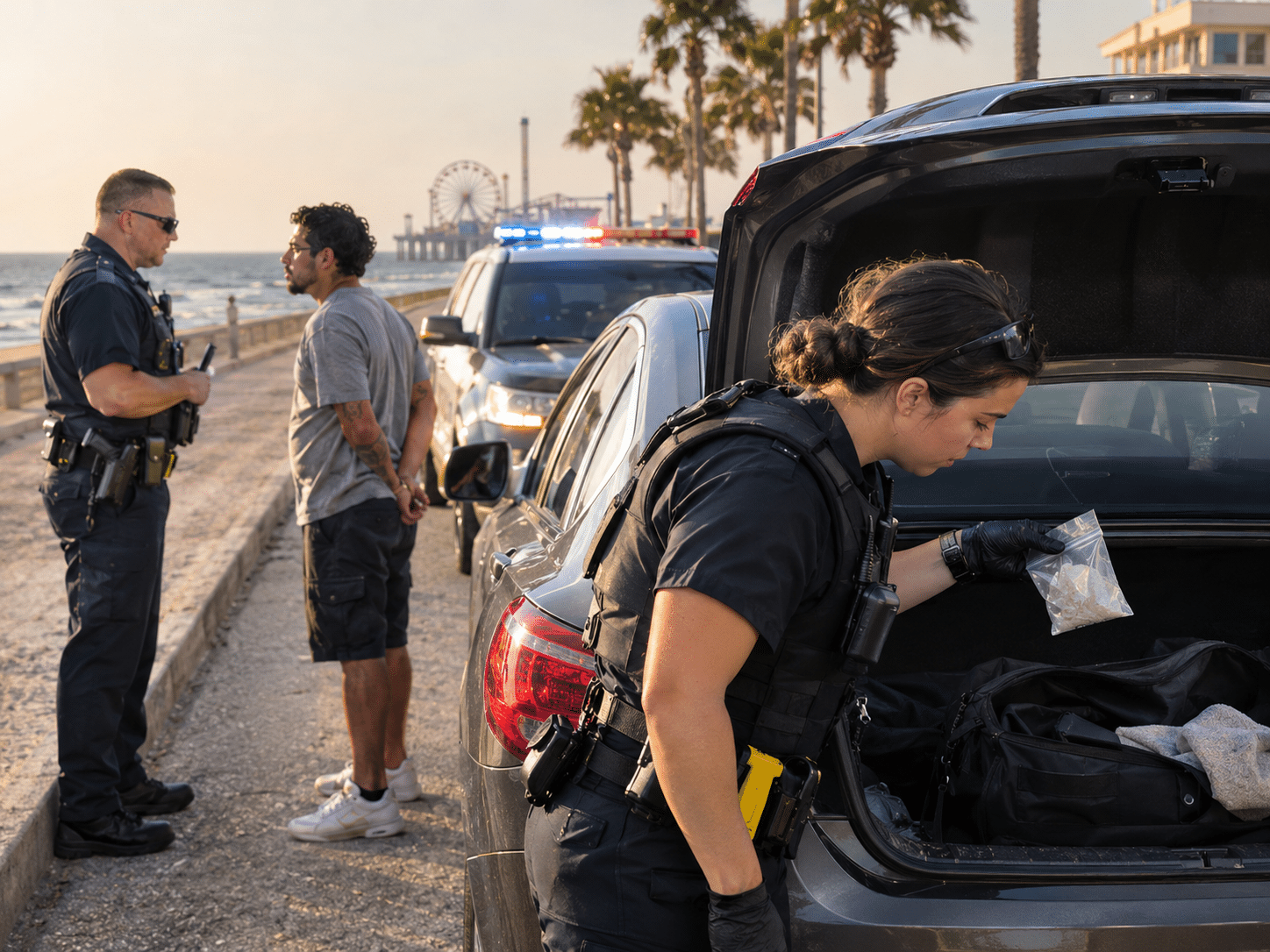
A simple traffic stop can quickly turn into a criminal investigation if police say they found drugs in a car. Factors like where the drugs were found, who owns the car, who was closest to the drugs, what people said, and why police searched the car all matter. Texas drug laws can bring misdemeanor or felony charges based on the type and amount of drug, and larger amounts may lead to accusations of intent to deliver. However, just finding drugs in a car does not mean everyone inside knew about them. When we handle these cases, we look at both sides of the story, including whether the stop and search were legal and if the State can actually link our client to the drugs.
Police Must Have A Lawful Basis For The Traffic Stop
Drug cases that start with a traffic stop usually begin with a claimed traffic violation like speeding, not signaling, or having broken equipment. Police must have a legal reason to stop a car. After stopping you, officers can ask for ID and deal with the reason for the stop, but if they keep you longer, those details can become important.
When we review a case, we check dash-cam and body-cam videos, the officer’s report, dispatch records, and the stated reason for the stop. If an officer says a violation happened but the video shows otherwise, that can be a key defense issue. Timing is also important because police cannot keep you longer just to look for other crimes without a legal reason.
A Traffic Stop Does Not Automatically Give Police The Right To Search The Car
Stopping a car and searching it are two different legal matters. Police can search if there is a valid exception to the warrant rule, like if you give permission or if they have probable cause to think there is evidence or illegal items in the car. Officers can also search in connection with an arrest if the law allows it.
If an officer asks for permission to search the car and the driver voluntarily agrees, the scope of that consent can become important. We examine exactly what the officer asked, what our client said, whether consent was limited in any way, and whether police exceeded what was authorized.
Police may also claim that they developed probable cause based on something they observed or detected during the stop. We do not simply accept that explanation. We review the total circumstances to determine whether the claimed justification actually existed before the search began.
Illegally Obtained Drugs May Be Challenged In Court
Texas law provides a powerful remedy when evidence is obtained unlawfully. Article 38.23 of the Texas Code of Criminal Procedure states that evidence obtained by an officer or another person in violation of the Texas or United States Constitution or laws generally cannot be admitted against the accused at trial.
That means the legality of the traffic stop, detention, and vehicle search can directly affect whether the drugs may be used as evidence. If we believe the search violated the law, we may seek suppression of the evidence. When the controlled substance is the central evidence supporting the charge, exclusion of that evidence can significantly weaken the prosecution’s case.
Texas Requires Proof Of Knowing Possession
Finding drugs in a vehicle is not the same as proving who possessed them. Texas Health and Safety Code § 481.002 defines possession as actual care, custody, control, or management. Texas controlled-substance possession statutes also generally require that the accused knowingly or intentionally possessed the substance.
This distinction becomes especially important when several people are in the vehicle. Drugs might be discovered under a passenger seat, inside a center console, in a backpack, behind a seat, or in the trunk. The State must still connect the accused to the drugs and establish knowing possession rather than relying only on presence inside the car.
We examine who owned the vehicle, who had access to the area where the drugs were found, whether the drugs were visible, whether personal property was located nearby, and whether statements or other evidence link a particular person to the substance. In a borrowed or shared vehicle, those issues can become particularly important.
The Drug And Its Weight Determine The Potential Charge
Texas separates controlled substances into different penalty groups. Under Texas Health and Safety Code § 481.115, knowingly or intentionally possessing a Penalty Group 1 or 1-B substance can lead to a state jail felony even when the amount is less than one gram. One to less than four grams can result in a third-degree felony, while four to less than 200 grams can result in a second-degree felony.
Other penalty groups have different weight thresholds. Texas Health and Safety Code § 481.116, for example, governs possession of Penalty Group 2 substances and similarly increases the level of the offense as the amount increases.
Marijuana is treated separately under Texas Health and Safety Code § 481.121. Possession of two ounces or less is generally a Class B misdemeanor, while possession of more than two ounces but no more than four ounces is generally a Class A misdemeanor. Larger quantities can result in felony charges.
Police May Claim The Drugs Were Intended For Delivery
A roadside drug case may become much more serious when officers find a larger quantity, separate packages, cash, scales, multiple phones, or other items they associate with distribution. Texas Health and Safety Code § 481.112 makes it an offense to knowingly manufacture, deliver, or possess with intent to deliver a Penalty Group 1 controlled substance. Even an amount under one gram can result in a state jail felony under that statute.
The presence of cash or packaging does not automatically prove an intent to deliver. We examine whether the prosecution has actual evidence of sales or distribution, including messages, recorded transactions, witness testimony, surveillance, or other facts connecting the accused to delivery activity.
The difference between simple possession and possession with intent to deliver can significantly affect the potential punishment. That makes the prosecution’s interpretation of the physical evidence an important part of the defense.
Statements Made During The Stop Can Become Evidence
Drivers and passengers often begin explaining themselves immediately after police discover suspected drugs. That reaction can cause problems. A person may make nervous, incomplete, or inaccurate statements without realizing that officers are documenting every word and comparing those statements to other evidence.
We review body-camera footage to determine exactly what was said and when it was said. We also examine whether questioning became custodial and whether protections governing custodial statements were followed. Texas Code of Criminal Procedure Article 38.22 contains rules governing the admissibility of statements resulting from custodial interrogation.
A person does not have to prove innocence on the side of the road. When a traffic stop turns into a drug investigation, statements made in the first few minutes can become a major part of the prosecution’s case.
Frequently Asked Questions About Drugs Found During A Texas Traffic Stop
What Happens If Police Find Drugs Under A Passenger Seat?
Where the drugs are found matters, but it does not automatically mean someone possessed them. Texas Health and Safety Code § 481.002 says possession means having actual care, custody, control, or management. If drugs turn up under a passenger seat, prosecutors may look at who was sitting there, if the drugs were visible, whether the passenger said anything about them, and if other evidence links that person to the drugs.
We would also examine whether anyone else had access to the area and whether the vehicle was borrowed, shared, or recently occupied by other people. The State must prove knowing possession, not merely proximity.
What If The Drugs Belonged To Someone Else In The Vehicle?
That can be a major defense issue. Texas controlled-substance statutes generally require proof that the accused knowingly or intentionally possessed the drugs. A person should not be convicted simply because another occupant brought drugs into the vehicle.
We look for evidence showing ownership or control, including where the drugs were found, whose belongings surrounded them, fingerprints or DNA when relevant, statements from other occupants, text messages, and other evidence. If another person admits ownership, that can be important, although prosecutors may still examine whether more than one person exercised control over the substance.
Do I Have To Let Police Search My Car During A Traffic Stop?
A driver is not required to voluntarily consent to every requested search. Police may nevertheless conduct a search without consent when another lawful basis exists, such as probable cause.
The distinction matters because officers sometimes ask for consent even when they do not yet have another basis to search. We review the interaction closely to determine whether consent was actually voluntary and whether the officer remained within its permitted scope.
If the search was unlawful, Texas Code of Criminal Procedure Article 38.23 may provide a basis for seeking exclusion of the resulting evidence.
What If Police Find Cocaine Or Methamphetamine In The Car?
Many commonly prosecuted drugs fall within Texas Penalty Group 1. Texas Health and Safety Code § 481.115 makes knowing or intentional possession of Penalty Group 1 or 1-B substances a criminal offense, with the punishment increasing according to weight. Less than one gram is generally a state jail felony, while one to less than four grams can result in a third-degree felony.
Larger amounts carry greater exposure. We verify the laboratory identification and reported weight because both can directly affect the level of the offense.
Speak With Mark Diaz & Associates About A Texas Drug Charge After A Traffic Stop
When drugs are found during a traffic stop, the defense should begin with more than simply asking what substance police recovered. We examine why the vehicle was stopped, how long the detention lasted, why officers searched, whether consent was actually given, where the drugs were located, who had access to them, and whether the State can prove knowing possession. We also evaluate whether prosecutors are attempting to elevate a possession allegation into possession with intent to deliver based on packaging, money, or other circumstantial evidence.
When you hire Mark Diaz & Associates, you work directly with your attorney. Our clients have their attorney’s personal cell phone number because questions, emergencies, and concerns do not always happen during normal business hours. You will not simply be handed off to a junior associate or become another case buried on a crowded docket. From arrest through resolution, we remain personally involved, accessible, and familiar with the evidence affecting your case.
Mark Diaz & Associates represents clients facing drug possession, possession with intent to deliver, and other criminal charges in Galveston and throughout Houston, Texas. If police found drugs during a traffic stop and you are facing an investigation or criminal charge, contact our Galveston drug crime lawyers by calling 409-515-6170 to schedule your free consultation.
