
What Is A Drug Distribution Conspiracy Under Federal Law?
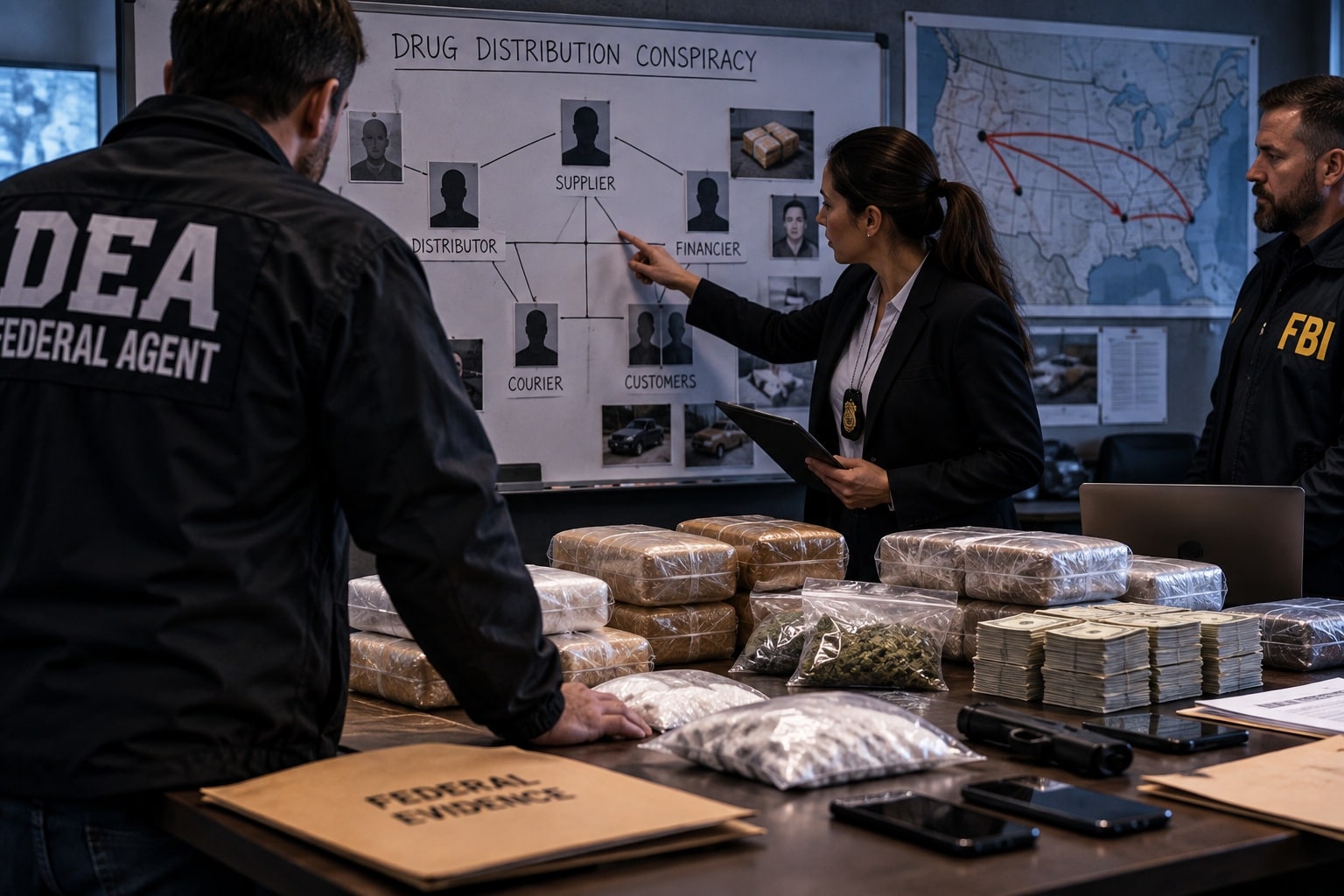
A federal drug distribution conspiracy charge can expose a person to years or even decades in federal prison, even when prosecutors do not claim that person personally sold drugs. These cases often involve several defendants, lengthy investigations, confidential informants, intercepted communications, surveillance, financial records, and testimony from people seeking favorable treatment in their own criminal cases. For someone in Galveston or the Houston area, an investigation may begin with local law enforcement before federal agencies and federal prosecutors become involved.
The government may attempt to connect people through phone calls, text messages, money transfers, travel, vehicles, meetings, or alleged relationships with other suspects. We believe anyone facing this type of investigation should understand that a federal conspiracy case is not simply a larger version of a Texas drug possession case. The legal theory is different, the sentencing consequences can be severe, and the government may try to prove participation through circumstantial evidence rather than a completed drug transaction.
Federal Drug Distribution Conspiracy Charges Under 21 U.S.C. § 846
The primary federal drug conspiracy statute is 21 U.S.C. § 846. It provides that a person who conspires to commit a federal controlled substance offense is subject to the same penalties prescribed for the underlying offense that was the object of the conspiracy.
In a drug distribution case, the alleged underlying offense is frequently a violation of 21 U.S.C. § 841(a)(1), which prohibits knowingly or intentionally manufacturing, distributing, dispensing, or possessing with intent to manufacture, distribute, or dispense a controlled substance. Federal prosecutors may therefore charge a defendant with conspiracy to distribute or possess with intent to distribute cocaine, methamphetamine, fentanyl, heroin, or another controlled substance.
The conspiracy itself is a separate federal crime. A person does not have to be accused of personally completing every drug transaction attributed to the alleged organization before prosecutors can pursue a conspiracy charge.
What Must Federal Prosecutors Prove?
In the Fifth Circuit, which includes Texas, a federal drug conspiracy generally requires proof that an agreement existed between two or more people to violate federal narcotics laws, that the defendant knew about the agreement and intended to join it, and that the defendant voluntarily participated in the conspiracy. The agreement does not have to be written or formally stated. Prosecutors may ask a jury to infer an agreement from communications, conduct, relationships, repeated transactions, travel patterns, financial activity, or other circumstances.
This does not mean that knowing a drug dealer or being present around people involved with drugs automatically proves conspiracy. Fifth Circuit decisions recognize that mere presence or association, standing alone, is not enough to establish participation in a drug conspiracy.
That distinction can become a major defense issue. We closely examine whether the evidence actually shows an agreement to participate in distribution or merely shows contact with someone suspected of criminal activity.
Federal Prosecutors Do Not Have To Prove An Overt Act
One important difference between a federal drug conspiracy charge and some other conspiracy statutes is that 21 U.S.C. § 846 does not require the government to prove an overt act in furtherance of the conspiracy. The United States Supreme Court confirmed this rule in United States v. Shabani. The alleged agreement itself can satisfy the conspiracy requirement if the government proves the necessary elements beyond a reasonable doubt.
This rule can make conspiracy investigations particularly serious. Prosecutors may attempt to establish an agreement before any planned distribution is completed. The defense therefore must examine exactly what the communications and conduct prove, rather than accepting the government’s interpretation of them.
A Buyer-Seller Relationship Does Not Automatically Establish A Conspiracy
A common issue in federal drug cases is whether the evidence establishes a conspiracy or simply a buyer-seller relationship. The Fifth Circuit has recognized that evidence of a buyer-seller relationship by itself is not sufficient to support a drug conspiracy conviction. The rule exists in part because nearly every drug sale necessarily involves an agreement between a buyer and seller, but that alone does not automatically establish participation in a broader distribution conspiracy.
The government may try to prove more by pointing to repeated transactions, substantial quantities, fronted drugs, shared customers, coordinated activity, or other evidence allegedly showing a common distribution objective. We examine whether those facts truly establish knowing participation in an ongoing conspiracy or whether prosecutors are stretching ordinary association or individual transactions into a larger criminal agreement.
Drug Quantity Can Have Major Sentencing Consequences
Drug quantity is often one of the most important issues in a federal conspiracy prosecution. Under 21 U.S.C. § 841(b), the type and amount of the controlled substance can substantially affect the statutory sentencing range. Certain quantities can trigger mandatory minimum sentences of five or ten years, while larger cases and cases involving qualifying prior convictions can carry considerably greater exposure.
A defendant may also dispute the quantity that federal prosecutors claim is legally attributable to that person. In conspiracy cases involving several defendants, the total amount alleged in the indictment can be far greater than the amount a particular defendant ever personally handled.
For that reason, drug type, quantity, laboratory evidence, witness credibility, communications, and the scope of the alleged agreement can all become critical issues.
How Texas Drug Laws Relate To A Federal Conspiracy Case
A federal prosecution is governed primarily by federal law, but many investigations begin with conduct that could also violate the Texas Controlled Substances Act. For example, Texas Health and Safety Code § 481.112 makes it an offense to knowingly manufacture, deliver, or possess with intent to deliver a Penalty Group 1 controlled substance. Texas penalties under that section increase according to the amount involved.
Texas also has its own criminal conspiracy statute. Under Texas Penal Code § 15.02, criminal conspiracy can arise when a person, with the required intent, agrees with one or more people that they or one of them will engage in conduct constituting an offense and one conspirator performs an overt act in furtherance of the agreement. Texas Health and Safety Code § 481.108 provides that the Penal Code provisions concerning preparatory offenses apply to offenses under Chapter 481.
That creates an important distinction. Federal drug conspiracy law under § 846 does not require proof of an overt act, while Texas conspiracy law does. Whether a case remains in state court or becomes a federal prosecution can therefore affect both the elements prosecutors must prove and the potential punishment.
Evidence Commonly Used In Federal Drug Conspiracy Investigations
Federal investigations may develop over months or years. Prosecutors may rely on text messages, encrypted messaging applications, telephone records, recorded conversations, surveillance, controlled purchases, GPS information obtained through lawful investigative methods, financial transactions, photographs, video, cooperating witnesses, and testimony from alleged co-conspirators.
We pay close attention to context. A text message that the government describes as coded drug language may have another explanation. A financial transaction may have a legitimate purpose. A person may appear in phone records because of a family, friendship, employment, or business relationship rather than participation in drug trafficking.
Cooperating witnesses deserve particular scrutiny because some may expect a reduced sentence or other consideration for providing information. Their statements should be tested against records, physical evidence, prior statements, and other facts.
Frequently Asked Questions About Federal Drug Distribution Conspiracy Charges
Can I Be Charged With Drug Conspiracy If I Never Personally Sold Drugs?
Yes. A federal conspiracy prosecution does not require prosecutors to prove that every alleged conspirator personally completed a drug sale. Under 21 U.S.C. § 846, the government instead focuses on whether there was an agreement to violate federal drug laws and whether the defendant knowingly and voluntarily participated in that agreement.
That does not mean prosecutors can obtain a conviction simply because you knew people involved with drugs. The government still has the burden of proving your knowing participation beyond a reasonable doubt. We examine communications, financial evidence, witness statements, alleged transactions, and the surrounding circumstances to determine whether they actually establish participation in a distribution agreement.
Does The Government Have To Prove That Drugs Were Actually Distributed?
Not necessarily. Federal law treats conspiracy as an independent offense, and the Supreme Court has held that § 846 does not require proof of an overt act in furtherance of the agreement. That means prosecutors do not necessarily have to prove that the planned drug distribution was successfully completed before bringing a conspiracy charge.
The government still must prove the existence of the alleged agreement and the defendant’s knowing and voluntary participation. A defense may therefore focus heavily on whether conversations or conduct actually demonstrate a criminal agreement rather than speculation, casual discussion, or unrelated activity.
Can I Be Charged Because I Was Friends With Someone Accused Of Selling Drugs?
Friendship or association alone does not establish a federal drug conspiracy. Fifth Circuit authority recognizes that mere presence around criminal activity or association with alleged conspirators is insufficient by itself to prove participation.
The problem is that prosecutors may point to additional circumstances and argue that the relationship involved more than friendship. Frequent calls, trips, money transfers, meetings, or other conduct may be presented as circumstantial evidence. We examine whether those facts actually demonstrate knowledge of and participation in a criminal agreement or have an innocent explanation.
Can A Single Drug Purchase Become A Federal Conspiracy Charge?
A simple buyer-seller relationship does not automatically establish a drug distribution conspiracy. The Fifth Circuit has specifically recognized that a buyer-seller relationship, standing alone, is insufficient because virtually every illegal drug sale necessarily involves a buyer and a seller.
Federal prosecutors may nevertheless argue that additional facts show something more. Repeated transactions, significant quantities, credit arrangements, redistribution, shared customers, or coordinated activity may be used to argue that the parties shared a larger distribution objective. The specific facts determine whether the government’s evidence supports that theory.
Speak With A Galveston Federal Drug Conspiracy Defense Lawyer
A federal drug distribution conspiracy accusation can place your freedom, career, reputation, and future at risk. These cases may involve years of alleged activity, multiple defendants, federal investigative agencies, cooperating witnesses, electronic communications, and significant drug quantities. At Mark Diaz & Associates, we examine what the government can actually prove, including whether an agreement existed, whether you knowingly joined it, whether witnesses are credible, whether evidence was lawfully obtained, and whether prosecutors can support the drug quantity they attribute to you.
When you hire our firm, you work directly with Mark Diaz. His clients have his personal cell phone number because questions, emergencies, and concerns do not always happen during business hours. You will not simply be handed off to a junior associate or become another file in a system with a crowded docket. From the beginning of the case through its resolution, Mark remains personally involved and accessible so you know who is handling your defense and can communicate directly when an important issue arises.
If you are under investigation, have been contacted by federal agents, received a target letter, or have been charged with a federal drug distribution conspiracy, contact our Galveston federal criminal attorney at Mark Diaz & Associates by calling 409-515-6170 to schedule your free consultation.
