
What Is A Federal Proffer Agreement And Should You Agree To One?
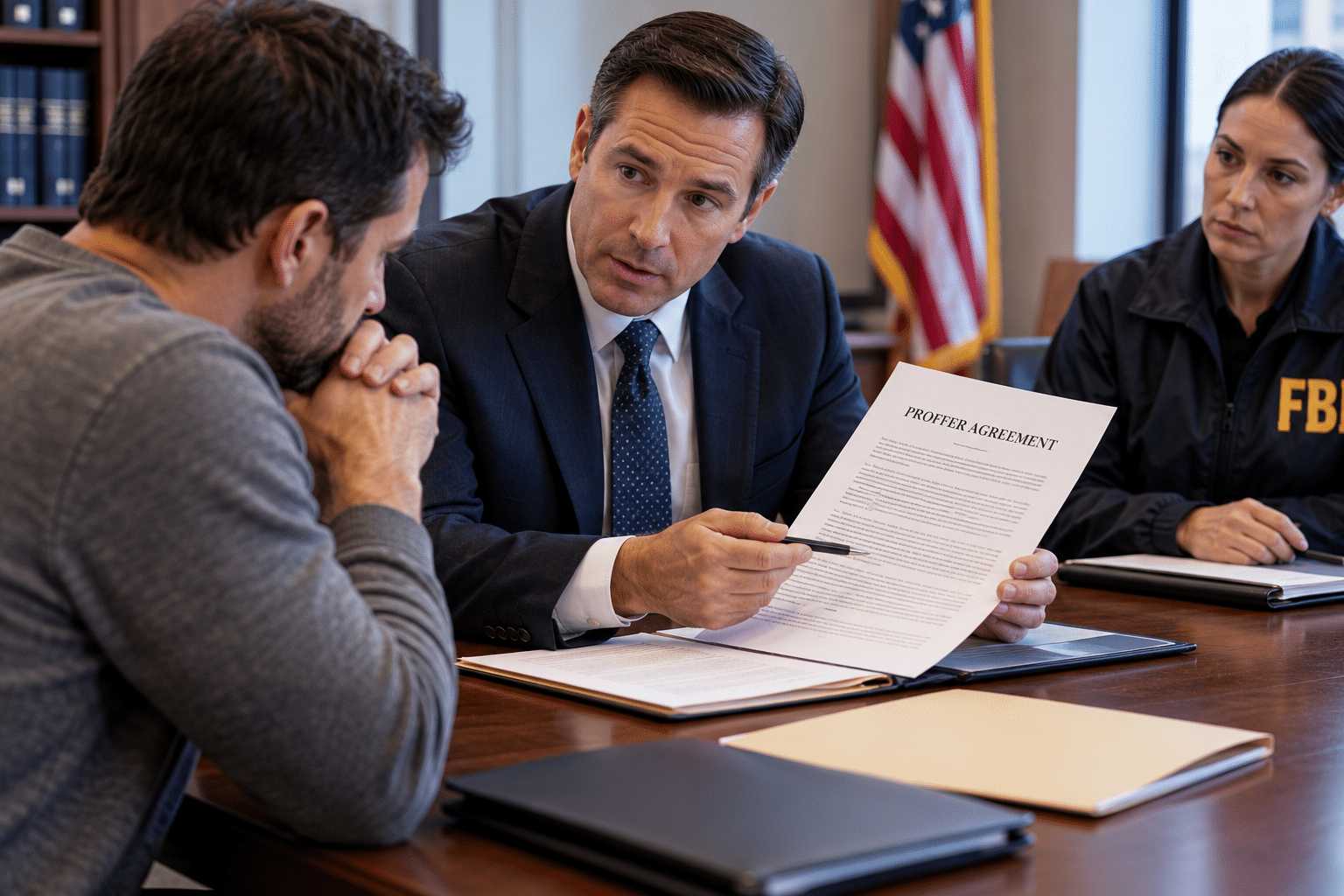
A federal proffer agreement can place a person in one of the most consequential meetings of a federal criminal investigation. Prosecutors may invite a suspect, target, defendant, or potential cooperating witness to provide information about a crime, other participants, financial transactions, communications, or other evidence. In return, the government may agree to limits on how it can use statements made during the meeting. Those limits are often much narrower than people expect. A proffer agreement is not automatically an immunity agreement, cooperation agreement, plea agreement, or promise that charges will be reduced. Before we advise a client to participate, we want to know exactly what the written agreement permits the government to do with anything the client says.
For someone under federal investigation in Galveston, or elsewhere in Texas, you may need to consider both federal and Texas criminal exposure. The federal government may be investigating conduct that could also support state charges involving conspiracy, organized criminal activity, drugs, fraud, weapons, or other offenses. For that reason, deciding whether to give a proffer requires much more than simply asking whether the client has useful information.
What A Federal Proffer Agreement Actually Does
A proffer is generally a meeting between a person, defense counsel, federal prosecutors, and federal law enforcement agents. The person agrees to answer questions and provide information so prosecutors can evaluate what the person knows and whether cooperation may be valuable.
A critical point is that a proffer agreement does not necessarily promise the person anything beyond the protections specifically written into the agreement. The Department of Justice has used written agreements expressly stating that a proffer is not a cooperation agreement, plea agreement, immunity agreement, or non-prosecution agreement. Such agreements may also permit prosecutors to use information obtained from the proffer to locate independent evidence.
We therefore examine the actual written language rather than relying on phrases such as “off the record” or “queen for a day.” Those expressions can create a dangerous misunderstanding about how protected the conversation really is.
Rule 410 Does Not Make Every Proffer Statement Untouchable
Federal Rule of Evidence 410 generally limits the government’s ability to introduce certain statements made during plea discussions with a prosecuting attorney when those discussions do not produce a guilty plea or result in a guilty plea that is later withdrawn. Federal Rule of Criminal Procedure 11 contains related protections governing plea discussions.
Those protections are important, but defendants can waive substantial rights relating to plea-discussion statements. In United States v. Mezzanatto, 513 U.S. 196 (1995), the United States Supreme Court held that the protections restricting the use of plea statements can be knowingly and voluntarily waived.
That is one reason the exact wording of a proffer agreement matters. Some agreements allow prosecutors to use proffer statements to impeach a defendant who later testifies inconsistently. Others contain broader provisions permitting statements to be used to rebut evidence or arguments presented by the defense. The government may also reserve the right to pursue investigative leads obtained from information disclosed during the session.
A Proffer Is Not The Same As Immunity
People sometimes hear that prosecutors cannot directly introduce their proffer statements during the government’s case and conclude that they have received immunity. Those are very different concepts.
A formal immunity arrangement can provide significantly broader protection. A proffer agreement usually provides only the protections stated in the written document. Department of Justice guidance recognizes different arrangements involving use immunity and non-prosecution agreements and stresses the importance of defining their scope.
Suppose a client tells prosecutors where certain financial records are stored. Even if the agreement prevents the government from introducing the client’s exact statement during its case-in-chief, the agreement may permit agents to obtain those records independently. Those records might then become admissible evidence against the client.
False Statements During A Proffer Can Create A New Federal Problem
Truthfulness is one of the most serious concerns surrounding a proffer session. Federal prosecutors generally expect complete and truthful information. Attempting to minimize conduct, conceal another person’s involvement, invent facts, or intentionally provide false information can expose the speaker to additional consequences.
Under 18 U.S.C. § 1001, knowingly and willfully making a materially false statement in a matter within federal jurisdiction can itself constitute a federal crime. The statute generally authorizes imprisonment of up to five years, with higher maximums applying in certain specified cases.
A client therefore should not enter a proffer hoping to test what prosecutors know. Before the meeting, we ordinarily need to evaluate the government’s allegations, available discovery, our client’s recollection, potential contradictions, and subjects that may create additional exposure.
Texas Charges May Still Matter In A Federal Investigation
Although the proffer itself is primarily controlled by federal law, conduct discussed during the session may overlap with Texas criminal statutes. Texas Penal Code § 15.02 defines criminal conspiracy as an agreement to commit a felony combined with an overt act by one or more conspirators in furtherance of that agreement.
Texas Penal Code § 71.02 also addresses engaging in organized criminal activity. Depending on the alleged offense and circumstances, conduct involving a combination of participants can create separate state-law concerns.
Other issues can arise after an investigation begins. Texas Penal Code § 37.09 prohibits certain conduct involving altering, destroying, concealing, fabricating, or presenting evidence with the required knowledge and intent when an investigation or official proceeding is pending or underway. Texas Penal Code § 36.05 separately addresses specified forms of witness tampering.
These statutes illustrate why we look beyond the immediate federal charge. Information provided during a federal investigation can touch several potential theories of criminal liability.
Prosecutors May Want Information About Other People
Federal proffer sessions frequently arise when prosecutors believe a person can provide useful information about other participants. That may involve drug distribution networks, fraud schemes, financial offenses, organized criminal conduct, firearms cases, public corruption, or other multi-defendant investigations.
Texas law similarly recognizes circumstances in which accomplice testimony can become important. Under Texas Code of Criminal Procedure Article 38.14, a conviction may not rest solely on an accomplice’s testimony unless other evidence tends to connect the accused with the offense.
A federal proffer operates under different evidentiary rules, but the underlying concern remains significant. Once a person begins identifying participants, transactions, meetings, communications, accounts, or locations, prosecutors may compare those statements against evidence they already possess.
Frequently Asked Questions About Federal Proffer Agreements
Does A Federal Proffer Agreement Mean The Government Cannot Use Anything I Say?
Not necessarily. The answer depends heavily on the language of the agreement you sign. Some agreements prevent prosecutors from introducing your statements directly during their case-in-chief but allow them to use those statements for impeachment, rebuttal, investigative leads, or other purposes stated in the agreement. The Supreme Court has recognized that defendants may knowingly and voluntarily waive protections associated with plea-discussion statements.
We therefore do not assume that a conversation is protected merely because someone calls it a proffer. We review the written agreement carefully and explain what prosecutors may still do with information disclosed during the session. Those details can materially change the risk involved.
Is A Proffer Agreement The Same Thing As Immunity?
No. A proffer agreement can provide limited protections without granting immunity from prosecution. Federal prosecutors may expressly state that the meeting does not constitute a cooperation agreement, immunity agreement, plea agreement, or promise not to prosecute.
That distinction is extremely important. A person may provide substantial information and still face prosecution unless another agreement is later reached. Before participating, we want to understand what the government is actually offering and whether any additional protection has been promised in writing.
Can Prosecutors Use Information They Learn During My Proffer To Find Other Evidence?
Often, yes. Many proffer agreements permit what is commonly called derivative use of information. This can allow investigators to follow leads obtained during the proffer and locate witnesses, records, electronic communications, financial documents, physical evidence, or other information.
For example, telling investigators where records are located may lead them to obtain those records through a subpoena, warrant, cooperating witness, or another lawful source. Even though the original statement may be restricted by the agreement, independently obtained evidence may still be used. The language of the specific agreement must be reviewed before the meeting.
What Happens If I Say Something False During A Federal Proffer?
A false statement can create significant additional exposure. Under 18 U.S.C. § 1001, knowingly and willfully making a materially false statement within federal jurisdiction may constitute a separate federal offense.
This is why we prepare carefully before any meeting takes place. A client should not guess, exaggerate, minimize conduct, or provide an answer simply because prosecutors appear to expect one. When a client genuinely does not remember something, that is very different from knowingly providing false information.
Speak With A Galveston Criminal Defense Lawyer About A Federal Proffer Agreement
If federal prosecutors or agents have asked you to participate in a proffer, the decision deserves careful attention before you say anything. At Mark Diaz & Associates, we represent people facing serious criminal investigations and charges in Galveston, throughout Houston, and across the surrounding Texas communities. We can review the proposed proffer agreement, assess the government’s apparent objectives, identify potential federal and Texas criminal exposure, and help determine the legal consequences of participating.
When you hire us, you work directly with your attorney. Our clients have direct access because questions, emergencies, and concerns do not always arise during ordinary business hours. You will not simply be handed off and forgotten in a system where your case becomes another file on a crowded docket. From the investigation and arrest through negotiations, hearings, trial preparation, and resolution, we remain personally involved in the defense.
If you have been contacted by federal agents, received a target letter, learned that you are under investigation, or have been offered a federal proffer agreement, speak with us before meeting with investigators or prosecutors. Call our Galveston federal crime attorney at Mark Diaz & Associates at 409-515-6170 to schedule your free consultation.
