
When A Drug Possession Charge Becomes A Federal Crime
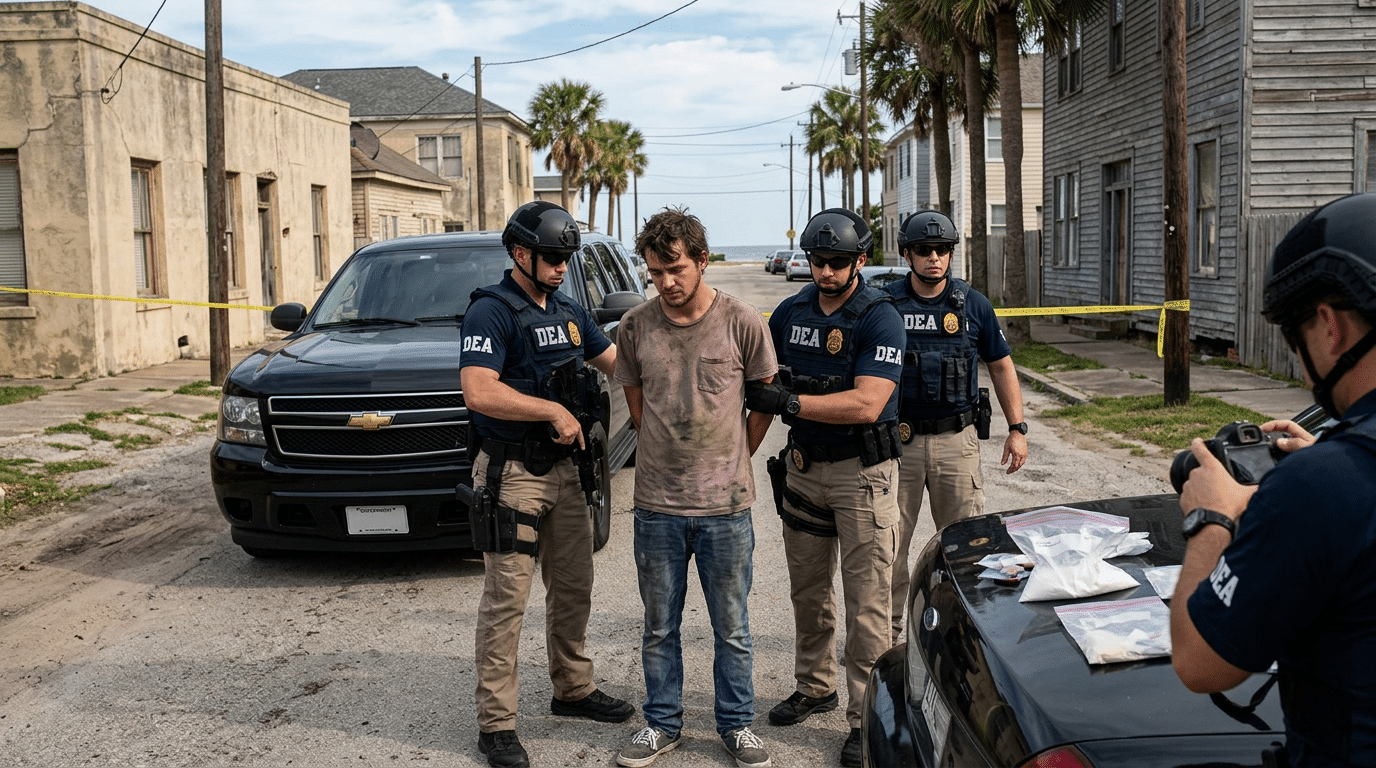
If you are arrested with drugs in Galveston, it does not mean you will automatically face federal charges. Most possession cases start under Texas law, but some situations draw the attention of federal agencies and prosecutors. When that happens, the case can become much more serious.
Federal drug cases can involve different charges, mandatory minimum sentences, federal sentencing rules, conspiracy claims, and investigations that go beyond what was found during one arrest. It is important to know from the start: there is no set amount of drugs that automatically turns a Texas possession case into a federal one.
Both federal and Texas drug laws can apply to the same situation. The main issue is usually not whether federal law could apply, but whether federal authorities choose to investigate and prosecute. Their decision may depend on the amount and type of drugs, signs of distribution, how many people are involved, links to interstate trafficking, firearms, money, electronic communications, criminal history, or if there is already an ongoing investigation.
How Drug Possession Is Charged Under Texas Law
Texas drug possession offenses are primarily governed by Chapter 481 of the Texas Health and Safety Code, commonly called the Texas Controlled Substances Act. Texas separates controlled substances into different penalty groups, and the seriousness of a possession charge generally depends on the substance and the amount allegedly possessed.
For example, Texas Health and Safety Code § 481.115 addresses possession of substances in Penalty Group 1, which includes a number of commonly prosecuted controlled substances. Depending on the quantity, a violation can range from a state jail felony to serious felony charges carrying substantial prison exposure. Texas separately addresses other penalty groups and substances, including marijuana under Texas Health and Safety Code § 481.121.
Texas law defines possession in terms of actual care, custody, control, or management. That distinction matters. Simply being near drugs does not necessarily establish that a person legally possessed them. In a vehicle, house, hotel room, apartment, or other location occupied by several people, the prosecution may have to prove a meaningful connection between the accused person and the controlled substance.
A Texas possession case can remain entirely within the state criminal system. However, the same incident may become part of a federal case when investigators believe the evidence points beyond personal possession.
Federal Law Also Makes Drug Possession A Crime
Simple possession itself can violate federal law. Under 21 U.S.C. § 844, knowingly or intentionally possessing a controlled substance without legal authorization is a federal offense. For a first offense, the statute generally authorizes up to one year of imprisonment and a minimum fine of $1,000, although prior qualifying drug convictions can increase the possible punishment.
Federal controlled substances are classified under schedules established by 21 U.S.C. § 812. Federal law defines a controlled substance as a drug, substance, or immediate precursor included within one of the federal schedules.
In reality, federal prosecutors usually focus on cases involving trafficking, distribution, large amounts of drugs, organized activity, interstate actions, firearms, or bigger criminal investigations, rather than small possession cases. This does not mean simple possession cannot be prosecuted federally. It just means federal prosecutors look at more than whether the law was technically broken.
There Is No Automatic Weight That Makes A Case Federal
One of the most common questions we hear is whether possessing a specific number of grams automatically creates a federal drug charge. The answer is generally no.
The amount of drugs matters a lot, especially since federal penalties under 21 U.S.C. § 841 can change at certain amounts. However, just having a certain quantity does not automatically move a case from Galveston County to federal court. Federal prosecutors must choose to take the case, usually after an investigation or a referral from federal law enforcement.
At the same time, larger quantities can cause investigators to question whether the drugs were actually possessed for personal use. As the quantity grows, law enforcement may begin looking for evidence of distribution or trafficking. That can result in a much more serious investigation.
Possession With Intent To Distribute Can Trigger Federal Attention
The most significant change often occurs when investigators believe that the evidence supports possession with intent to distribute rather than simple possession.
Under 21 U.S.C. § 841(a), federal law prohibits knowingly or intentionally manufacturing, distributing, dispensing, or possessing with intent to manufacture, distribute, or dispense a controlled substance. Penalties depend heavily on the substance, weight, criminal history, and other facts.
Texas has similar offenses. Texas Health and Safety Code § 481.112, for example, prohibits knowingly manufacturing, delivering, or possessing with intent to deliver certain controlled substances. Texas defines “deliver” broadly enough to include actual or constructive transfers.
Law enforcement does not need to catch someone physically selling drugs before alleging an intent to distribute. Investigators may rely on the amount of drugs, how they were packaged, digital scales, cash, multiple cell phones, text messages, social media communications, firearms, ledgers, shipping records, or statements from other people.
The defense must therefore examine much more than what was physically found. We look at how prosecutors intend to prove knowledge, possession, intent, and the alleged connection between our client and every item the government claims supports trafficking.
Interstate Activity Can Draw Federal Investigators Into A Case
Federal investigations commonly become more likely when drugs allegedly cross state or international boundaries.
A case may involve drugs shipped into Galveston or Houston from another state, transportation through Texas, packages delivered through commercial carriers, money sent across state lines, or communications involving people in several jurisdictions. Galveston’s location near major transportation corridors, Houston, ports, and maritime activity can also place local investigations within larger federal enforcement efforts.
Federal law expressly recognizes that illegal controlled-substance activity can affect interstate commerce, and the Controlled Substances Act provides a nationwide framework for federal drug enforcement.
A person does not necessarily have to personally transport drugs across a state line to become involved in a federal investigation. If federal prosecutors believe the person participated in a larger distribution operation, the government may pursue charges based on that alleged participation.
A Federal Drug Conspiracy Can Be Much Broader Than Possession
Federal conspiracy law creates another major source of risk.
Under 21 U.S.C. § 846, a person who attempts or conspires to commit a federal drug offense may face the same penalties prescribed for the underlying offense.
This means a federal drug prosecution can extend far beyond the drugs found in someone’s pocket, vehicle, or residence. Investigators may use text messages, phone records, financial transactions, cooperating witnesses, surveillance, controlled purchases, and statements from alleged co-conspirators to claim that a defendant was part of a larger agreement to distribute drugs.
The government may also attempt to attribute quantities connected to the alleged conspiracy rather than focusing only on what was physically seized from one defendant. That is one reason we treat potential federal conspiracy investigations very differently from a routine possession arrest.
Federal And State Authorities Can Investigate The Same Conduct
Another misconception is that a drug case must belong exclusively to either Texas or the federal government. That is not necessarily true.
The federal Controlled Substances Act does not generally prevent states from enforcing their own controlled-substance laws. Congress specifically addressed the relationship between federal and state drug law in 21 U.S.C. § 903.
As a practical matter, local police, sheriff’s offices, state agencies, and federal agencies may work together. A Galveston investigation can begin locally and later involve the Drug Enforcement Administration, FBI, Department of Homeland Security, or another federal agency depending on the allegations.
When federal authorities become involved, the defense strategy must immediately account for the possibility of a federal indictment rather than assuming the case will remain a Texas prosecution.
Firearms And Large Amounts Of Cash Can Change The Investigation
When police find drugs together with firearms or large amounts of cash, investigators often view the case differently.
Neither cash nor lawful firearm ownership automatically proves drug trafficking. There can be legitimate explanations for both. Yet prosecutors frequently use those facts as circumstantial evidence when arguing that controlled substances were intended for distribution.
Federal investigations may also produce additional firearms charges depending on the circumstances. That can substantially increase sentencing exposure and complicate plea negotiations.
We examine where each item was found, who controlled the location, whether searches were lawful, whether the accused actually knew the items were present, and whether the government’s interpretation of the evidence is supported by facts rather than assumptions.
Federal Drug Penalties Can Become Extremely Serious
The difference between simple federal possession under 21 U.S.C. § 844 and federal distribution or possession with intent to distribute under 21 U.S.C. § 841 can be dramatic.
Section 841 contains several penalty provisions tied to particular controlled substances and quantities. Certain offenses can carry lengthy federal prison sentences, and qualifying circumstances can trigger statutory minimum terms.
Federal prosecutors can also charge conspiracy under 21 U.S.C. § 846, exposing a defendant to the penalties applicable to the underlying federal drug offense.
These consequences make it important to determine early whether a case is merely a local possession prosecution or part of a developing federal investigation.
Illegal Searches Can Be Challenged In State And Federal Drug Cases
Many drug cases begin with a traffic stop, vehicle search, home search, hotel-room search, package investigation, or search warrant. The government must comply with constitutional restrictions when obtaining evidence.
We examine the legality of the initial stop, whether officers had sufficient grounds to detain the accused, whether consent to search was actually voluntary, whether a warrant was legally sufficient, and whether officers remained within the lawful scope of the search.
If evidence was obtained in violation of the Fourth Amendment, we may seek to suppress it. When drugs, firearms, communications, or other important evidence are excluded, the prosecution’s entire theory can be weakened.
Do Not Assume A Local Drug Arrest Will Stay Local
A person arrested by local police may believe that federal criminal defense is irrelevant because no federal agent was present at the scene. That assumption can be dangerous.
Federal investigations are often built over time. Local evidence may be shared with federal agencies. Search warrants, grand jury subpoenas, cooperating witnesses, phone data, financial records, and subsequent arrests may reveal that prosecutors are investigating a broader alleged trafficking organization.
We want to identify that risk as early as possible. Statements made during what appears to be a routine local investigation can later become evidence in federal court.
Speak Our Federal Defense Attorneys About Your Texas Or Federal Drug Investigation
A drug possession arrest in Galveston can be serious even when the case remains in Texas state court. When allegations of distribution, conspiracy, significant quantities, interstate activity, firearms, or federal investigators enter the picture, the potential consequences become much greater. We examine how the investigation started, whether searches were lawful, whether the government can prove actual or constructive possession, whether evidence truly supports an intent to distribute, and whether prosecutors are attempting to connect our client to conduct committed by other people.
When you hire me, you work directly with me. My clients have my personal cell phone number because questions, emergencies, and concerns don’t always happen during business hours. You won’t be handed off to a junior associate or lost in a system where your case is one of dozens on a crowded docket. From arrest through resolution, I remain personally involved and accessible.
If you have been arrested for a drug offense or believe state or federal authorities are investigating you, contact our Galveston federal drug crime attorney at Mark Diaz & Associates by calling 409-515-6170 to schedule your free consultation. We represent clients throughout Galveston and all areas of Houston, Texas, in serious state and federal criminal matters.
